
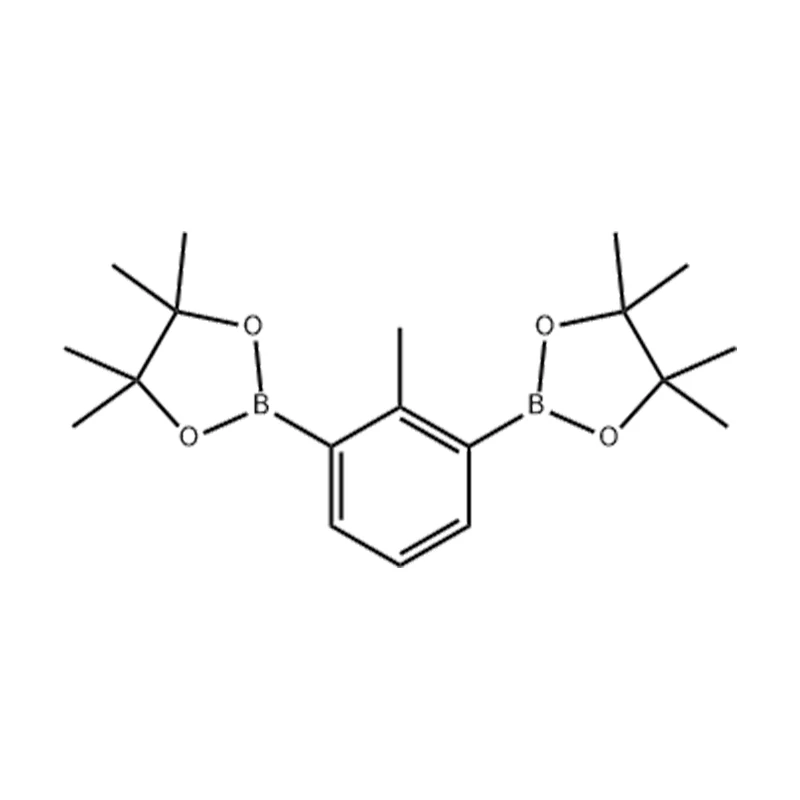
1,3,2-Dioxaborolane, 2,2'-(2-methyl-1,3-phenylene)bis[4,4,5,5-tetramethyl- is a dual Suzuki‑Miyaura donor used to synthesize 1,3‑diaryl‑2‑methylbenzene derivatives. The two pinacol ester groups of 1,3,2-Dioxaborolane, 2,2'-(2-methyl-1,3-phenylene)bis[4,4,5,5-tetramethyl- react independently under standard coupling conditions, enabling the construction of unsymmetrical teraryl cores by controlling stoichiometry and catalyst. In materials chemistry, 1,3,2-Dioxaborolane, 2,2'-(2-methyl-1,3-phenylene)bis[4,4,5,5-tetramethyl- serves as a rigid, conjugated building block for covalent organic frameworks and macrocyclic receptors. Cosperpharm ensures that 1,3,2-Dioxaborolane, 2,2'-(2-methyl-1,3-phenylene)bis[4,4,5,5-tetramethyl- is supplied with minimal mono‑boronate or de‑borylated impurities, guaranteeing stoichiometric precision in two‑fold couplings.
|
Parameter |
Specification |
|
Product Name |
1,3,2-Dioxaborolane, 2,2'-(2-methyl-1,3-phenylene)bis[4,4,5,5-tetramethyl- |
|
CAS Number |
849402-14-8 |
|
Molecular Formula |
C₁₉H₃₀B₂O₄ |
|
Molecular Weight |
344.06 g/mol |
|
Appearance |
White to off-white crystalline powder |
|
Melting Point |
~130–135 °C (typical) |
|
Purity (HPLC) |
≥98.0% |
|
Solubility |
Soluble in THF, DMF, dichloromethane; sparingly soluble in methanol, water |
|
Storage Condition |
2–8 °C, sealed under inert atmosphere, protect from moisture |
|
Shelf Life |
24 months under recommended conditions |
1. Two Boronate Handles, One Core – Enables one‑pot or sequential double Suzuki couplings for rapid complexity generation.
2. Symmetrical Structure with Methyl Bias – The 2‑methyl group creates a small steric difference that can be exploited for stepwise coupling.
3. High‑Melting Solid – Crystalline, non‑hygroscopic, and easy to handle on the open bench for short periods.
4. Predictable Reactivity – The pinacol esters react reliably with Pd(PPh₃)₄ or Pd(dppf)Cl₂ under standard conditions.
5. Bulk Supply Consistency – Lot‑to‑lot reproducibility suitable for process validation and GMP‑adjacent campaigns.
Q1: Can I perform a selective mono‑coupling with this di‑boronate?
A: Yes, using 1.0 equivalent of an aryl bromide with a bulky ligand such as SPhos often leads to preferential mono‑substitution. The steric effect of the 2‑methyl group aids selectivity.
Q2: What are the standard double‑coupling conditions?
A: Use 2.5 equivalents of aryl bromide, 4 mol% Pd(PPh₃)₄, and aqueous K₂CO₃ in DME at 85 °C for 18 h.
|
Advantage |
Detail |
|
Production Strength |
GMP-certified campus spanning 100+ mu, 3 multi-purpose workshops, 6 D-grade clean zone production lines, and 150+ reactors (20L–5000L), supporting high/low temp, anaerobic & hydrogenation; kg to ton scale production. |
|
Fast Delivery |
R&D samples: one week; commercial orders: 1–2 months after payment. Express (DHL/FedEx) or air/sea freight available. |
|
Global Partners |
Trusted by 30+ pharmaceutical companies in USA, Europe, India, Brazil, and Southeast Asia; long-term cooperation with generic drug manufacturers, CROs, and impurity standard distributors. |
|
Licensed Exporter |
Valid drug import/export license — no compliance delays. |
|
Dual Quality Grades |
Both research/pharma grade(≥98%)and high-purity impurity grade(≥99%)available to meet diverse customer needs. |
For a quote on this versatile di‑boronate, or to request a sample for a feasibility study, reach out to Cosperpharm’s specialty chemical division — we can deliver a small‑quantity evaluation pack and discuss tailored supply agreements for your production needs.
Address
No. 2 Yangguang 3rd Road, Duodao Chemical Cycle Industrial Park, Jingmen City, Hubei Province, China
Tel

![1-[2,3-Bis[(9Z,12Z)-octadeca-9,12-dien-1-yloxy]propyl]pyrrolidine](https://www.cosperpharma.com/upload/8820/1-2-3-bis-9z-12z-octadeca-9-12-dien-1-yloxy-propyl-pyrrolidine-349384.webp "1-[2,3-Bis[(9Z,12Z)-octadeca-9,12-dien-1-yloxy]propyl]pyrrolidine")
![1,2,4-Triazolo[4,3-a]pyridin-3(2H)-one](https://www.cosperpharma.com/upload/8820/1-2-4-triazolo-4-3-a-pyridin-3-2h-one-440735.webp "1,2,4-Triazolo[4,3-a]pyridin-3(2H)-one")