
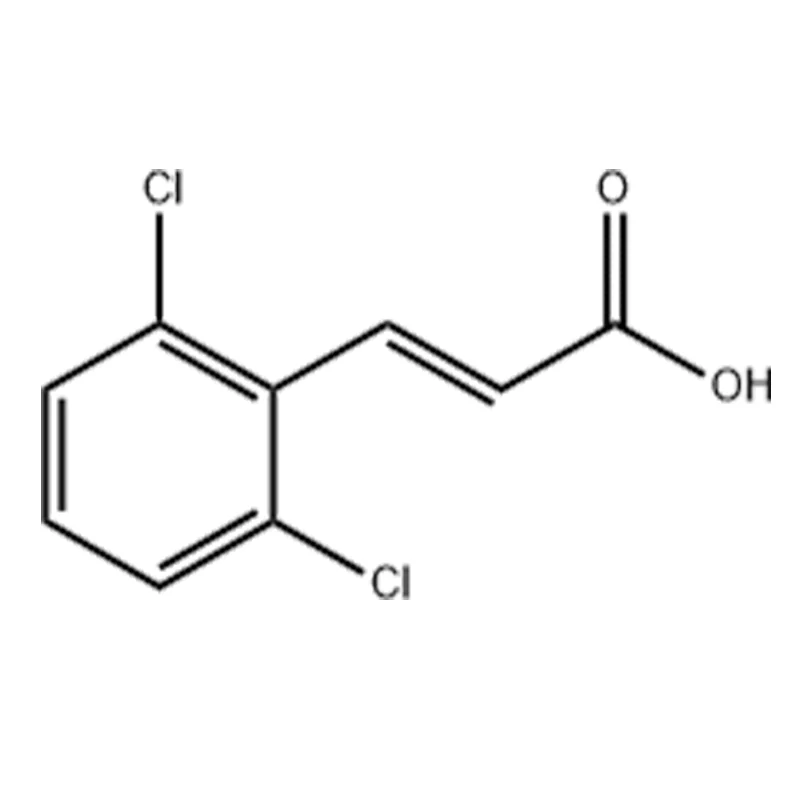
2,6-Dichloro-trans-cinnamic acid (CAS 20595-49-7) is a functionalized aromatic α,β-unsaturated carboxylic acid that serves as a key intermediate in pharmaceutical synthesis and agrochemical development. The trans configuration of the double bond between the phenyl ring and the carboxylic acid group is essential for its biological activity and its ability to participate in stereospecific reactions.
In medicinal chemistry, 2,6-dichloro-trans-cinnamic acid is valuable in the development of drugs targeting inflammatory and metabolic disorders. Its unique 2,6-dichloro substitution pattern makes it a useful building block for studying the effects of halogenated cinnamic acids on biological systems. The compound has been investigated for its potential as a selective inhibitor of mushroom tyrosinase, an enzyme involved in melanin biosynthesis, with kinetic studies showing that chlorinated derivatives exhibit varying degrees of inhibition based on their structural features. Additionally, the compound has been studied for its anti-inflammatory effects, with research indicating that it may inhibit inflammatory pathways and reduce the production of pro-inflammatory cytokines in vitro.
In agricultural applications, 2,6-dichloro-trans-cinnamic acid is employed in the synthesis of agrochemicals, particularly herbicides and fungicides, due to its bioactive properties. Studies have shown that trans-cinnamic acids bearing 2,6-dichloro substitution exhibit high inhibitory effect on the growth of Mimosa pigra Linn (giant sensitive plant), a significant invasive weed species. The compound has also been investigated for its potential to inhibit phenylalanine ammonia-lyase (PAL), a key enzyme in plant metabolism.
In research settings, 2,6-dichloro-trans-cinnamic acid acts as a building block for organic synthesis and material science. It has been used as a ligand in the synthesis of copper(II) complexes, which have been characterized by electronic and ESR spectroscopy. Its role in photopolymerization processes also makes it useful for creating advanced polymers and coatings.
The compound‘s ethyl ester derivative has been investigated for its antimicrobial properties, demonstrating significant activity against various pathogens including Escherichia coli (MIC of 32 µg/mL) and Staphylococcus aureus. Preliminary studies have also explored its potential to induce apoptosis in cancer cells through the modulation of specific signaling pathways.
|
Parameter |
Specification |
|
CAS Number |
20595-49-7 |
|
Molecular Formula |
C₉H₆Cl₂O₂ |
|
Molecular Weight |
217.05 g/mol |
|
Purity |
≥95% as standard; ≥98% available upon request |
|
Appearance |
White to off-white crystalline solid |
|
Melting Point |
192–196°C |
|
Boiling Point |
355.8 ± 27.0°C (Predicted) |
|
Density |
1.457 ± 0.06 g/cm³ (Predicted) |
|
pKa |
4.11 ± 0.16 (Predicted) |
|
Canonical SMILES |
C1=CC(=C(C(=C1)Cl)C=CC(=O)O)Cl |
|
Solubility |
Soluble in organic solvents such as ethanol, dichloromethane, acetic acid; poorly soluble in water |
|
Storage Condition |
Sealed in dry, room temperature; or 2–8°C |
|
Storage Class |
11 – combustible solid |
l Unique 2,6-dichloro substitution pattern – The ortho,ortho‑disubstitution provides distinct steric and electronic effects compared to 2,4- or 3,4-dichloro analogues, influencing both chemical reactivity and biological activity.
l Pharmaceutical intermediate – Serves as a valuable building block for the development of drugs targeting inflammatory, metabolic, and infectious diseases.
l Agricultural bioactivity – Exhibits high inhibitory effect on the growth of the invasive weed Mimosa pigra, and is employed in the synthesis of herbicides and fungicides.
l Tyrosinase inhibition – Has been studied as an inhibitor of mushroom tyrosinase, an enzyme involved in melanin biosynthesis, with potential applications in skin‑lightening or anti‑browning products.
l PAL enzyme inhibition – Demonstrates inhibitory activity against phenylalanine ammonia‑lyase (PAL), a key enzyme in plant metabolism and a target for agricultural research.
l Versatile synthetic handle – The α,β-unsaturated carboxylic acid structure supports esterification, reduction, oxidation, and photochemical reactions, enabling diverse derivatization pathways.
l High purity – Standard ≥95% ensures reliable results; higher purity grades available upon request
l Photopolymerization utility – Useful in material science for creating advanced polymers and coatings via photopolymerization processes
A: Preliminary studies suggest that the ethyl ester derivative may induce apoptosis in cancer cells through the modulation of specific signaling pathways, and trans-cinnamic acid derivatives have been explored as potential anti‑tumor agents. However, further research is needed.
A: The compound is not classified as a DOT/IATA hazardous material for transport. Standard laboratory safety precautions should be observed: use appropriate PPE (gloves, goggles, lab coat), work in a well‑ventilated area, avoid generating dust, and wash hands thoroughly after handling.
A cosmetics research team is developing novel skin‑lightening agents targeting mushroom tyrosinase, an enzyme critical for melanin biosynthesis. 2,6-Dichloro-trans-cinnamic acid is evaluated as a lead compound, with kinetic studies showing that its chlorinated structure provides effective inhibition. The compound‘s carboxylic acid group can be further derivatized to amides or esters to improve skin penetration and formulation stability, leading to candidates for hyperpigmentation treatment.
A pharmaceutical research group is screening cinnamic acid derivatives for their ability to inhibit inflammatory pathways. 2,6-Dichloro-trans-cinnamic acid is incorporated into a focused library of trans-cinnamic acid derivatives synthesized via the Perkin reaction. Lead compounds that reduce the production of pro-inflammatory cytokines in vitro are identified for further optimization into oral or topical anti‑inflammatory therapeutics.
An agrochemical company is developing selective herbicides to control the invasive weed Mimosa pigra, which threatens agricultural lands. 2,6-Dichloro-trans-cinnamic acid is one of the trans-cinnamic acids identified as showing high inhibitory effect on the growth of M. pigra. The compound serves as a lead scaffold for generating derivatives with enhanced selectivity, crop safety, and environmental profile for use in integrated weed management programs.
An infectious disease research laboratory evaluates halogenated cinnamic acid derivatives for activity against drug‑resistant bacterial strains. 2,6-Dichloro-trans-cinnamic acid and its ethyl ester derivative are screened against E. coli (MIC 32 µg/mL) and S. aureus. Structure‑activity relationship studies reveal that the 2,6-dichloro substitution pattern is critical for antimicrobial activity, guiding the design of next‑generation antibacterial agents.
A materials science research group is developing UV‑curable coatings with enhanced durability and chemical resistance. 2,6-Dichloro-trans-cinnamic acid is incorporated into photopolymerizable formulations, where its α,β-unsaturated carbonyl system undergoes [2+2] photocycloaddition under UV light. The resulting crosslinked polymer networks exhibit improved mechanical properties, making them suitable for protective coatings in industrial applications.
A plant biochemistry lab is investigating chemical regulators that modulate phenylalanine ammonia‑lyase (PAL) activity, a key enzyme in the phenylpropanoid pathway. 2,6-Dichloro-trans-cinnamic acid is tested as a PAL inhibitor, with studies confirming that the presence of a hydrophobic aromatic ring, α,β-double bond, and carboxyl group is essential for inhibitory activity. The compound serves as a tool for studying lignin biosynthesis and plant defense responses.
A coordination chemistry research group is preparing novel metal complexes for catalytic applications. Using 2,6-dichloro-trans-cinnamic acid as a ligand, copper(II) complexes Cu(2,6-DCA)₂·2H₂O are synthesized and characterized by electronic and ESR spectroscopy. These complexes exhibit interesting magnetic properties and potential applications in oxidation catalysis.
A chemical manufacturing company requires a versatile aromatic building block for the synthesis of specialty fine chemicals and advanced intermediates. 2,6-Dichloro-trans-cinnamic acid serves as a component in the preparation of various fine chemicals, offering the reactive α,β-unsaturated acid functionality and two chlorine handles for further nucleophilic aromatic substitution or cross‑coupling reactions.
Need a reliable source for this versatile building block? Reach out to us today.At Cosperpharm, we combine technical expertise with exceptional customer service. Whether you need a small sample for R&D, a bulk order for production, or technical support for your synthesis project, our team is ready to assist.
Address
No. 2 Yangguang 3rd Road, Duodao Chemical Cycle Industrial Park, Jingmen City, Hubei Province, China
Tel

![1-[2,3-Bis[(9Z,12Z)-octadeca-9,12-dien-1-yloxy]propyl]pyrrolidine](https://www.cosperpharma.com/upload/8820/1-2-3-bis-9z-12z-octadeca-9-12-dien-1-yloxy-propyl-pyrrolidine-349384.webp "1-[2,3-Bis[(9Z,12Z)-octadeca-9,12-dien-1-yloxy]propyl]pyrrolidine")
![1,2,4-Triazolo[4,3-a]pyridin-3(2H)-one](https://www.cosperpharma.com/upload/8820/1-2-4-triazolo-4-3-a-pyridin-3-2h-one-440735.webp "1,2,4-Triazolo[4,3-a]pyridin-3(2H)-one")