
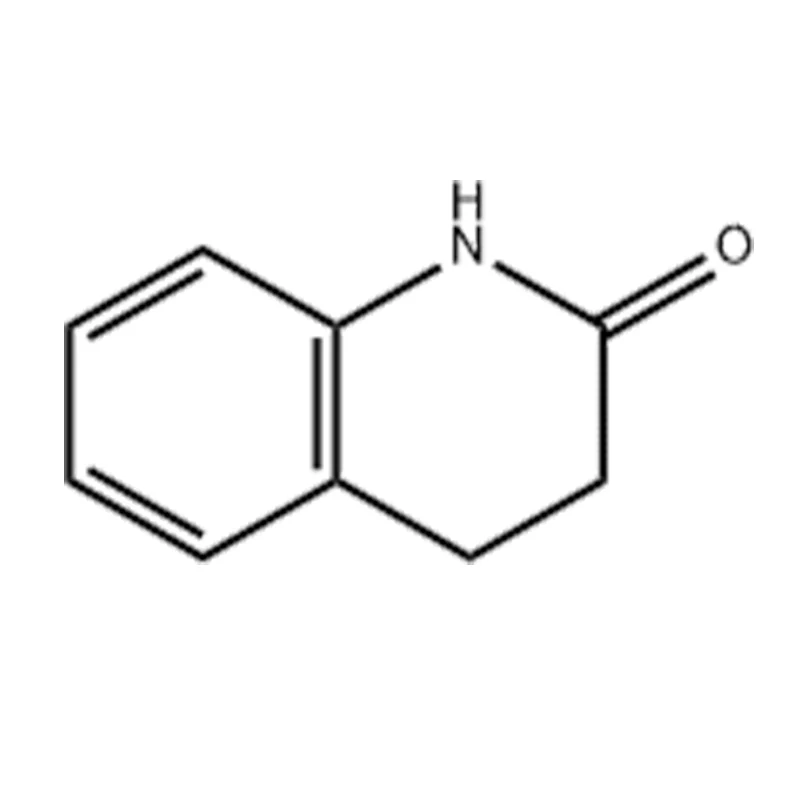
3,4-Dihydro-2(1H)-quinolinone (CAS 553-03-7) is a versatile organic building block and fragment molecule widely used as a key intermediate in the synthesis of various heterocyclic compounds and pharmaceuticals. It features a dihydroquinoline core with a ketone functional group at the 2‑position, which enables diverse chemical modifications.
As a molecular building block, 3,4-dihydro-2(1H)-quinolinone can be used to synthesize antipsychotic drugs such as aripiprazole or CYP11B2 inhibitors. It is also used to prepare potent bicyclic peptide deformylase inhibitors with antibacterial effects, as well as substituted iminopiperidines as inhibitors of human nitric oxide synthase isoforms. Beyond biomedical applications, 3,4-dihydro-2(1H)-quinolinone has also been employed as a medium supplement in the culture medium of Pseudomonas ayucida during enrichment culture experiments.
3,4-Dihydro-2(1H)-quinolinone derivatives have been explored as novel antidepressant drugs, with certain compounds showing central nervous system‑stimulating activity and sigma receptor agonism that could contribute to antidepressant‑like effects. They have also been developed as dual ligands of sigma (σ) receptors and the NMDA receptor GluN2b subunit, with antioxidant and neuroprotective properties. In addition, 3,4-dihydro-2(1H)-quinolinone is recognized as Aripiprazole Impurity 41, a pharmaceutical impurity reference standard supplied with detailed characterization data compliant with regulatory guidelines.
|
Parameter |
Specification |
|
CAS Number |
553-03-7 |
|
Molecular Formula |
C₉H₉NO |
|
Molecular Weight |
147.17 g/mol |
|
Purity |
≥98% (standard grade) |
|
Appearance |
White to off-white crystalline powder |
|
Melting Point |
165–167 °C (lit.) |
|
Boiling Point |
328.1 ± 31.0 °C at 760 mmHg |
|
Density |
1.1 ± 0.1 g/cm³ (Predicted) |
|
Vapor Pressure |
0.0 ± 0.7 mmHg at 25 °C |
|
Refractive Index |
1.564 (Predicted) |
|
Flash Point |
189.4 ± 9.8 °C |
|
LogP |
1.34 |
|
pKa |
14.76 ± 0.20 (Predicted) |
|
Complexity |
167 |
|
Canonical SMILES |
C1CC(=O)NC2=CC=CC=C21 |
|
Storage Condition |
Keep in dark place, sealed in dry, room temperature |
|
Solubility |
DMF: 30 mg/mL, DMSO: 30 mg/mL, DMSO:PBS (pH 7.2, 1:6): 0.14 mg/mL; slight solubility in water |
|
Sensitivity |
Light-sensitive |
A: It is primarily used as a fragment molecule and building block in drug discovery, as an intermediate for synthesizing antipsychotic drugs (e.g., aripiprazole), for preparing antibacterial peptide deformylase inhibitors, and as a pharmaceutical impurity reference standard. It is also used to synthesize inhibitors of nitric oxide synthase isoforms and dual TXA2 synthase/cAMP PDE inhibitors.
A: Derivatives exhibit: (1) selective inhibition of human neuronal nitric oxide synthase (nNOS), effective in preclinical models of neurological disorders; (2) combined inhibition of thromboxane A2 synthase and cAMP phosphodiesterase, with antiaggregatory and antithrombotic effects; (3) sigma receptor agonism with CNS‑stimulating activity; and (4) antioxidant and neuroprotective properties.
|
Hazard Category |
Hazard Statement Code |
Description |
|
Acute toxicity (oral) |
H302 |
Harmful if swallowed |
|
Skin corrosion/irritation |
H315 |
Causes skin irritation |
|
Sensitization, skin |
H317 |
May cause an allergic skin reaction |
|
Serious eye damage/eye irritation |
H319 |
Causes serious eye irritation |
|
Specific target organ toxicity, single exposure |
H335 |
May cause respiratory irritation |
● Avoid breathing dust/fume/gas/mist/vapours/spray
● Use only outdoors or in a well-ventilated area
● Wear protective gloves/protective clothing/eye protection/face protection
● IF SWALLOWED: Call a POISON CENTER/doctor if you feel unwell
● IF ON SKIN: Wash with plenty of water
● IF INHALED: Remove person to fresh air and keep comfortable for breathing
● IF IN EYES: Rinse cautiously with water for several minutes. Remove contact lenses if present and easy to do. Continue rinsing.
● Store locked up
● If inhaled: Move person into fresh air. If not breathing, give artificial respiration. Consult a physician.
● In case of skin contact: Wash off with soap and plenty of water. Consult a physician.
● In case of eye contact: Rinse thoroughly with plenty of water for at least 15 minutes and consult a physician.
● If swallowed: Rinse mouth with water. Never give anything by mouth to an unconscious person. Consult a physician.
Each batch undergoes:
● Gas chromatography (GC) – purity ≥97.0%
● Non‑aqueous titration – purity ≥97.0%
● Refractive index – confirmatory analysis
● ¹H NMR – structural verification
● Appearance – colorless to light yellow to light orange clear liquid
A comprehensive COA, MSDS (with full GHS information), and certificate of origin accompany every shipment.
We’re here to help you move your research forward.At Cosperpharm, we are committed to delivering high-quality chemical products with exceptional customer service. Our team is ready to support you.
Address
No. 2 Yangguang 3rd Road, Duodao Chemical Cycle Industrial Park, Jingmen City, Hubei Province, China
Tel

![1-[2,3-Bis[(9Z,12Z)-octadeca-9,12-dien-1-yloxy]propyl]pyrrolidine](https://www.cosperpharma.com/upload/8820/1-2-3-bis-9z-12z-octadeca-9-12-dien-1-yloxy-propyl-pyrrolidine-349384.webp "1-[2,3-Bis[(9Z,12Z)-octadeca-9,12-dien-1-yloxy]propyl]pyrrolidine")
![1,2,4-Triazolo[4,3-a]pyridin-3(2H)-one](https://www.cosperpharma.com/upload/8820/1-2-4-triazolo-4-3-a-pyridin-3-2h-one-440735.webp "1,2,4-Triazolo[4,3-a]pyridin-3(2H)-one")