
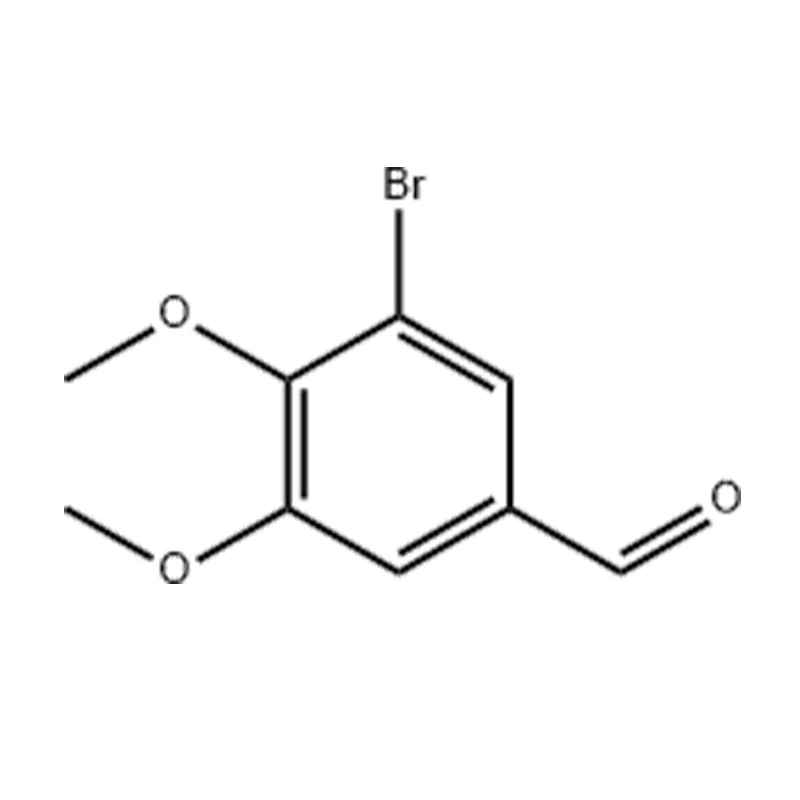
3-Bromo-4,5-dimethoxybenzaldehyde is a versatile aromatic aldehyde and pharmaceutical intermediate extensively utilized as a key building block in the synthesis of complex heterocycles and biologically active small molecules. As a key synthetic precursor, 3-Bromo-4,5-dimethoxybenzaldehyde has been employed as a reagent to synthesize aromatic vinyl sulfones — compounds that act as inhibitors of HIV-1 — and as a key building block in the total synthesis of (−)-Tejedine, a secobisbenzylisoquinoline natural product found in Barberry (Berberis species, a medicinal plant) with potential therapeutic applications. 3-Bromo-4,5-dimethoxybenzaldehyde has also been investigated for its potential biological activities, including antimicrobial and anticancer properties, and has been shown to increase the protein and mRNA levels of glutathione‑synthesizing enzymes, thereby enhancing reduced glutathione production in human keratinocytes. The synthetic utility and biological relevance of 3-Bromo-4,5-dimethoxybenzaldehyde have positioned it as a common reagent in the construction of proaporphine and homoproaporphine‑type alkaloids and as a valuable precursor for the synthesis of pharmaceutical intermediates and other functionalized aromatic compounds.
|
Parameter |
Specification |
|
CAS Number |
6948-30-7 |
|
Molecular Formula |
C₉H₉BrO₃ |
|
Molecular Weight |
245.07 g/mol |
|
Purity |
≥95.0% (GC); ≥98.0% upon request |
|
Physical Form |
Crystalline powder |
|
Appearance |
White to off-white to yellow-orange to green crystals |
|
Melting Point |
63–64 °C (lit.) |
|
Boiling Point |
313.8 ± 37.0 °C (Predicted) |
|
Density |
1.482 ± 0.06 g/cm³ (Predicted) |
|
LogP |
2.30 (Predicted) |
|
Solubility |
Soluble in methanol, ethanol, chloroform, DMSO, acetone |
|
Stability |
Stable under recommended storage conditions |
|
Storage Condition |
Sealed, 2–8 °C, dry, protected from light |
A: 3-Bromo-4,5-dimethoxybenzaldehyde has two principal medicinal chemistry applications: as a reagent for synthesizing aromatic vinyl sulfones, which have been shown to act as inhibitors of HIV‑1, and as a key building block in the total synthesis of (−)-Tejedine, a secobisbenzylisoquinoline natural product found in Barberry (Berberis species), a plant used in traditional medicine systems.
A: The bromine atom at the 3‑position (adjacent to the 4‑methoxy group) provides a handle for cross‑coupling reactions (e.g., Suzuki–Miyaura, Buchwald–Hartwig). The 4,5‑dimethoxy groups are electron‑donating, activating the aromatic ring toward electrophilic aromatic substitution while also influencing the reactivity of the aldehyde group through resonance and inductive effects.
Store 3-Bromo-4,5-dimethoxybenzaldehyde in a tightly sealed container under refrigerated conditions at 2–8 °C. Keep the container dry, protected from light, and stored in a clean, well‑ventilated area away from strong oxidizing agents, strong bases, and sources of ignition. The crystalline solid is stable under recommended storage conditions. Avoid prolonged exposure to humid air, as moisture may cause caking or accelerate degradation. Do not freeze.
Shelf life: 2 years when stored as recommended in a sealed container under refrigerated conditions, protected from light. Accelerated stability data (40 °C / 75 % RH) and long‑term stability summaries are available upon request to support regulatory filings.
Handling precautions: Use only in a fume hood. Wear chemical‑resistant gloves (tested against EN 374 or equivalent), safety goggles, and a lab coat. Avoid generating dust or aerosols. Do not eat, drink or smoke in work areas. After handling, wash hands thoroughly. Contaminated clothing should be removed and washed before reuse. Refer to the Safety Data Sheet (SDS) for complete safety information.
|
Advantage |
Detail |
|
Production Strength |
GMP-certified campus spanning 100+ mu, 3 multi-purpose workshops, 6 D-grade clean zone production lines, and 150+ reactors (20L–5000L), supporting high/low temp, anaerobic & hydrogenation; kg to ton scale production. |
|
Fast Delivery |
R&D samples: one week; commercial orders: 1–2 months after payment. Express (DHL/FedEx) or air/sea freight available. |
|
Global Partners |
Trusted by 30+ pharmaceutical companies in USA, Europe, India, Brazil, and Southeast Asia; long-term cooperation with generic drug manufacturers, CROs, and impurity standard distributors. |
|
Licensed Exporter |
Valid drug import/export license — no compliance delays. |
|
Dual Quality Grades |
Both research/pharma grade(≥98%)and high-purity impurity grade(≥99%)available to meet diverse customer needs. |
Sourcing 3-Bromo-4,5-dimethoxybenzaldehyde for your HIV‑1 inhibitor research, natural product total synthesis, or pharmaceutical intermediate program should be straightforward. Cosperpharm makes it easy.
Address
No. 2 Yangguang 3rd Road, Duodao Chemical Cycle Industrial Park, Jingmen City, Hubei Province, China
Tel

![1-[2,3-Bis[(9Z,12Z)-octadeca-9,12-dien-1-yloxy]propyl]pyrrolidine](https://www.cosperpharma.com/upload/8820/1-2-3-bis-9z-12z-octadeca-9-12-dien-1-yloxy-propyl-pyrrolidine-349384.webp "1-[2,3-Bis[(9Z,12Z)-octadeca-9,12-dien-1-yloxy]propyl]pyrrolidine")
![1,2,4-Triazolo[4,3-a]pyridin-3(2H)-one](https://www.cosperpharma.com/upload/8820/1-2-4-triazolo-4-3-a-pyridin-3-2h-one-440735.webp "1,2,4-Triazolo[4,3-a]pyridin-3(2H)-one")