
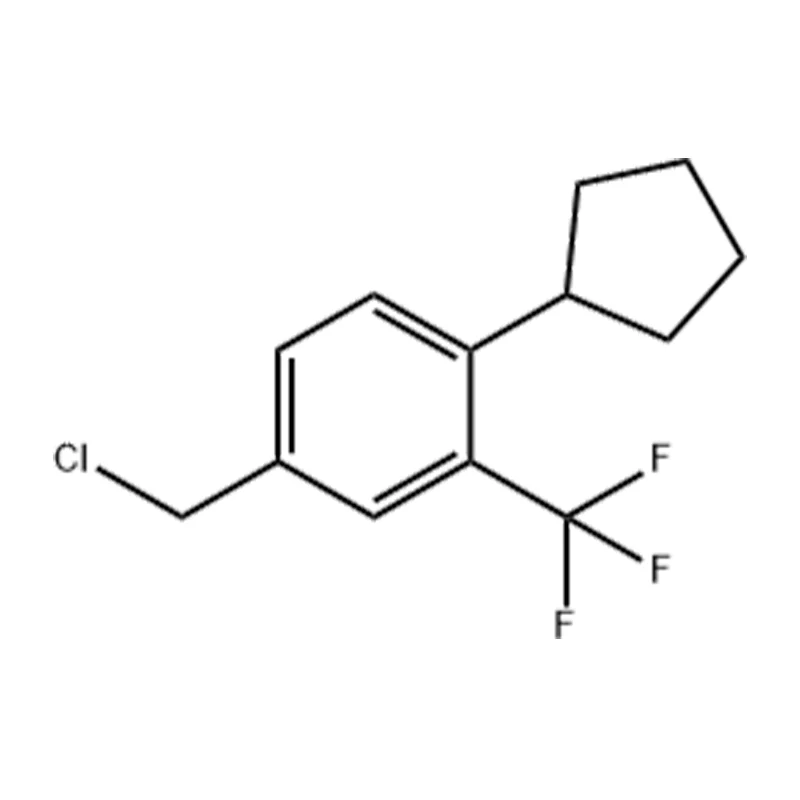
4-ChloroMethyl-1-cyclopentyl-2-trifluoroMethyl-benzene is a specialized benzylic halide widely used in medicinal chemistry to attach a cyclopentyl‑trifluoromethylphenyl motif to nucleophilic pharmacophores. The benzylic chloride of 4-ChloroMethyl-1-cyclopentyl-2-trifluoroMethyl-benzene reacts smoothly with amines, alcohols, and thiols under mild Sₙ2 conditions, allowing late‑stage diversification without affecting the trifluoromethyl or cyclopentyl groups. Because 4-ChloroMethyl-1-cyclopentyl-2-trifluoroMethyl-benzene combines three distinct structural features in one building block, it enables rapid exploration of SAR around lipophilic pockets in enzyme active sites. Cosperpharm ensures that 4-ChloroMethyl-1-cyclopentyl-2-trifluoroMethyl-benzene is supplied with strict control over the bis‑alkylated dimer and the corresponding benzyl alcohol, guaranteeing high conversion in subsequent N‑ or O‑alkylations.
|
Parameter |
Specification |
|
Product Name |
4-ChloroMethyl-1-cyclopentyl-2-trifluoroMethyl-benzene |
|
CAS Number |
957208-65-0 |
|
Molecular Formula |
C₁₄H₁₆ClF₃ |
|
Molecular Weight |
276.73 g/mol |
|
Appearance |
Colorless to pale yellow liquid |
|
Purity (GC) |
≥97.0% |
|
Solubility |
Soluble in dichloromethane, THF, toluene; insoluble in water |
|
Storage Condition |
2–8 °C, sealed under nitrogen, protect from moisture |
|
Shelf Life |
18 months under recommended conditions |
|
Advantage |
Detail |
|
Production Strength |
GMP-certified campus spanning 100+ mu, 3 multi-purpose workshops, 6 D-grade clean zone production lines, and 150+ reactors (20L–5000L), supporting high/low temp, anaerobic & hydrogenation; kg to ton scale production. |
|
Fast Delivery |
R&D samples: one week; commercial orders: 1–2 months after payment. Express (DHL/FedEx) or air/sea freight available. |
|
Global Partners |
Trusted by 30+ pharmaceutical companies in USA, Europe, India, Brazil, and Southeast Asia; long-term cooperation with generic drug manufacturers, CROs, and impurity standard distributors. |
|
Licensed Exporter |
Valid drug import/export license — no compliance delays. |
|
Dual Quality Grades |
Both research/pharma grade(≥98%)and high-purity impurity grade(≥99%)available to meet diverse customer needs. |
1.Trifluoromethyl‑Activated Benzyl Chloride – The adjacent CF₃ group enhances the electrophilicity of the chloromethyl group while blocking metabolic soft spots.
2.Saturated Cyclopentyl Ring – Introduces three‑dimensional shape and lipophilicity, often improving target selectivity over flat aromatic rings.
3.Three Orthogonal Handles – The chloride is a leaving group; the CF₃ is chemically inert; the cyclopentyl group can be further functionalized if desired.
4.Consistent Liquid Form – The low‑viscosity oil is easy to dispense by syringe or pump in both lab and kilo‑lab settings.
5.Broad Reactivity – Alkylates amines, phenols, thiophenols, and heterocycles efficiently without requiring a catalyst.
Q: Can I use it in SₙAr reactions?
A: The chloromethyl group is an alkyl chloride; it does not participate in nucleophilic aromatic substitution. The aromatic ring is deactivated by the CF₃ group.
Q: What is the typical protocol for amine alkylation?
A: Stir the amine (1.0–1.2 equiv) with this compound in acetonitrile or DMF, using K₂CO₃ or i‑Pr₂NEt as base, at 60 °C for 4–8 h. Yields are generally >80%.
For a quote on this densely functionalized benzyl chloride, or to request an analytical sample for a feasibility trial, connect with Cosperpharm’s sales desk — we typically provide technical data and a pricing proposal within your preferred time frame.
Address
No. 2 Yangguang 3rd Road, Duodao Chemical Cycle Industrial Park, Jingmen City, Hubei Province, China
Tel