
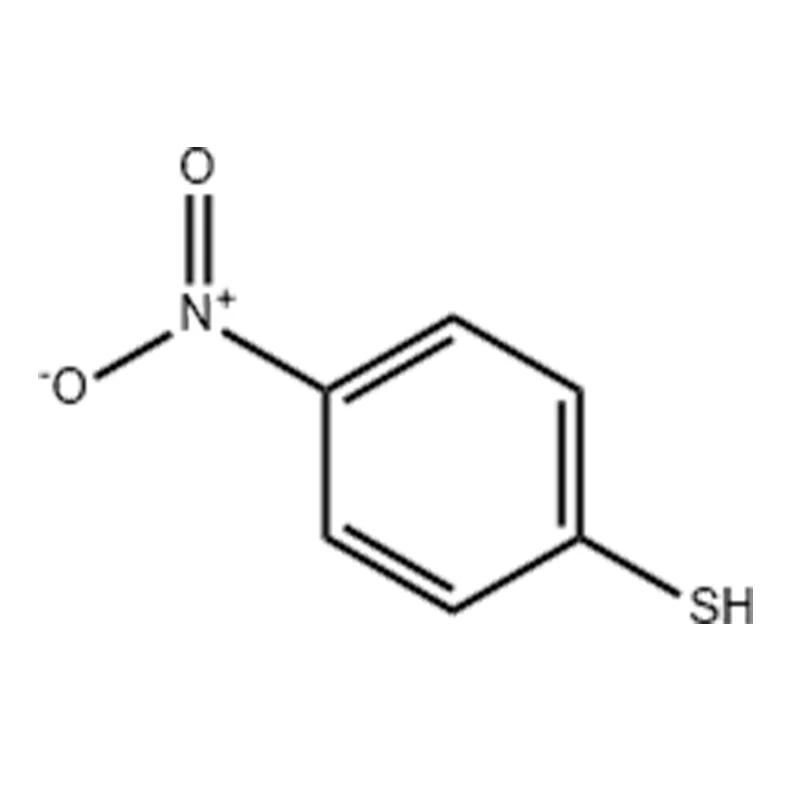
4-Nitrobenzenethiol (CAS 1849-36-1) is a yellow crystalline solid belonging to the nitro‑substituted aromatic thiol family. The molecular formula is C₆H₅NO₂S with a molecular weight of 155.17 g/mol. The compound is supplied at purities ranging from 96% to 98% as yellow crystalline powder and/or chunks.
4-Nitrobenzenethiol is an important raw material and intermediate used in organic synthesis, pharmaceuticals, agrochemicals, and dyestuffs. The compound is closely related to thiophenol but significantly more acidic due to the strong electron‑withdrawing effect of the para‑nitro group, which stabilizes the thiolate anion. This enhanced acidity (pKa ≈ 4.68) makes 4-nitrobenzenethiol a more reactive nucleophile in many transformations compared to unsubstituted thiophenol.
In medicinal chemistry, 4-nitrobenzenethiol has been used in the synthesis of HIV‑1 Vif inhibitors. Researchers have developed a novel class of Vif inhibitors with a 2‑amino‑N‑(5‑hydroxy‑2‑methoxyphenyl)‑6‑((4‑nitrophenyl)thio)benzamide scaffold, which show obvious activity in HIV‑1 infected cells and are effective against drug‑resistant strains. Additionally, 4-nitrobenzenethiol is a key intermediate in the synthesis of various organic compounds and serves as a versatile building block for creating a range of molecules.
In materials science and analytical chemistry, 4-nitrobenzenethiol has been used in the synthesis of dual emission fluorescent probes for the differential sensing of glutathione (GSH) and cysteine/homocysteine (Cys/Hcy), which are essential for various biological processes and can be indicators of certain diseases when their levels are abnormal. It can also be used to detect the presence of nitrite ions in solution, which can be used to identify nitrite‑dependent bacteria such as Clostridium botulinum, Staphylococcus aureus, and Salmonella enterica.
In organic synthesis, 4-nitrobenzenethiol is a key intermediate in the synthesis of various organic compounds. Its chemical properties make it a versatile building block for creating a range of molecules with different applications. The compound can be used to synthesize diaryl thioethers via copper‑catalyzed C‑S coupling reactions, and it reacts with chlorine to give 4‑nitrophenylsulfenyl chloride, a useful reagent for introducing the 4‑nitrophenylsulfenyl protecting group in peptide synthesis. In addition, 4-nitrobenzenethiol can be used in the preparation of thiosulfonate derivatives, which have demonstrated broad‑spectrum antifungal activity against various plant pathogenic fungi, including Fusarium oxysporum, Fusarium solani, Alternaria solani, Alternaria brassicicola, Valsa mali, Phomopsis sp., Phytophthora capsica, and Rhizoctonia solani.
|
Parameter |
Specification |
|
CAS Number |
1849-36-1 |
|
Molecular Formula |
C₆H₅NO₂S |
|
Molecular Weight |
155.17 g/mol |
|
Purity |
96% as standard; ≥98% available upon request |
|
Appearance |
Yellow crystalline powder and/or chunks |
|
Melting Point |
72–77°C |
|
Boiling Point |
281.9 ± 23.0 °C at 760 mmHg (Predicted) |
|
Flash Point |
124.3 °C |
|
pKa |
4.68 ± 0.10 (Predicted) |
|
Canonical SMILES |
C1=CC(=CC=C1N+[O-])S |
|
Solubility |
Partly soluble in water and chloroform; sparingly soluble in chloroform; slightly soluble in methanol |
|
Sensitivity |
Stench (strong unpleasant odor) |
|
Storage Condition |
2–8°C, sealed, in dark place, under inert atmosphere |
|
Stability |
Stable when stored under recommended conditions; avoid contact with oxidizing agents |
|
GHS Signal Word |
Warning |
|
Hazard Statements |
H315 (Causes skin irritation); H319 (Causes serious eye irritation); H335 (May cause respiratory irritation) |
4‑Nitrobenzenethiol was first prepared by the sulfidation of 4‑nitrochlorobenzene using alkali metal sulfides or polysulfides. The classical synthetic route involves the nucleophilic aromatic substitution (SNAr) reaction of 4‑nitrochlorobenzene with sodium hydrosulfide (NaSH) or sodium polysulfide (Na₂Sₓ) in a suitable solvent such as water, methanol, or ethanol.
The classic synthesis proceeds via the following steps:
● Reaction: 4‑Nitrochlorobenzene is reacted with sodium hydrosulfide (NaSH) in a polar protic solvent (water, methanol, or ethanol) under reflux conditions.
● Mechanism: The strongly electron‑withdrawing para‑nitro group activates the aromatic ring toward nucleophilic aromatic substitution, allowing the hydrosulfide anion (HS⁻) to displace the chlorine atom.
● Work‑up: After completion, the reaction mixture is neutralized with acid to protonate the thiolate anion and liberate the free thiol.
● Isolation: The product is isolated by filtration, washed, and dried to yield 4‑nitrobenzenethiol as a yellow solid.
● Yield: Typically 60–80% depending on reaction conditions.
An improved synthetic route involves the intentional generation of a polysulfide intermediate:
Step 1: 4‑Nitrochlorobenzene is reacted with an excess of sodium polysulfide (Na₂Sₓ) in aqueous or alcoholic medium.
Step 2: The initially formed polysulfide intermediate is reduced in situ by the excess polysulfide or by a reducing agent to generate the thiolate anion.
Step 3: Acidification yields 4‑nitrobenzenethiol in higher yields (up to 85–90%) and with fewer by‑products compared to the direct NaSH route.
The compound can also be synthesized from 4‑nitrofluorobenzene or 4‑nitroiodobenzene, which are more reactive toward nucleophilic aromatic substitution than 4‑nitrochlorobenzene due to the better leaving‑group ability of fluoride or iodide. However, these starting materials are more expensive, making the chlorobenzene route more cost‑effective for industrial production.
Industrial production typically follows the polysulfide route due to its higher yield and cleaner product profile. The reaction is scaled up in large reactors with precise temperature control and efficient agitation. The product is purified by recrystallization from an appropriate solvent (e.g., ethanol or water/ethanol mixtures) to achieve 96–98% purity. Due to the strong unpleasant odor of the compound, special ventilation and odor‑control measures are required during manufacturing and packaging.
A pharmaceutical research team is developing novel therapeutics to combat HIV‑1, particularly drug‑resistant strains, by targeting the viral infectivity factor (Vif), a protein that neutralizes the host restriction factor A3G. 4‑Nitrobenzenethiol is used as a key building block to synthesize a novel class of Vif inhibitors with a 2‑amino‑N‑(5‑hydroxy‑2‑methoxyphenyl)‑6‑((4‑nitrophenyl)thio)benzamide scaffold. The team reacts 4‑nitrobenzenethiol with an appropriate 2‑amino‑halobenzamide derivative under copper‑catalyzed C‑S coupling conditions to construct the core scaffold. The resulting compounds are evaluated for antiviral activity in HIV‑1 infected cells and for their ability to block Vif‑A3G interactions. RN‑18, a known Vif antagonist, is among the compounds that incorporate the 4‑nitrophenylthio motif and serves as a reference standard.
An analytical chemistry research group is developing new fluorescent probes for the selective and sensitive detection of biothiols (GSH, Cys, Hcy) in biological samples, as abnormal levels of these small‑molecule thiols are associated with various diseases. 4‑Nitrobenzenethiol is used as a starting material to synthesize a dual emission fluorescent probe. The probe is designed to undergo a thiol‑triggered reaction that results in a ratiometric fluorescence response, enabling differential sensing of GSH versus Cys/Hcy. The probe is characterized by UV‑Vis and fluorescence spectroscopy and applied to the detection of biothiols in human plasma or cell lysates, providing a rapid and sensitive method for disease diagnostics.
An agrochemical research center is developing new, environmentally friendly fungicides to combat plant pathogenic fungi that cause devastating crop losses. 4‑Nitrobenzenethiol is used to synthesize a series of thiosulfonate derivatives via oxidation with appropriate sulfonyl chlorides. The resulting thiosulfonates are screened for in vitro antifungal activity against a panel of plant pathogenic fungi, including Fusarium oxysporum, Fusarium solani, Alternaria solani, Alternaria brassicicola, Valsa mali, Phomopsis sp., Phytophthora capsica, and Rhizoctonia solani. The thiosulfonate derivatives exhibit broad‑spectrum antifungal activity, and lead compounds are evaluated for phytotoxicity and field efficacy in greenhouse trials.
A peptide synthesis laboratory requires a protecting group for the selective protection of thiol and amine functional groups during solid‑phase peptide synthesis. 4‑Nitrobenzenethiol is treated with chlorine gas in an inert solvent (e.g., dichloromethane) at low temperature to prepare 4‑nitrophenylsulfenyl chloride (Nps‑Cl). This reagent is used to introduce the Nps protecting group, which is stable under acidic conditions but can be selectively removed under mild reductive conditions. The reagent enables the orthogonal protection of cysteine thiols or lysine amines in the synthesis of complex peptides and peptide conjugates.
A medicinal chemistry team requires a library of diaryl thioether derivatives for structure‑activity relationship (SAR) studies targeting a novel enzyme. Using 4‑nitrobenzenethiol as the thiol coupling partner, the team performs copper‑catalyzed C‑S cross‑coupling reactions with a variety of aryl iodides or bromides under mild conditions. The resulting 4‑nitrophenyl aryl thioethers are further functionalized at the nitro group (reduction to aniline, followed by amidation) or at the aryl ring via additional cross‑coupling reactions. The library is screened for activity against the target enzyme, and structure‑activity relationship analysis identifies key substituents responsible for potency and selectivity.
A food safety laboratory needs a rapid and cost‑effective method to detect nitrite‑producing bacteria in food products, particularly Clostridium botulinum, Staphylococcus aureus, and Salmonella enterica, which can cause severe foodborne illness. 4‑Nitrobenzenethiol is used as a colorimetric or fluorometric probe for nitrite ion detection. The thiol reacts with nitrite under acidic conditions to form a nitrosothiol or other chromogenic product that can be detected by UV‑Vis spectroscopy at a specific wavelength. The assay is optimized for sensitivity and selectivity and applied to the screening of food samples for nitrite contamination and bacterial contamination.
A materials science research group is studying the mechanism of plasmon‑induced surface‑catalyzed reactions for applications in photocatalysis and solar energy conversion. 4‑Nitrobenzenethiol is used as a probe molecule in surface‑enhanced Raman scattering (SERS) experiments on plasmonic metal nanoparticles (e.g., silver or gold). The molecule adsorbs onto the metal surface via the thiol group, and the catalytic conversion of 4‑nitrobenzenethiol to 4,4‘‑dimercaptoazobenzene or other products is monitored in situ by SERS under laser illumination. The reaction kinetics and mechanism are elucidated, providing insights into the role of hot electrons and plasmonic effects in surface catalysis.
Each batch undergoes:
● Gas chromatography (GC) – purity ≥97.0%
● Non‑aqueous titration – purity ≥97.0%
● Refractive index – confirmatory analysis
● ¹H NMR – structural verification
● Appearance – colorless to light yellow to light orange clear liquid
A comprehensive COA, MSDS (with full GHS information), and certificate of origin accompany every shipment.
We look forward to supporting your research and production needs.If you have any questions regarding 4‑Nitrobenzenethiol (CAS 1849-36-1) or wish to request a quotation, please do not hesitate to reach out. Our sales and technical support teams are ready to assist you.
Address
No. 2 Yangguang 3rd Road, Duodao Chemical Cycle Industrial Park, Jingmen City, Hubei Province, China
Tel


![1-[2,3-Bis[(9Z,12Z)-octadeca-9,12-dien-1-yloxy]propyl]pyrrolidine](https://www.cosperpharma.com/upload/8820/1-2-3-bis-9z-12z-octadeca-9-12-dien-1-yloxy-propyl-pyrrolidine-349384.webp "1-[2,3-Bis[(9Z,12Z)-octadeca-9,12-dien-1-yloxy]propyl]pyrrolidine")
![1,2,4-Triazolo[4,3-a]pyridin-3(2H)-one](https://www.cosperpharma.com/upload/8820/1-2-4-triazolo-4-3-a-pyridin-3-2h-one-440735.webp "1,2,4-Triazolo[4,3-a]pyridin-3(2H)-one")