
Overview
Icatibant acetate is a disease-specific treatment for hemangioid angioma (HAE) developed by Shire, which received FDA approval on August 25,2011, for the management of acute episodes of hereditary angioedema in adults aged 18 years and older. It is also the third drug approved by the FDA for treating HAE attacks. Icatibant acetate possesses a structure similar to a bradykinin-like d-decapeptide but contains five non-protein-derived amino acids. It acts as a potent, selective competitive antagonist of bradykinin type 2 (B2) receptors, alleviating local swelling, inflammation, and pain associated with HAE episodes by inhibiting the effects of bradykinin. HAE represents only one of several potential indications for which icatibant may be indicated; other potential applications include asthma, liver cirrhosis, and other types of angioedema. Consequently, icatibant acetate exhibits significant therapeutic value and broad market prospects.
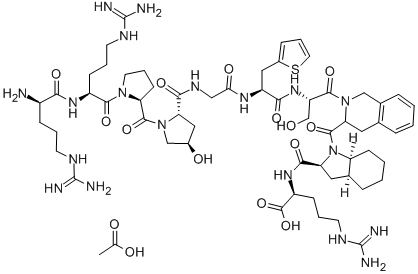
Chemical structure formula of Icatibant acetate
Essential Information
Chinese name: 醋酸艾替班特
English name: Icatibant acetate
Company ID:GT-F005
CAS:138614-30-9;130308-48-4
Serial number:H-D-Arg-Arg-Pro-Hyp-Gly-Thi-Ser-D-Tic-Oic-Arg-OH
Molecular formula:C59H89N19O13S
Molecular weight:1304.52
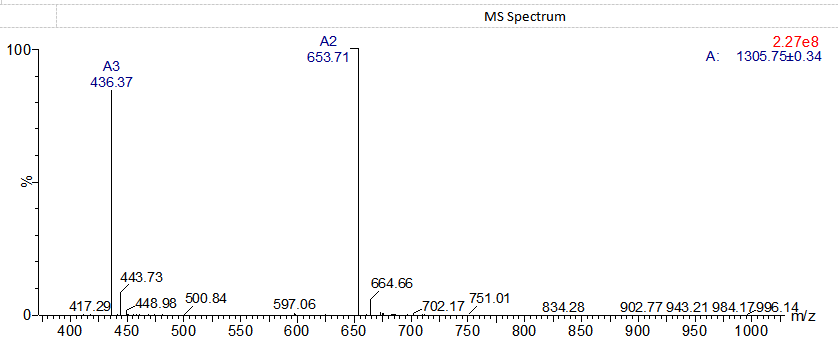
Icatibant acetate MS spectrum
Synthetic Route
1: Preparation of Fmoc-Arg(Pbf)-CTC resin
Add 11.1 g of 2-chlorotrifenylmethylicloride resin with a substitution rate of 0.9 mmol/g to the solid-phase reaction column, followed by addition of DMF-swelled resin for 30 minutes. Add 3.50 μL of DIPEA to 12.98 g of Fmoc-Arg(Pbf)-OH and activate for 5 minutes; then add the DMF-swelled resin and allow the mixture to reach equilibrium after 10 minutes. Add another 3.50 μL of DIPEA, react at room temperature for 45 minutes, and finally seal with methanol for 20 minutes. Evaporate the reaction mixture, wash three times with DMF, three times with DCM, and then contract three times with methanol for 3 minutes, 5 minutes, and 8 minutes respectively, yielding Fmoc-Arg(Pbf)-CTC resin with a measured substitution rate of 0.5 mmol/g.
2:Coupling of Fmoc-Oic-OH
Weigh 10 mmol of Fmoc-Arg (Pbf)-CTC resin and add it to a solid-phase reactor, swell it in DMF for 0.5 h, then remove the Fmoc protection twice using 20% DBLK solution for 10 min and 5 min respectively; after washing, conjugate it with Fmoc-Oic-OH. Dissolve 11.73 g of Fmoc-Oic-OH, 4.9 g of HOBt, and 6.1 mL of DIC in DCM (a small amount of DMF may be added for solubilization), activate the mixture in an ice water bath for 7 min, then transfer it to the solid-phase reactor and react at room temperature for 1–2 h. The reaction endpoint is determined by the indantrone method. Upon completion, aspirate the reaction mixture, wash with DMF, remove the Fmoc protection twice using 20% DBLK solution for 10 min and 5 min respectively, wash again, and prepare for coupling with the next amino acid.
3:Coupling of Fmoc-D-Cit-OH
Dissolve 11.91 g of Fmoc-D-Cit-OH, 5.00 g of HOAt, and 11.4 g of HATU in DCM (with a small amount of DMF added for solubilization). Add 3.87 g of DIPEA under ice water bath and activate for 7 minutes; then transfer the mixture to a solid-phase reactor and react at room temperature for 1–2 hours. Reaction completion is determined by the indiol method. After reaction, remove the reaction mixture, wash with DMF, and eliminate the Fmoc protection using 20% DBLK solution. Following washing, prepare for coupling with the next amino acid.
4:Coupling of Fmoc-Ser(tBu)-OH
Dissolve 11.49 g of Fmoc-Ser(tBu)-OH, 5.00 g of HOAt, and 6.1 mL of DIC in DCM (with a small amount of DMF added for solubilization). After activation under ice water bath for 7 minutes, transfer the mixture to a solid-phase reactor and react at room temperature for 1–2 hours; reaction completion is determined by the indiol method. Upon completion, remove the reaction mixture, wash with DMF, then eliminate the Fmoc protection using 20% DBLK solution, followed by washing before proceeding to coupling with the next amino acid.
5:Coupling of Fmoc-Thi-OH
Dissolve 11.79 g of Fmoc-Thi-OH, 5.00 g of HOBt, and 11.37 g of HBTU in DCM (with a small amount of DMF added for solubilization). Add 3.87 g of DIPEA under ice water bath and activate for 7 minutes; then transfer the mixture to a solid-phase reactor and allow reaction at room temperature for 1–2 hours. Reaction completion is determined by the indiol method. After reaction, remove the reaction mixture, wash with DMF, and eliminate the Fmoc protection using 20% DBLK solution. Following washing, prepare for coupling with the next amino acid.
6:Coupling of Fmoc-Gly-OH
Dissolve 8.91 g of Fmoc-Gly-OH, 5.00 g of HOBt, and 9.63 g of TBTU in DCM (with a small amount of DMF added for solubilization). Add 3.63 g of TMP under ice water bath and activate for 7 minutes; then transfer the mixture to a solid-phase reactor and allow reaction at room temperature for 1–2 hours. Reaction completion is determined by the indanone method. After reaction, remove the reaction mixture, wash with DMF, and eliminate the Fmoc protection using 20% DBLK solution. Following washing, prepare for coupling with the next amino acid.
7:Coupling of Fmoc-Hyp(tBu)-OH
Dissolve 12.27 g of Fmoc-Hyp(tBu)–OH, 5.00 g of HOAt, and 9.66 g of TATU in DCM (with a small amount of DMF added for solubilization). Add 3.63 g of TMP under ice water bath and activate for 7 minutes; then transfer the mixture to a solid-phase reactor and react at room temperature for 1–2 hours. The reaction endpoint is determined by the indiol method. After completion, remove the reaction mixture, wash with DMF, and eliminate the Fmoc protection using 20% DBLK solution. Following washing, prepare for coupling with the next amino acid.
8:Coupling of Fmoc-Pro-OH
Dissolve 10.11 g of Fmoc-Pro-OH, 5.00 g of HOAt, and 11.4 g of HATU in DCM (with a small amount of DMF added for solubilization). Add 3.87 g of DIPEA under ice water bath and activate for 7 minutes; then transfer the mixture to a solid-phase reactor and react at room temperature for 1–2 hours. The reaction endpoint is determined by the indiol method. Upon completion, remove the reaction mixture, wash with DMF, and eliminate the Fmoc protection using 20% DBLK. After washing, prepare for coupling with the next amino acid.
9:Coupling of Fmoc-Arg(Pbf)-OH
Dissolve 19.44 g of Fmoc-Arg(Pbf)-OH, 5.00 g of HOAt, and 11.4 g of HATU in DCM (with a small amount of DMF added for solubilization). Add 3.87 g of DIPEA under ice water bath and activate for 7 minutes; then transfer the mixture to a solid-phase reactor and react at room temperature for 1–2 hours. Reaction completion is determined by the indiol method. After reaction, remove the reaction mixture, wash with DMF, and eliminate the Fmoc protection using 20% DBLK solution. Following washing, prepare for coupling with the next amino acid.
10:Coupling of Fmoc-D-Arg(Pbf)-OH
Dissolve 19.44 g of Fmoc-D-Arg(Pbf)-OH, 5.00 g of HOAt, and 11.4 g of HATU in DCM (with a small amount of DMF added for solubilization). Add 3.87 g of DIPEA under ice water bath and activate for 7 minutes; then transfer the mixture to a solid-phase reactor and react at room temperature for 1–2 hours. The reaction endpoint is determined by the indiolone method. After completion, remove the reaction mixture, wash with DMF, then use 20% DBLK to remove the Fmoc protection. Wash three times with DMF, three times with DCM, and three times with methanol for contraction (for 3 min, 5 min, and 8 min respectively), followed by vacuum drying to obtain etibant peptide acetate resin.
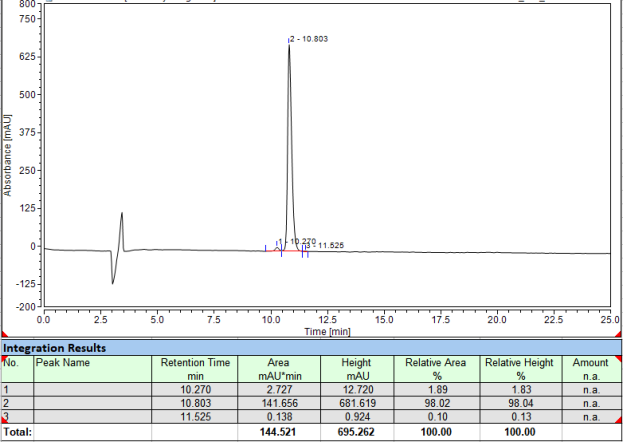
HPLC chromatogram of Icatibant acetate
11:Resin pyrolysis of Icatibant acetate
Prepare 200 mL of lysis reagent containing 190 mL trifluoroacetic acid, 6 mL triisopropylsilane, and 4 mL water, and pre-cool it in a refrigerator for 30 minutes. Add 20.0 g of etibant peptide acetate resin to a 500 mL round-bottom flask, then add the prepared 200 mL lysis reagent to the resin while stirring under an ice bath and under nitrogen flow. After 30 minutes of reaction, remove the ice bath and continue the reaction at room temperature for 2 hours. Filter the resin and collect the filtrate. Wash the resin with a small amount of trifluoroacetic acid, filter, and combine the filtrates. Gradually add the filtrate to 20 L of ice-cold ether; a white precipitate forms. Centrifuge at 3000 rpm to collect the precipitate, wash five times with ice-cold ether, and dry under reduced pressure to obtain 10.3 g of crude peptide with HPLC purity>90%.