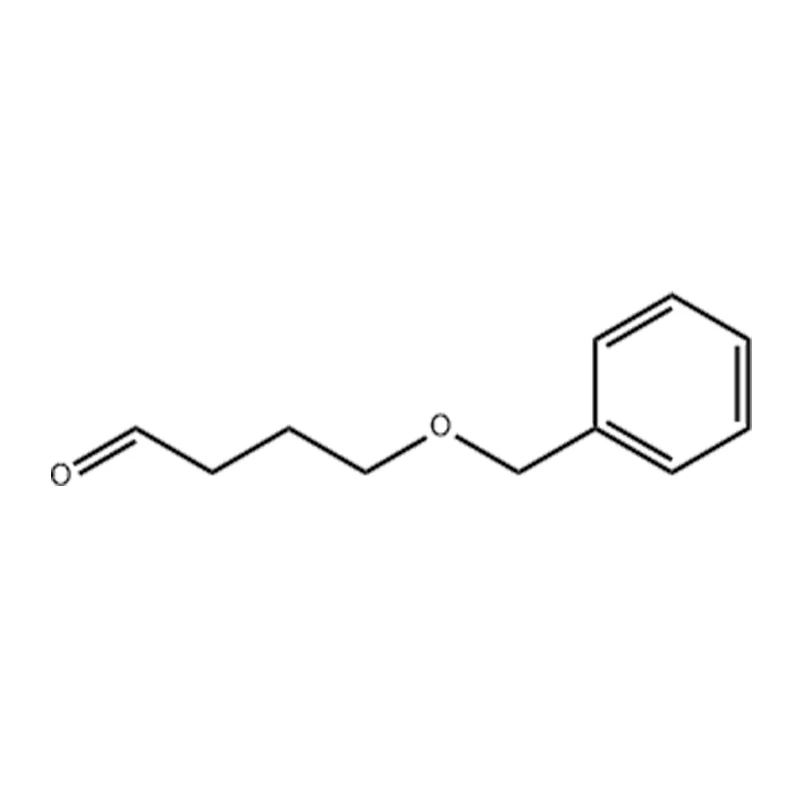
4-(Phenylmethoxy)butanal is a benzyl-protected aldehyde building block that finds extensive application as a key synthetic intermediate in medicinal chemistry and pharmaceutical process development. The benzyl protecting group in 4-(Phenylmethoxy)butanal is acid-labile, providing stability under basic and neutral conditions while allowing selective deprotection under hydrogenolytic (H₂, Pd/C) or Lewis acid-mediated conditions to liberate 4-hydroxybutanal for further functionalization. The reactive primary aldehyde in 4-(Phenylmethoxy)butanal can participate in nucleophilic addition reactions, reductive aminations, Wittig olefinations, and Grignard reactions, making it a versatile C4 synthon for the convergent assembly of complex molecular architectures. In the context of bioconjugation chemistry, 4-(Phenylmethoxy)butanal has been identified as a linker molecule containing an acid-labile benzyl protecting group and a reactive primary aldehyde that can react with hydrazide and aminooxy groups commonly used in biomolecular probes for labeling and crosslinking carbonyls such as oxidized carbohydrates.The predictable reactivity profile and orthogonal protecting group strategy of 4-(Phenylmethoxy)butanal have established it as a valuable tool in the modern synthetic chemist‘s repertoire.
|
Parameter |
Specification |
|
Product Name |
4-(Phenylmethoxy)butanal |
|
CAS Number |
5470-84-8 |
|
Molecular Formula |
C₁₁H₁₄O₂ |
|
Molecular Weight |
178.23 g/mol |
|
SMILES |
O=CCCCOCC1=CC=CC=C1 |
|
Purity (GC) |
97–98% |
|
Physical Form |
Liquid |
|
Appearance |
Colorless to pale yellow liquid |
|
Boiling Point |
276 °C at 760 mmHg (lit.); 275.8 °C at 760 mmHg (predicted) |
|
Density |
1.015 g/cm³ at 25 °C (lit.) |
|
Flash Point |
115 °C (closed cup) |
|
Refractive Index |
~1.50 (predicted) |
|
LogP |
~2.18 (predicted) |
|
Solubility |
Soluble in organic solvents (dichloromethane, ethyl acetate, THF, chloroform, methanol); limited solubility in water; insoluble in water per some sources |
|
Storage Condition |
2–8 °C, stored under nitrogen, sealed, dry, inert atmosphere; room temperature (alternative specification) |
|
Advantage |
Detail |
|
Production Strength |
GMP-certified campus spanning 100+ mu, 3 multi-purpose workshops, 6 D-grade clean zone production lines, and 150+ reactors (20L–5000L), supporting high/low temp, anaerobic & hydrogenation; kg to ton scale production. |
|
Fast Delivery |
R&D samples: one week; commercial orders: 1–2 months after payment. Express (DHL/FedEx) or air/sea freight available. |
|
Global Partners |
Trusted by 30+ pharmaceutical companies in USA, Europe, India, Brazil, and Southeast Asia; long-term cooperation with generic drug manufacturers, CROs, and impurity standard distributors. |
|
Licensed Exporter |
Valid drug import/export license — no compliance delays. |
|
Dual Quality Grades |
Both research/pharma grade(≥98%)and high-purity impurity grade(≥99%)available to meet diverse customer needs. |
The preparation of 4-(Phenylmethoxy)butanal is most commonly accomplished via the oxidation of the corresponding primary alcohol, 4-benzyloxy-1-butanol. A representative synthetic approach involves the controlled oxidation using reagents such as Dess-Martin periodinane (DMP) or Swern oxidation conditions (oxalyl chloride, DMSO, triethylamine).
In a Swern oxidation protocol, oxalyl chloride (1.2–1.5 equivalents) is added dropwise to a solution of anhydrous DMSO (2.5–3.0 equivalents) in dichloromethane at –78 °C under an inert atmosphere. After stirring for 15–30 minutes, a solution of 4-benzyloxy-1-butanol (1.0 equivalent) in dichloromethane is added slowly, and the mixture is stirred at low temperature for an additional 1–2 hours. Triethylamine (4.0–5.0 equivalents) is then added, and the reaction is allowed to warm gradually to room temperature. Aqueous workup, extraction with dichloromethane, drying over anhydrous sodium sulfate, filtration, and concentration under reduced pressure affords the crude aldehyde. Purification by silica gel column chromatography (typically eluting with hexanes/ethyl acetate gradients) yields 4-(Phenylmethoxy)butanal as a colorless to pale yellow liquid.
Alternative oxidation methods employing pyridinium chlorochromate (PCC) or TEMPO/bleach systems may also be employed depending on scale and substrate availability. The reaction progress is conveniently monitored by TLC (visualized with potassium permanganate, 2,4-DNP, or anisaldehyde stain), and the purified product is characterized by ¹H NMR spectroscopy, with the diagnostic aldehyde proton appearing as a triplet at approximately δ 9.77 ppm and the benzylic methylene as a singlet at approximately δ 4.50 ppm in CDCl₃.
An alternative synthetic approach, particularly suitable for laboratory-scale preparation, involves the direct alkylation of 4-hydroxybutanal with benzyl bromide in the presence of silver oxide or another suitable base in dry toluene at room temperature. This Williamson ether synthesis strategy provides direct access to the target benzyl-protected aldehyde in a single step from commercially available starting materials.
Store 4-(Phenylmethoxy)butanal at 2–8 °C in a tightly sealed container under an inert atmosphere of nitrogen or argon, protected from light and moisture at all times. The compound should be kept in a cool, dry, well-ventilated place, away from oxidizing agents, heat, sparks, and open flames. Allow the sealed container to equilibrate to ambient temperature before opening to prevent moisture condensation. The aldehyde group is susceptible to air oxidation to the corresponding carboxylic acid, and the benzyl ether may undergo oxidative cleavage under forcing conditions; therefore, storage under inert gas is strongly recommended for maintaining long-term integrity. Some suppliers also indicate that room temperature storage is acceptable for short-term use; however, refrigerated storage (2–8 °C) is recommended for maximum shelf life. Under recommended storage conditions, the compound is stable; however, prolonged exposure to air, moisture, or elevated temperatures should be avoided. Adherence to the storage recommendations specified in the Certificate of Analysis is essential for maintaining product integrity throughout its documented shelf life.
Looking to add 4-(Phenylmethoxy)butanal to your synthetic toolbox or analytical reference standard library? Reach out to Cosperpharm with your requirements, and our team will prepare a personalized quotation without delay.
Address
No. 2 Yangguang 3rd Road, Duodao Chemical Cycle Industrial Park, Jingmen City, Hubei Province, China
Tel

![1-[2,3-Bis[(9Z,12Z)-octadeca-9,12-dien-1-yloxy]propyl]pyrrolidine](https://www.cosperpharma.com/upload/8820/1-2-3-bis-9z-12z-octadeca-9-12-dien-1-yloxy-propyl-pyrrolidine-349384.webp "1-[2,3-Bis[(9Z,12Z)-octadeca-9,12-dien-1-yloxy]propyl]pyrrolidine")
![1,2,4-Triazolo[4,3-a]pyridin-3(2H)-one](https://www.cosperpharma.com/upload/8820/1-2-4-triazolo-4-3-a-pyridin-3-2h-one-440735.webp "1,2,4-Triazolo[4,3-a]pyridin-3(2H)-one")