
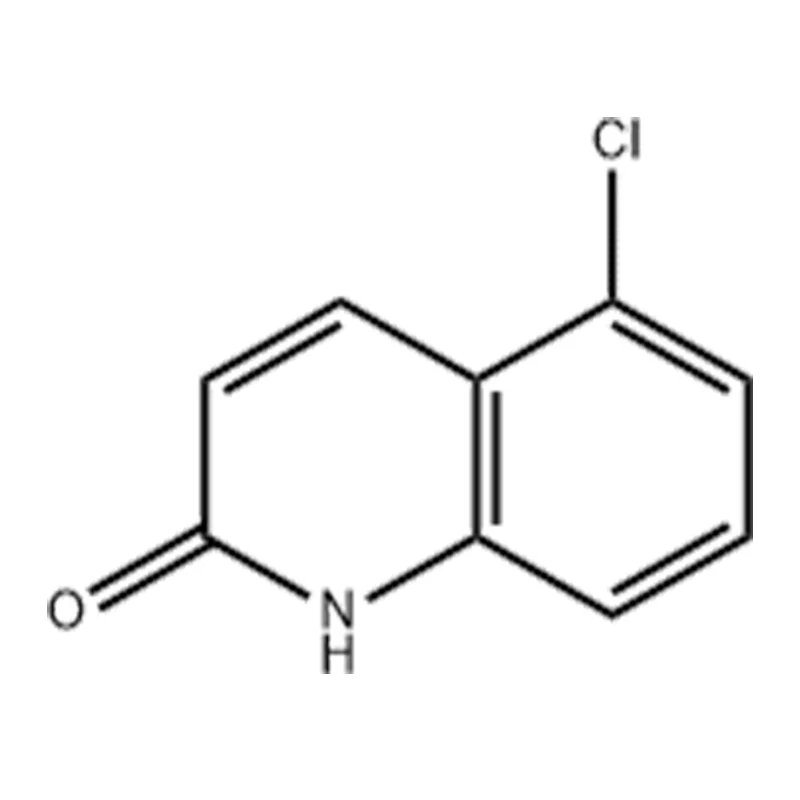
The quinoline scaffold is one of the most privileged heterocycles in drug discovery — quinine (antimalarial), ciprofloxacin (antibiotic), and chloroquine (antimalarial/immunomodulatory) all feature this core. 5-Chloro-quinolin-2-ol builds on this foundation by introducing a chlorine atom at the 5‑position and a hydroxyl/carbonyl group at the 2‑position, creating a versatile platform that can be used as a building block for pharmaceutical compounds with potential antimicrobial, anticancer, and anti‑inflammatory activities. 5‑Chloro‑quinolin‑2‑ol offers two distinct handles: the chlorine atom serves for further functionalization (e.g., cross‑coupling reactions, nucleophilic aromatic substitution), while the 2‑hydroxy group can be alkylated or acylated to create diverse libraries. Cosperpharm supplies 5‑Chloro‑quinolin‑2‑ol with ≥95% purity by HPLC, backed by full analytical documentation. The product is stable when stored sealed in a cool, dry place under inert atmosphere, and 5‑Chloro‑quinolin‑2‑ol is available from research quantities to pilot‑scale lots.
|
Parameter |
Specification |
|
CAS Number |
23981-22-8 |
|
IUPAC Name |
5-chloro-1,2-dihydroquinolin-2-one; 5-chloro-1H-quinolin-2-one |
|
Molecular Formula |
C₉H₆ClNO |
|
Molecular Weight |
179.60 g/mol |
|
Melting Point |
288–289 °C (Solv: methanol) |
|
Boiling Point (Predicted) |
372.6 ± 42.0 °C at 760 mmHg |
|
Density (Predicted) |
1.339 ± 0.06 g/cm³ |
|
pKa (Predicted) |
10.89 ± 0.70 |
|
Appearance |
White to light-yellow to light-orange powder |
|
Storage |
Sealed in dry container; store long-term in a cool, dry place; under inert atmosphere preferred |
5-Chloro-quinolin-2-ol serves as a building block for pharmaceutical compounds with broad biological activities. Quinoline derivatives have been extensively studied for their antibacterial, antifungal, antimalarial, anticancer, and anti‑inflammatory properties. The chlorine atom at the 5‑position enhances chemical reactivity and biological activity by modulating electronic properties and lipophilicity.
Notably, 5‑chloro‑ and other halogenated quinolin‑8‑ols have shown potent anticandidal activity, with the 5‑chloro derivative being most effective at inhibiting the growth of Candida albicans. A related compound, 5‑chloro‑8‑quinolinol, has demonstrated unique p53‑modulating activity, shifting transactivation from proapoptotic to protective responses, including enhancing p21 induction and suppressing PUMA induction — suggesting potential as a radioprotective agonist.
The hydroxyl group at the 2‑position makes the compound a potential metal chelator, allowing it to disrupt metal‑dependent enzymes in pathogens — a mechanism shared by many bioactive quinolinols.
The compound can be functionalized through multiple pathways:
● N‑alkylation (at the 1‑position) — using alkyl halides, alkyl tosylates, or Mitsunobu conditions to introduce diverse side chains.
● O‑alkylation (converting the 2‑hydroxy group to 2‑alkoxy) — using alkyl halides with base or under Mitsunobu conditions.
● Electrophilic aromatic substitution (at the 3‑, 6‑, 7‑, or 8‑positions) — the chlorine at the 5‑position directs incoming electrophiles to specific positions.
● Cross‑coupling (Suzuki, Stille, Sonogashira) — replace the chlorine with aryl, alkyl, alkynyl, or other groups.
● Hydrolysis/decarboxylation — access other quinoline derivatives.
The resulting 5‑substituted quinolin‑2‑ones can be further elaborated into libraries of potential drug candidates or materials.
Quinoline and its derivatives are increasingly applied in materials science, particularly in the development of organic semiconductors and light‑emitting diodes (OLEDs) . The rigid, π‑conjugated quinoline core provides excellent charge‑transport properties. The electron‑withdrawing chlorine substituent and the hydrogen‑bonding hydroxyl/carbonyl group allow tuning of electronic properties — the HOMO‑LUMO gap can be adjusted by varying substituents. Quinoline‑containing macromolecules have found applications as active materials in organic electronic devices, stable heat‑resistant coatings in packaging, and fluorescent probes in various sensing schemes.
When incorporated into polymers or small molecules, the quinoline unit contributes to thermal stability, fluorescence, and electron‑transport capability.
5-Chloro-quinolin-2-ol serves as a probe for studying enzyme activities and protein‑ligand interactions. Quinoline derivatives have been shown to affect cell signaling pathways, gene expression, and cellular metabolism. For instance, certain quinolines (including chloroquine and quinine) have been identified as potent pigmentation inhibitors, acting by disrupting the intracellular trafficking of tyrosinase‑related proteins — distinct from the mechanism of traditional tyrosinase inhibitors. These quinolines were considerably more effective than arbutin, a widely used skin‑lightening agent, in a human skin equivalent model. This finding suggests potential applications in "cosmeceutical" skin lightening and the treatment of hyperpigmentation disorders — an angle worth exploring if your work touches dermatology or cosmetic chemistry.
The compound is used in the synthesis of dyes, pigments, and agrochemicals. The quinoline core is a common structural motif in natural products and synthetic molecules with applications ranging from pharmaceuticals to crop protection. The chlorine atom provides a synthetic handle for creating libraries of quinoline carboxamides, which have been explored as fungicides, herbicides, and insecticides.
Each batch undergoes:
● HPLC purity — ≥95% (research grade); ≥98% available on request
● Melting point — 288–289 °C (sharp range confirms crystalline purity)
● ¹H NMR — structural verification (quinoline proton pattern)
● LC‑MS — molecular weight confirmation ([M+H]⁺ expected 180.0)
● Loss on drying — ≤0.5%
● Residual solvents — GC analysis (methanol, etc.)
● Appearance — white to light‑yellow to light‑orange powder
A complete COA, MSDS (with full GHS information), and Certificate of Origin accompany each shipment. Stability data and method validation reports are available upon request.
Need a reliable source of 5-Chloro-quinolin-2-ol for your medicinal chemistry or materials science project? Cosperpharm supplies CAS 23981‑22‑8 with verified purity, full documentation, and flexible packaging from 250 mg to 1 kg. We support your research from initial screening to process development.
Address
No. 2 Yangguang 3rd Road, Duodao Chemical Cycle Industrial Park, Jingmen City, Hubei Province, China
Tel

![1-[2,3-Bis[(9Z,12Z)-octadeca-9,12-dien-1-yloxy]propyl]pyrrolidine](https://www.cosperpharma.com/upload/8820/1-2-3-bis-9z-12z-octadeca-9-12-dien-1-yloxy-propyl-pyrrolidine-349384.webp "1-[2,3-Bis[(9Z,12Z)-octadeca-9,12-dien-1-yloxy]propyl]pyrrolidine")
![1,2,4-Triazolo[4,3-a]pyridin-3(2H)-one](https://www.cosperpharma.com/upload/8820/1-2-4-triazolo-4-3-a-pyridin-3-2h-one-440735.webp "1,2,4-Triazolo[4,3-a]pyridin-3(2H)-one")