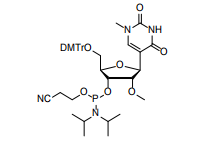

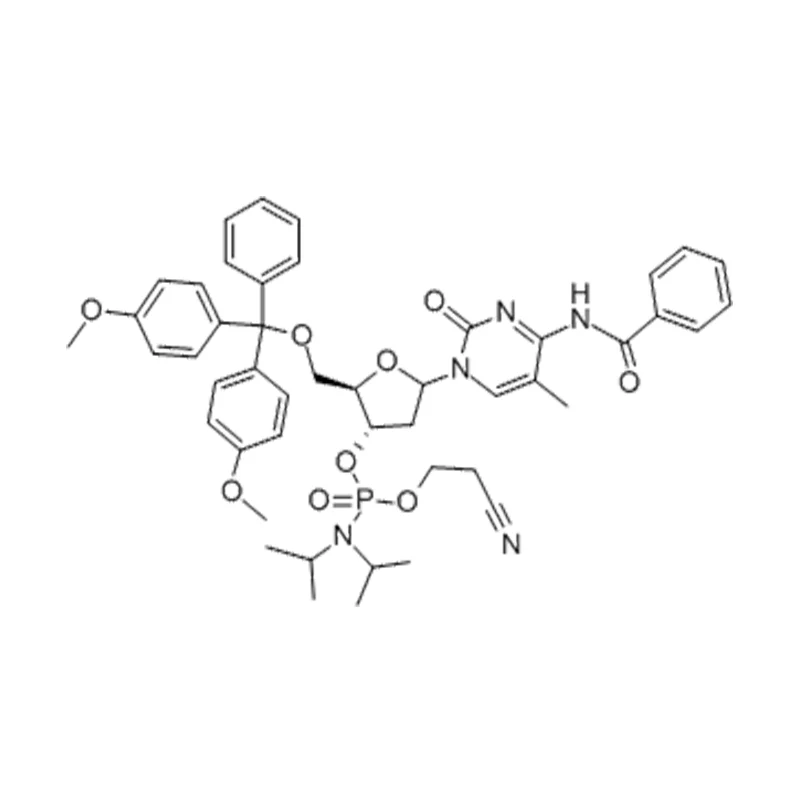
5'-O-(4,4'-DiMethoxytrityl)-N4-benzoyl-2'-deoxy-5-Methylcytidine-3'-O-(O-2-cyanoethyl-N,N-diisopropylaMino) phosphoramidite is the standard monomer for introducing 5‑methyl‑2′‑deoxycytidine residues into synthetic DNA and antisense oligonucleotides. The N4‑benzoyl group protects the exocyclic amine of the cytosine base, preventing branching reactions during solid‑phase synthesis. The 5‑methyl group on the cytosine ring increases the thermal stability of duplexes formed with complementary DNA or RNA (ΔTm ≈ +0.5–1.0°C per modification) and, importantly, reduces the immunostimulatory potential of CpG motifs when used in antisense or CpG‑based vaccines. 5'-O-(4,4'-DiMethoxytrityl)-N4-benzoyl-2'-deoxy-5-Methylcytidine-3'-O-(O-2-cyanoethyl-N,N-diisopropylaMino) phosphoramidite is fully compatible with standard DNA synthesis cycles (coupling time 2–3 minutes, activator such as tetrazole or DCI) and standard deprotection conditions (concentrated NH₃, 55°C, 8–16 h). 5'-O-(4,4'-DiMethoxytrityl)-N4-benzoyl-2'-deoxy-5-Methylcytidine-3'-O-(O-2-cyanoethyl-N,N-diisopropylaMino) phosphoramidite is also a key intermediate in the synthesis of locked nucleic acid (LNA)‑containing oligonucleotides when combined with other modified monomers. This phosphoramidite is frequently used in the manufacture of FDA‑approved antisense drugs and in research applications exploring epigenetic regulation and DNA methylation analysis.
|
Parameter |
Specification |
|
Product Name |
5'-O-(4,4'-DiMethoxytrityl)-N4-benzoyl-2'-deoxy-5-Methylcytidine-3'-O-(O-2-cyanoethyl-N,N-diisopropylaMino) phosphoramidite |
|
CAS Number |
105931-57-5 |
|
Molecular Formula |
C₄₇H₅₄N₅O₈P |
|
Molecular Weight |
847.94 g/mol |
|
Purity (HPLC) |
≥98% (typical supplier specification) |
|
Physical Form |
Solid |
|
Appearance |
White to pale yellow |
|
Storage Temperature |
–20°C (under inert atmosphere) |
|
Water Solubility |
DMSO:250 mg/mL(294.84 mM ) |
|
Stability |
Moisture-sensitive; stable at –20°C |
|
Coupling Efficiency |
≥99% (standard DNA cycle) |
|
Deprotection |
Concentrated NH₃, 55°C, 8 h (removes Bz and CE) |
Each batch undergoes:
● Gas chromatography (GC) – purity ≥97.0%
● Non‑aqueous titration – purity ≥97.0%
● Refractive index – confirmatory analysis
● ¹H NMR – structural verification
● Appearance – colorless to light yellow to light orange clear liquid
A comprehensive COA, MSDS (with full GHS information), and certificate of origin accompany every shipment.
Store 5'-O-(4,4'-DiMethoxytrityl)-N4-benzoyl-2'-deoxy-5-Methylcytidine-3'-O-(O-2-cyanoethyl-N,N-diisopropylaMino) phosphoramidite in a tightly sealed container under inert atmosphere (nitrogen or argon) at –20°C for long‑term storage. Short‑term storage (up to 3 months) at 2–8°C under desiccation may be acceptable but is not recommended for extended periods. Keep the container dry, protected from light, and away from strong oxidizing agents and acids. The compound is highly moisture‑sensitive; open only under anhydrous conditions (glovebox or with argon purging). After opening, return unused material to –20°C immediately under argon.
Shelf life: 2–3 years when stored at –20°C in a sealed, inert‑purged container with desiccant.
Handling precautions: Use in a fume hood. Wear nitrile gloves, safety goggles, and a lab coat. Avoid generating dust. Wash hands after handling. Refer to SDS for complete safety information.
The 5‑methyl group on the cytosine base increases the melting temperature (Tm) of DNA/DNA and DNA/RNA duplexes by approximately 0.5–1.0°C per modification. This thermal stabilization is particularly valuable in antisense oligonucleotides, where higher binding affinity translates to improved potency and reduced required dose. The methyl group also confers increased resistance to certain nucleases.
Unmethylated CpG dinucleotides are recognized by Toll‑like receptor 9 (TLR9) in human immune cells, leading to unwanted immunostimulatory effects. Incorporating 5‑methylcytosine into CpG motifs (converting CpG to 5‑meCpG) ablates TLR9 recognition, reducing off‑target cytokine release in antisense and siRNA applications. 5'-O-(4,4'-DiMethoxytrityl)-N4-benzoyl-2'-deoxy-5-Methylcytidine-3'-O-(O-2-cyanoethyl-N,N-diisopropylaMino) phosphoramidite enables this critical immunomodulation.
5'-O-(4,4'-DiMethoxytrityl)-N4-benzoyl-2'-deoxy-5-Methylcytidine-3'-O-(O-2-cyanoethyl-N,N-diisopropylaMino) phosphoramidite uses the same protecting group scheme as standard 2′‑deoxycytidine phosphoramidite (DMT at 5′, Bz at N4, CE at 3′), with the only difference being the 5‑methyl substituent. Therefore, no changes to synthesis cycles, activator solutions, or deprotection conditions are required — it works seamlessly on all standard DNA synthesizers.
In epigenetic research, oligonucleotides with defined 5‑methylcytosine patterns are used as substrates for methyltransferases, as standards for bisulfite sequencing, and as probes for methyl‑binding proteins. 5'-O-(4,4'-DiMethoxytrityl)-N4-benzoyl-2'-deoxy-5-Methylcytidine-3'-O-(O-2-cyanoethyl-N,N-diisopropylaMino) phosphoramidite allows researchers to synthesize custom‑methylated DNA sequences without enzymatic methylation, which often yields incomplete or heterogeneous patterns.
Several FDA‑approved antisense drugs (e.g., nusinersen, inotersen) incorporate 5‑methylcytosine residues to enhance stability and reduce immunogenicity. 5'-O-(4,4'-DiMethoxytrityl)-N4-benzoyl-2'-deoxy-5-Methylcytidine-3'-O-(O-2-cyanoethyl-N,N-diisopropylaMino) phosphoramidite is the monomer of choice for manufacturing such therapeutics at commercial scale.
Looking for a trusted supplier of 5'-O-(4,4'-DiMethoxytrityl)-N4-benzoyl-2'-deoxy-5-Methylcytidine-3'-O-(O-2-cyanoethyl-N,N-diisopropylaMino) phosphoramidite? Cosperpharm is ready to provide high‑quality product, comprehensive documentation, and responsive technical support.
Address
No. 2 Yangguang 3rd Road, Duodao Chemical Cycle Industrial Park, Jingmen City, Hubei Province, China
Tel

![1-[2,3-Bis[(9Z,12Z)-octadeca-9,12-dien-1-yloxy]propyl]pyrrolidine](https://www.cosperpharma.com/upload/8820/1-2-3-bis-9z-12z-octadeca-9-12-dien-1-yloxy-propyl-pyrrolidine-349384.webp "1-[2,3-Bis[(9Z,12Z)-octadeca-9,12-dien-1-yloxy]propyl]pyrrolidine")
![1,2,4-Triazolo[4,3-a]pyridin-3(2H)-one](https://www.cosperpharma.com/upload/8820/1-2-4-triazolo-4-3-a-pyridin-3-2h-one-440735.webp "1,2,4-Triazolo[4,3-a]pyridin-3(2H)-one")