
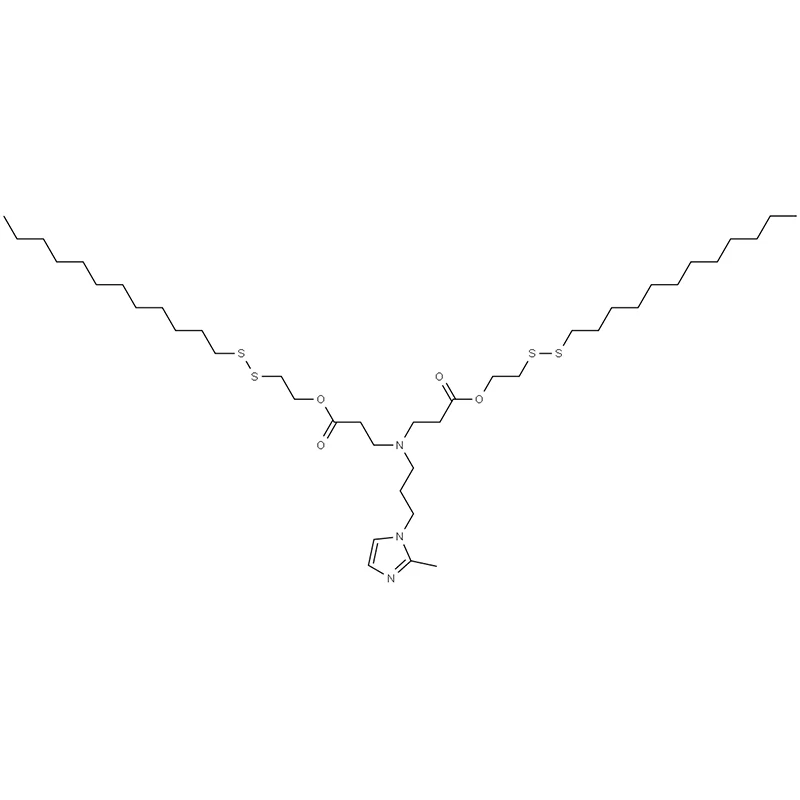
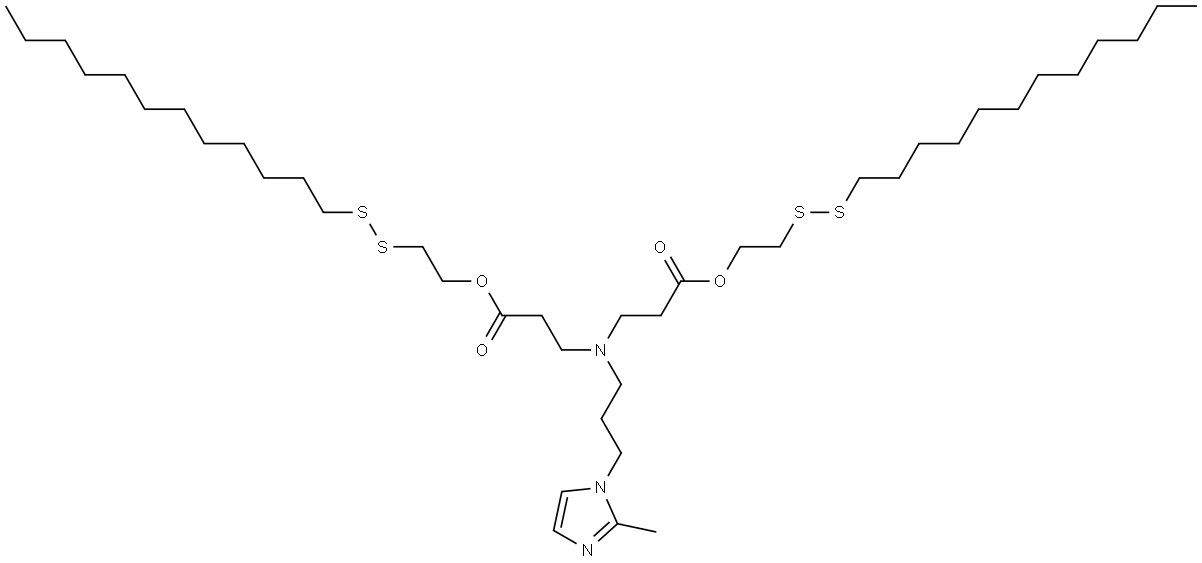
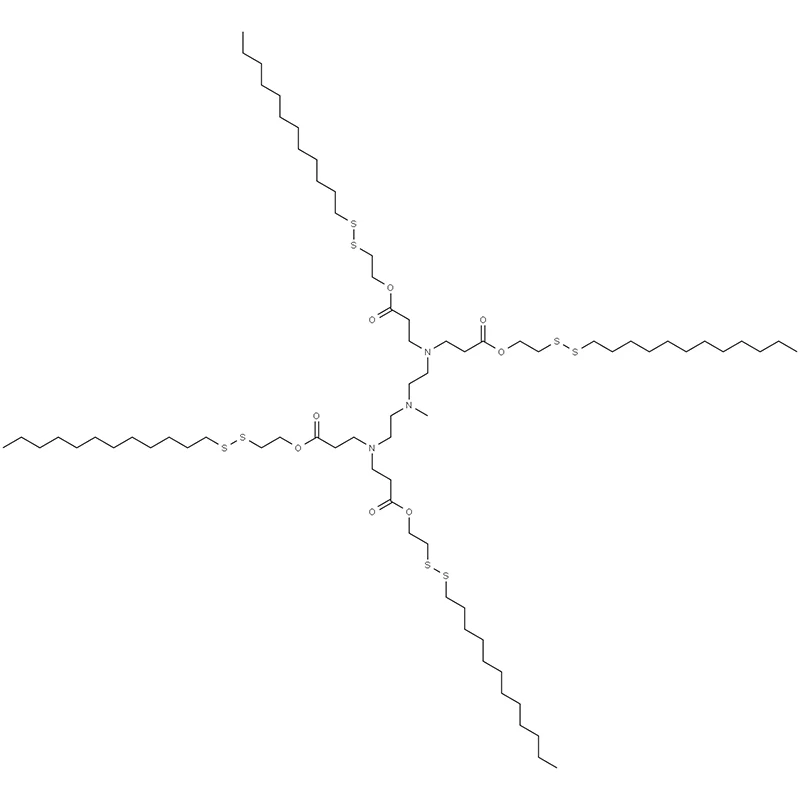
9322-O16B (CAS 2909427-23-0) is an ionizable cationic lipid specifically designed for the generation of lipid nanoparticles (LNPs). The molecule features a complex architecture incorporating multiple disulfide linkages, amide functionalities, and an imidazole‑containing headgroup that collectively enable pH‑dependent charge modulation. This unique structural design allows 9322-O16B to remain charge‑neutral at physiological pH (reducing systemic toxicity), while becoming protonated in the acidic endosomal environment — a property critical for endosomal escape and efficient cytosolic delivery of nucleic acid cargo. The presence of disulfide bonds within the lipid tails also offers potential for redox‑responsive cargo release in the reducing environment of the cytosol.
|
Parameter |
Specification |
|
Product Name |
9322-O16B |
|
CAS Number |
2909427-23-0 |
|
Molecular Formula |
C41H77N3O4S4 |
|
Molecular Weight |
804.33 g/mol |
|
Purity |
≥95%; ≥98% |
|
Appearance |
Colorless to light yellow liquid |
|
pKa |
7.793±0.31(Predicted) |
|
Solubility |
Chloroform: Soluble; Ethanol: Soluble |
|
Boiling Point |
824.048±65.00℃ |
|
Density |
1.070±0.14 g/cm3 |
Q1: What is 9322-O16B?
A: 9322-O16B is an ionizable cationic lipid used for the generation of lipid nanoparticles. It has been demonstrated to deliver mRNA encoding chimeric antigen receptors for the production of anti‑CD19 CAR macrophages with anticancer activity.
Q2: What purity does Cosperpharm supply for 9322-O16B?
A: Cosperpharm supplies 9322-O16B at ≥95% purity as verified by HPLC, with ≥98% purity available upon request. Batch‑specific Certificates of Analysis are available.
Store 9322-O16B at –80°C for long‑term stability. The powder form is stable for up to 3 years at –20°C and up to 2 years at 4°C; however, the manufacturer recommends –80°C storage for optimal preservation. For prepared stock solutions, store at –80°C for up to 6 months or at –20°C for up to 1 month. 9322-O16B is shipped on dry ice; upon receipt, transfer immediately to –80°C storage unless immediate use is planned. Protect the compound from light and moisture. Allow the sealed container to equilibrate to ambient temperature before opening to minimize moisture condensation.
Handling precautions: Use appropriate personal protective equipment (lab coat, safety goggles, chemical‑resistant gloves) when handling 9322-O16B. Work in a well‑ventilated area or fume hood. Avoid skin and eye contact. In case of contact, rinse immediately with plenty of water and seek medical advice if irritation persists.
1. CAR Macrophage Production for Cancer Immunotherapy
9322-O16B is used to formulate LNPs encapsulating mRNA encoding chimeric antigen receptors (CARs). These LNPs have been successfully employed to generate anti‑CD19 CAR macrophages with documented anticancer activity, representing a novel cellular immunotherapy platform.
2. LNP Formulation for mRNA Vaccine Development
As an ionizable cationic lipid, 9322-O16B serves as a key component in LNP formulations for mRNA vaccine development, enabling efficient encapsulation and endosomal escape of antigen‑encoding mRNA.
3. Gene Editing Delivery (CRISPR‑Cas9)
The ionizable properties of 9322-O16B make it suitable for formulating LNPs that deliver CRISPR‑Cas9 components (mRNA and guide RNA) for gene editing applications in research settings.
4. siRNA and RNAi Therapeutic Development
9322-O16B‑based LNPs can encapsulate siRNA for gene silencing applications, with the disulfide linkages offering potential for redox‑responsive release in the cytosolic compartment.
5. LNP Process Development and Scale‑Up
Process development scientists use 9322-O16B as a model ionizable lipid to optimize LNP manufacturing parameters, including lipid mixing ratios, microfluidic formulation conditions, and encapsulation efficiency measurement.
6. Lipid Library Screening for Drug Delivery
9322-O16B is included in ionizable lipid screening panels to identify optimal LNP compositions for specific therapeutic applications, leveraging its well‑characterized ionizable behavior and disulfide‑mediated redox responsiveness.
7. Ex Vivo Cell Engineering
9322-O16B‑based LNPs can be used to deliver mRNA to primary immune cells ex vivo for cell engineering applications, including the production of CAR‑macrophages for adoptive cell transfer therapies.
8. Preclinical Toxicology and Biodistribution Studies
Research organizations developing LNP‑based therapeutics use 9322-O16B in preclinical studies to evaluate formulation safety, tissue distribution, and efficacy prior to IND‑enabling studies.
Whether you are developing next‑generation CAR‑macrophage therapies or optimizing LNP formulations for nucleic acid delivery, Cosperpharm delivers 9322-O16B with the purity, documentation, and technical support your research demands. Contact us today for pricing, batch availability, and formulation guidance.
Address
No. 2 Yangguang 3rd Road, Duodao Chemical Cycle Industrial Park, Jingmen City, Hubei Province, China
Tel

![1-[2,3-Bis[(9Z,12Z)-octadeca-9,12-dien-1-yloxy]propyl]pyrrolidine](https://www.cosperpharma.com/upload/8820/1-2-3-bis-9z-12z-octadeca-9-12-dien-1-yloxy-propyl-pyrrolidine-349384.webp "1-[2,3-Bis[(9Z,12Z)-octadeca-9,12-dien-1-yloxy]propyl]pyrrolidine")
![1,2,4-Triazolo[4,3-a]pyridin-3(2H)-one](https://www.cosperpharma.com/upload/8820/1-2-4-triazolo-4-3-a-pyridin-3-2h-one-440735.webp "1,2,4-Triazolo[4,3-a]pyridin-3(2H)-one")