
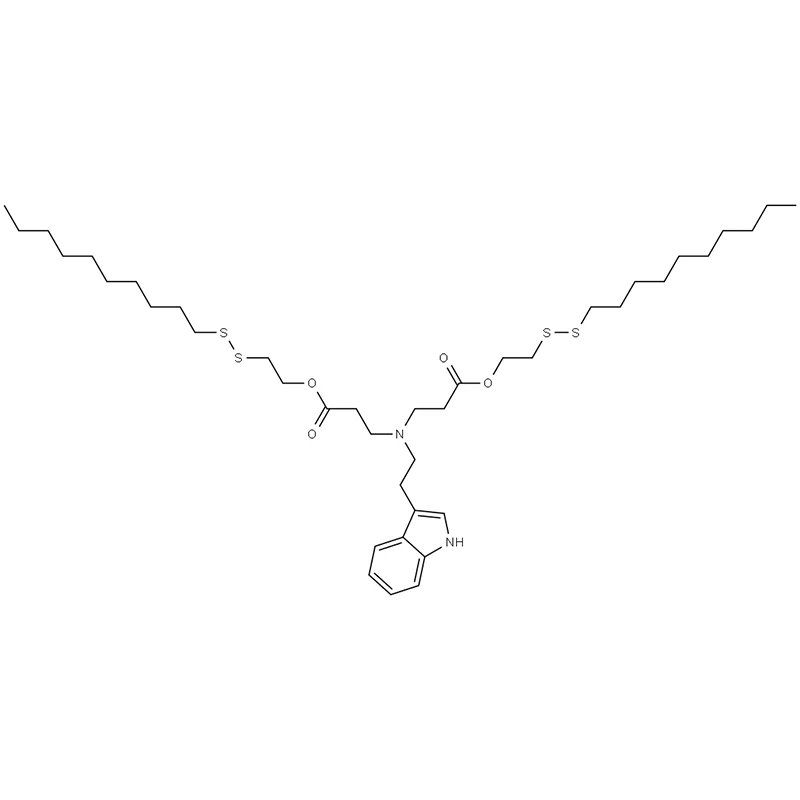
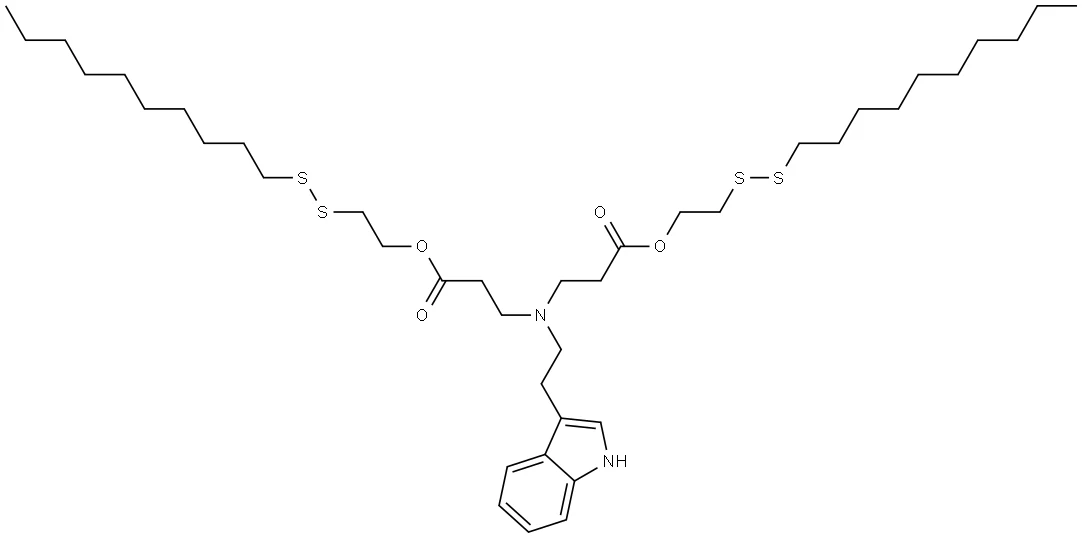
Bis(2-(decyldisulfaneyl)ethyl) 3,3'-((2-(1H-indol-3-yl)ethyl)azanediyl)dipropionate is a stimulus-responsive lipid that was designed to address the persistent challenge of off-target RNA release from lipid nanoparticles. By inserting a disulfide linker between the hydrophilic headgroup and each hydrophobic decyl tail, the lipid retains the ability to encapsulate nucleic acids and promote cellular uptake, yet disintegrates upon encountering the 1–10 mM glutathione concentrations found in the cytosol. LNPs formulated with Bis(2-(decyldisulfaneyl)ethyl) 3,3'-((2-(1H-indol-3-yl)ethyl)azanediyl)dipropionate therefore exhibit cytoplasmic-triggered unloading, improving the efficiency of mRNA translation while reducing carrier-associated cytotoxicity. Preclinical studies have explored Bis(2-(decyldisulfaneyl)ethyl) 3,3'-((2-(1H-indol-3-yl)ethyl)azanediyl)dipropionate for the delivery of tumor-suppressor mRNA, siRNA against oncogenic drivers, and gene-editing constructs, and the lipid is increasingly recognized as a benchmark reducible carrier in the nucleic acid delivery field.
|
Parameter |
Specification |
|
Product Name |
Bis(2-(decyldisulfaneyl)ethyl) 3,3'-((2-(1H-indol-3-yl)ethyl)azanediyl)dipropionate |
|
CAS Number |
2739805-64-0 |
|
Molecular Formula |
C40H68N2O4S4 |
|
Molecular Weight |
769.24 |
|
Appearance |
Colorless to pale yellow |
|
Purity (HPLC/ELSD) |
≥95% |
|
Boiling Point |
812.9±65.0 °C(predicted) |
|
Density |
1.098±0.06 g/cm3(predicted) |
|
kPa |
17.27±0.30(predicted) |
The synthesis of Bis(2-(decyldisulfaneyl)ethyl) 3,3'-((2-(1H-indol-3-yl)ethyl)azanediyl)dipropionate is achieved by preparing 2-(decyldisulfaneyl)ethanol, activating it as an acrylate or 3-halopropionate ester, and then performing a double aza-Michael addition or alkylation with 2-(1H-indol-3-yl)ethan-1-amine. The disulfide bonds are introduced early and preserved under mild, non-reducing conditions throughout the final coupling and purification steps. A detailed process description and impurity profile can be disclosed as part of a DMF or quality agreement.
Q1: What makes this lipid bioreducible?
A: Bis(2-(decyldisulfaneyl)ethyl) 3,3'-((2-(1H-indol-3-yl)ethyl)azanediyl)dipropionate contains two disulfide bonds that are stable in the blood but cleaved by glutathione in the cytoplasm, causing the lipid to break apart and release its nucleic acid cargo.
Q2: Can this lipid be used for non-liver targets?
A: While LNPs naturally accumulate in the liver, Bis(2-(decyldisulfaneyl)ethyl) 3,3'-((2-(1H-indol-3-yl)ethyl)azanediyl)dipropionate can be combined with targeting ligands or engineered particle sizes to shift tropism toward tumor, lung, or spleen, depending on the application.
Bis(2-(decyldisulfaneyl)ethyl) 3,3'-((2-(1H-indol-3-yl)ethyl)azanediyl)dipropionate must be stored at –20 °C in a sealed, argon-flushed container protected from light. Oxidizing agents, free thiols, and prolonged exposure to ambient atmosphere must be strictly avoided to preserve the disulfide bonds. For repeated use, prepare aliquots in a glove box or under a nitrogen stream and re-seal the original container immediately. Shelf life is 2 years when stored as directed, and ongoing stability monitoring confirms that disulfide content remains within specification over this period.
Partner with Cosperpharm to make glutathione-responsive delivery a reality in your next nucleic acid program — ask for a sample of Bis(2-(decyldisulfaneyl)ethyl) 3,3'-((2-(1H-indol-3-yl)ethyl)azanediyl)dipropionate, request a quote for multi-gram supply, or schedule a technical call to discuss how our quality-by-design approach can de-risk your LNP development timeline.
Address
No. 2 Yangguang 3rd Road, Duodao Chemical Cycle Industrial Park, Jingmen City, Hubei Province, China
Tel

![1-[2,3-Bis[(9Z,12Z)-octadeca-9,12-dien-1-yloxy]propyl]pyrrolidine](https://www.cosperpharma.com/upload/8820/1-2-3-bis-9z-12z-octadeca-9-12-dien-1-yloxy-propyl-pyrrolidine-349384.webp "1-[2,3-Bis[(9Z,12Z)-octadeca-9,12-dien-1-yloxy]propyl]pyrrolidine")
![1,2,4-Triazolo[4,3-a]pyridin-3(2H)-one](https://www.cosperpharma.com/upload/8820/1-2-4-triazolo-4-3-a-pyridin-3-2h-one-440735.webp "1,2,4-Triazolo[4,3-a]pyridin-3(2H)-one")