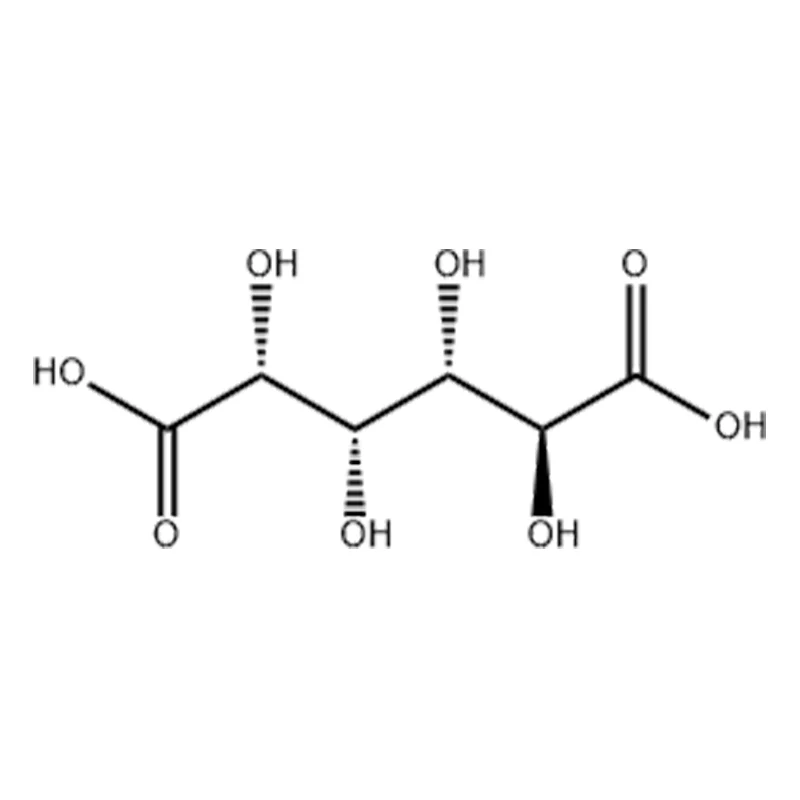
In 2004, D-Glucaric Acid was identified by the U.S. Department of Energy (DOE) as one of the 12 "most valuable bio‑refinery products," highlighting its enormous potential as a renewable building block for the synthesis of highly efficient and environmentally friendly biomass‑based energy materials. D‑Glucaric Acid has since gained significant commercial traction across multiple industries, ranging from cosmetics and pharmaceuticals to bioplastics and industrial feedstocks. D‑Glucaric Acid is also recognized as a β‑glucuronidase inhibitor, a property that has drawn research interest in areas such as drug metabolism and cancer prevention. As the international community continues to promote green chemistry and bio‑based economic development, demand for high‑purity D‑Glucaric Acid has grown substantially.
|
Parameter |
Specification |
|
CAS |
87-73-0 |
|
Molecular Formula |
C₆H₁₀O₈ |
|
Molecular Weight |
210.14 g/mol |
|
Purity (HPLC) |
≥98% (≥99% for high-purity grade) |
|
Any single impurity |
≤0.50% |
|
Total impurity |
≤1.0% |
|
Appearance |
White to off-white crystalline powder |
|
Melting Point |
124–126 °C (125–126 °C) |
|
Specific Rotation (Optical Activity) |
+7° → +21° |
|
Specific Rotation (Reported) |
D19 +6.86° → +20.60° (H₂O) |
|
Boiling Point |
269.65 °C (rough estimate) |
|
Density |
1.5274 g/cm³ (rough estimate) |
|
Refractive Index |
1.5800 (estimate) |
|
pKa (Acidity Coefficient) |
2.99±0.35 (Predicted) |
|
Solubility |
Easily soluble in water and ethanol |
|
Cosmetic Ingredient Function |
Hair Conditioning |
|
Storage Conditions |
Sealed in dry, 2–8 °C, protect from light and moisture |
|
WGK Germany |
3 |
D-Glucaric Acid is recognized under INCI (International Nomenclature of Cosmetic Ingredients) as a functional cosmetic ingredient with the primary function of hair conditioning. It enhances the appearance and feel of hair, leaving hair easy to comb, supple, soft, shiny, and imparting volume, lightness, gloss, and texture. The compound helps the hair shaft retain moisture, smooths the cuticle surface, and reduces static. It is widely incorporated into shampoos, conditioners, hair serums, and leave-on products.
Beyond hair care, D-Glucaric Acid is also used in skin care formulations for its antioxidant and cleansing properties, as well as to enhance product stability and skin conditioning performance.
In 2004, D-Glucaric Acid was identified by the U.S. Department of Energy (DOE) as one of the 12 "most valuable bio-refinery products." It serves as a renewable building block for the synthesis of multiple high-performance and environmentally friendly biomass-based materials, including:
● Biodegradable polymers and plasticizers
● Bio-based platform chemicals for green chemistry initiatives
● Feedstock for the production of adipic acid, a precursor to nylon-6,6
● Chelating agents for industrial applications
D-Glucaric acid has notable potential health benefits, including:
● β-Glucuronidase inhibitor – It acts as a competitive inhibitor of β-glucuronidase, an enzyme that can deconjugate glucuronidated toxins and promote their reabsorption. Inhibition of β-glucuronidase has been studied in the context of cancer prevention (colon, breast, and prostate).
● Heavy metal chelation – Its four hydroxyl and two carboxyl groups allow D-glucaric acid to form stable complexes with heavy metals (e.g., lead, cadmium, mercury), supporting their excretion from the body.
● Nutraceutical ingredient – It is incorporated into dietary supplements for detoxification, metabolic health, and cholesterol management.
● Pharmaceutical intermediate – It serves as a starting material for synthesizing various active pharmaceutical ingredients (APIs) and drug delivery agents.
D-Glucaric acid is widely used in biochemical research as a model compound for studying:
● Oxidative metabolism and the β-glucuronidase/glucuronidation pathway
● Heavy metal chelation mechanisms and metal homeostasis
● Plant physiology and carbohydrate metabolism
In cosmetic formulations, D-Glucaric Acid enhances product stability and skin conditioning performance, making it a versatile multifunctional ingredient for modern personal care products.
The strong chelating ability of D-Glucaric acid makes it useful in industrial applications as a biodegradable scale inhibitor and as an environmentally friendly alternative to phosphates in detergents and metal cleaning formulations.
A: Yes, D-Glucaric Acid is widely recognized as safe for cosmetic use. It has been reviewed by the Cosmetic Ingredient Review (CIR) panel and is approved for use in rinse-off and leave-on products in concentrations up to a few percent. It is non-toxic, non-sensitizing, and non-irritating at typical use levels. However, as with any raw material, we recommend conducting a patch test before final formulation. The compound has a WGK Germany classification of 3, indicating moderate water hazard potential, but this is more relevant for environmental impact than for human safety at typical usage concentrations.
A: D-Glucaric acid and glucuronic acid are both oxidized derivatives of glucose but differ in structure and function:
● D-Glucaric acid (Saccharic acid, C₆H₁₀O₈) is a dicarboxylic acid with two terminal carboxyl groups. It is formed by the oxidation of both the aldehyde and primary alcohol groups of glucose and serves mainly as a chelating agent, β-glucuronidase inhibitor, and building block for biodegradable polymers.
● Glucuronic acid (C₆H₁₀O₇) is a uronic acid with a single carboxyl group at the C6 position. It is a key component of glycosaminoglycans (e.g., hyaluronic acid) and plays a crucial role in phase II detoxification metabolism (glucuronidation).
● Glucuronolactone is the lactone form of glucuronic acid. It is widely used in energy drinks for its reported "detoxifying" and "anti-fatigue" properties.
In short: glucaric acid is a dicarboxylic acid with strong metal chelation, while glucuronic acid is involved in the body's conjugation system for eliminating xenobiotics.
Ready to purchase D-Glucaric Acid (CAS 87-73-0)? Contact Cosperpharm today for a sample or quote. Whether you need cosmetic-grade material for hair conditioning applications, high-purity reference standards for nutraceutical and pharmaceutical R&D, or industrial-grade product for bio-refinery and chelation applications, we look forward to becoming your long-term China D-Glucaric Acid supplier.
Address
No. 2 Yangguang 3rd Road, Duodao Chemical Cycle Industrial Park, Jingmen City, Hubei Province, China
Tel

![1-[2,3-Bis[(9Z,12Z)-octadeca-9,12-dien-1-yloxy]propyl]pyrrolidine](https://www.cosperpharma.com/upload/8820/1-2-3-bis-9z-12z-octadeca-9-12-dien-1-yloxy-propyl-pyrrolidine-349384.webp "1-[2,3-Bis[(9Z,12Z)-octadeca-9,12-dien-1-yloxy]propyl]pyrrolidine")
![1,2,4-Triazolo[4,3-a]pyridin-3(2H)-one](https://www.cosperpharma.com/upload/8820/1-2-4-triazolo-4-3-a-pyridin-3-2h-one-440735.webp "1,2,4-Triazolo[4,3-a]pyridin-3(2H)-one")