
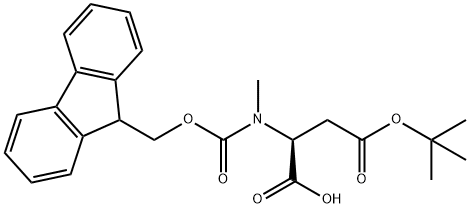
Fmoc-N-Me-Asp(OtBu)-OH is the reagent of choice for incorporating an N‑methylated aspartic acid residue into peptide chains via Fmoc SPPS. Fmoc-N-Me-Asp(OtBu)-OH serves as a building block for the introduction of N‑α‑methyl‑aspartic acid amino‑acid residues by Fmoc solid‑phase peptide synthesis. N‑methyl amino acids, including Fmoc-N-Me-Asp(OtBu)-OH, have been shown to improve the proteolytic stability of peptides, making them valuable tools in the development of peptide‑based therapeutics with extended plasma half‑lives. The tert‑butyl ester protecting group on the β‑carboxylic acid of Fmoc-N-Me-Asp(OtBu)-OH is selectively cleaved under acidic conditions (e.g., TFA) during final global deprotection, leaving the peptide backbone intact.
Product Parameters
|
Parameter |
Specification |
|
Product Name |
Fmoc-N-Me-Asp(OtBu)-OH |
|
CAS Number |
152548-66-8 |
|
Molecular Formula |
C₂₄H₂₇NO₆ |
|
Molecular Weight |
425.47 g/mol |
|
Appearance |
White to off white powder |
|
Melting Point |
135–140 °C |
|
Boiling Point |
598.7±50.0℃ |
|
Density |
1.237±0.06g/cm3 |
|
Solubility |
Clearly soluble in DMF (1 mmol in 2 mL); Soluble in water or 1% acetic acid |
|
Storage Temperature |
2–8 °C |
Product Advantages
1. N‑Methylation for Enhanced Proteolytic Stability
The N‑methyl group on Fmoc-N-Me-Asp(OtBu)-OH creates a secondary amide bond when incorporated into a peptide sequence, eliminating the hydrogen bond donor at that residue. This structural modification confers significant resistance to proteolytic degradation by enzymes such as trypsin, chymotrypsin, and other proteases — an essential property for developing peptide therapeutics with extended circulating half‑lives.
2. Steric Modulation of Peptide Conformation
N‑methylation restricts backbone flexibility, favoring specific folded conformations that can improve target binding affinity and selectivity. Fmoc-N-Me-Asp(OtBu)-OH is widely used in structure–activity relationship (SAR) studies to probe the conformational requirements for receptor recognition and to stabilize bioactive peptide conformations.
3. Dual Protection for Orthogonal Deprotection
Fmoc-N-Me-Asp(OtBu)-OH features a base‑labile Fmoc group (removed with piperidine) and an acid‑labile tert‑butyl ester protecting group on the β‑carboxylic acid (removed with TFA during final global deprotection). The OtBu group is selectively cleaved by TFA (50–95%) at room temperature within 1–2 hours, while benzyl, methyl, and allyl esters remain unaffected — enabling differential side‑chain functionalization strategies.
4. Broad Utility in Peptide Drug Discovery
Fmoc-N-Me-Asp(OtBu)-OH is extensively used in the synthesis of bioactive peptides and peptidomimetics across multiple therapeutic areas — including antimicrobial peptides, protease‑resistant GLP‑1 analogs, integrin‑binding peptides for cancer targeting, and cyclic peptide scaffolds for intracellular protein–protein interaction inhibitors.
5. Compatibility with Automated SPPS
Fmoc-N-Me-Asp(OtBu)-OH is fully compatible with standard Fmoc SPPS protocols and automated peptide synthesizers. While N‑methyl amino acids generally couple more slowly than their unmodified counterparts, optimized conditions using HATU/DIEA or PyBOP/DIEA with extended coupling times (typically 2–4 hours) achieve high coupling efficiencies.
Synthetic Route
Fmoc-N-Me-Asp(OtBu)-OH is synthesized from L‑aspartic acid through a multi‑step protection and N‑methylation sequence. The β‑carboxylic acid of L‑aspartic acid is first protected as the tert‑butyl ester under acidic conditions. The α‑amino group is then protected with the Fmoc group using Fmoc‑OSu or Fmoc‑Cl. The N‑methylation is introduced by reductive amination or alkylation under controlled conditions to retain stereochemical integrity. The final product is purified by recrystallization or flash chromatography and characterized by HPLC, TLC, optical rotation, and NMR.
FAQ
Q1: Why use N‑methylated amino acids in peptide synthesis?
A: N‑methylation prevents the peptide backbone from forming hydrogen bonds at the modified amide, increasing proteolytic stability and influencing conformational preferences. This makes N‑methylated peptides more resistant to enzymatic degradation — a critical advantage for developing oral or long‑acting peptide therapeutics.
Q2: Does N‑methylation affect coupling efficiency?
A: Yes. N‑methylated amino acids typically couple more slowly than their non‑methylated counterparts due to increased steric hindrance at the α‑amino group. Extended coupling times (2–4 hours), elevated temperatures, and more powerful activating reagents such as HATU or PyBOP are often recommended to achieve high coupling yields.
Contact Us
Looking for a dependable source of Fmoc-N-Me-Asp(OtBu)-OH to power your peptide drug discovery efforts? Cosperpharm is your partner. Contact us today for pricing, COA requests, or to discuss your custom synthesis requirements — our team is ready to support your project with quality products and responsive service.
Address
No. 2 Yangguang 3rd Road, Duodao Chemical Cycle Industrial Park, Jingmen City, Hubei Province, China
Tel

![1-[2,3-Bis[(9Z,12Z)-octadeca-9,12-dien-1-yloxy]propyl]pyrrolidine](https://www.cosperpharma.com/upload/8820/1-2-3-bis-9z-12z-octadeca-9-12-dien-1-yloxy-propyl-pyrrolidine-349384.webp "1-[2,3-Bis[(9Z,12Z)-octadeca-9,12-dien-1-yloxy]propyl]pyrrolidine")
![1,2,4-Triazolo[4,3-a]pyridin-3(2H)-one](https://www.cosperpharma.com/upload/8820/1-2-4-triazolo-4-3-a-pyridin-3-2h-one-440735.webp "1,2,4-Triazolo[4,3-a]pyridin-3(2H)-one")