
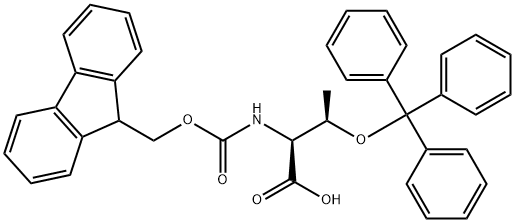
Fmoc-Thr(Trt)-OH is a widely used building block in Fmoc solid‑phase peptide synthesis, providing a reliable and versatile method for incorporating L‑threonine residues into synthetic peptides. Fmoc-Thr(Trt)-OH is particularly valued for the synthesis of phosphothreonine‑containing peptides and peptides requiring selective modification at the threonine side‑chain, as the Trt group can be removed under mild conditions while the peptide remains attached to the resin. The orthogonal protecting group strategy employed in Fmoc-Thr(Trt)-OH — base‑labile Fmoc for α‑amino protection and acid‑labile Trt for side‑chain protection — enables precise control over the sequential deprotection and coupling steps in SPPS. When used as a standard building block, Fmoc-Thr(Trt)-OH has been shown to produce purer final peptide products compared to conventional tBu‑protected threonine derivatives, making it the preferred choice for demanding synthetic applications requiring high purity.
Product Parameters
|
Parameter |
Specification |
|
Product Name |
Fmoc-Thr(Trt)-OH |
|
CAS Number |
133180-01-5 |
|
Molecular Formula |
C₃₈H₃₃NO₅ |
|
Molecular Weight |
583.67g/mol |
|
Melting Point |
70 – 85 °C |
|
Boiling Point |
753.0±60.0℃ |
|
Density |
1.241±0.06g/cm3 |
|
pKa |
3.31±0.10 |
|
Storage Temperature |
Store at -15℃ to -25℃ |
Why Cosperpharm?
When your peptide synthesis campaign demands high‑purity Fmoc‑protected amino acids with reliable lot‑to‑lot consistency, Cosperpharm delivers Fmoc-Thr(Trt)-OH with the analytical documentation and supply flexibility that pharmaceutical and biotech customers require.
Purity that ensures coupling efficiency. Every batch of Fmoc-Thr(Trt)-OH is subjected to comprehensive analytical release testing — including HPLC purity (≥98.0%), TLC verification, acidimetric assay, water content determination by Karl Fischer (≤1.5%), and enantiomeric purity confirmation (≥99.0%) — because your peptide synthesis depends on the quality of each building block.
Documentation for regulatory and R&D applications. Each shipment includes a Certificate of Analysis (COA) with batch‑specific purity data, chromatographic traceability, and identity confirmation. DMF‑ready documentation, stability summaries, and custom quality agreements are available upon request to support your GMP peptide manufacturing or regulatory submissions.
Flexible supply across all scales. Cosperpharm supplies Fmoc-Thr(Trt)-OH across the full range of applications — from 1g–50g for R&D and small‑scale peptide synthesis, to 100g–500g for process validation and pilot production, to kilogram quantities for commercial peptide manufacturing. R&D samples ship within 5–7 business days; bulk orders ship within 2–3 weeks.
Technical support for Fmoc SPPS. Our process chemistry and peptide synthesis team can advise on optimal deprotection conditions (including selective Trt removal protocols), coupling strategies for sterically hindered residues, and analytical methods for purity assessment. We have extensive experience supporting peptide synthesis campaigns across multiple therapeutic areas.
Product Advantages
1. Orthogonal Protecting Group Strategy
Fmoc-Thr(Trt)-OH incorporates a dual orthogonal protection system: the α‑amino group is protected by the base‑labile Fmoc group, while the side‑chain hydroxyl is protected by the acid‑labile trityl (Trt) group. This orthogonality enables precise, sequential deprotection during Fmoc SPPS — Fmoc is removed with piperidine in DMF, while the Trt group remains intact until the final acidic cleavage or selective side‑chain modification is required.
2.Mild and Selective Trt Deprotection
The Trt group in Fmoc-Thr(Trt)-OH can be selectively removed under exceptionally mild acidic conditions — typically 1% TFA in DCM containing 5% TIS — without cleaving the peptide from the resin or affecting the Fmoc protection on subsequent residues. This mildness allows the free hydroxyl group to undergo further selective modifications (e.g., phosphorylation, glycosylation) while the peptide remains attached to the solid support, a capability not possible with standard tBu‑protected threonine.
3. Superior Product Purity
It has been demonstrated that the use of trityl‑protected amino acids, including Fmoc-Thr(Trt)-OH, results in purer final peptide products than when conventional tBu‑protected amino acids are utilized. This improvement in purity is attributed to the enhanced steric bulk and stability of the Trt protecting group, which minimizes side‑reactions during chain assembly.
4. Critical for Phosphopeptide Synthesis
Fmoc-Thr(Trt)-OH is the preferred building block for the synthesis of phosphothreonine‑containing peptides — a class of peptides essential for studying protein phosphorylation, signal transduction pathways, and kinase‑substrate interactions. The mild Trt deprotection conditions enable the selective introduction of phosphate groups at the threonine side‑chain without compromising the integrity of the peptide backbone.
5. Standard Building Block for Fmoc SPPS
As a standard building block manufactured under quality level 200 specifications, Fmoc-Thr(Trt)-OH is fully compatible with automated and manual Fmoc SPPS platforms. It is supplied in powder form with clearly documented solubility in DMF, facilitating straightforward integration into standard coupling protocols.
FAQ
Q1: What is the difference between Fmoc-Thr(Trt)-OH and Fmoc‑Thr(tBu)‑OH?
A: Fmoc-Thr(Trt)-OH uses a trityl (Trt) group to protect the side‑chain hydroxyl, while Fmoc‑Thr(tBu)‑OH uses a tert‑butyl (tBu) group. The Trt group is significantly more sterically hindered and offers two key advantages: (1) it can be removed under milder acidic conditions (1% TFA) than tBu, and (2) it has been shown to produce purer final peptide products. The Trt group is preferred when selective side‑chain modification is required.
Q2: What is the solubility of Fmoc-Thr(Trt)-OH?
A: Fmoc-Thr(Trt)-OH is clearly soluble in DMF (1 mmol in 2 mL DMF). It is recommended to prepare stock solutions in DMF or other appropriate polar aprotic solvents for peptide synthesis applications.
Contact Us
Ready to incorporate Fmoc-Thr(Trt)-OH into your next peptide synthesis project? Whether you need a small quantity for early‑stage research or bulk supply for commercial production, Cosperpharm is here to help. Contact us today for pricing, lead times, or technical support.
Address
No. 2 Yangguang 3rd Road, Duodao Chemical Cycle Industrial Park, Jingmen City, Hubei Province, China
Tel

![1-[2,3-Bis[(9Z,12Z)-octadeca-9,12-dien-1-yloxy]propyl]pyrrolidine](https://www.cosperpharma.com/upload/8820/1-2-3-bis-9z-12z-octadeca-9-12-dien-1-yloxy-propyl-pyrrolidine-349384.webp "1-[2,3-Bis[(9Z,12Z)-octadeca-9,12-dien-1-yloxy]propyl]pyrrolidine")
![1,2,4-Triazolo[4,3-a]pyridin-3(2H)-one](https://www.cosperpharma.com/upload/8820/1-2-4-triazolo-4-3-a-pyridin-3-2h-one-440735.webp "1,2,4-Triazolo[4,3-a]pyridin-3(2H)-one")