
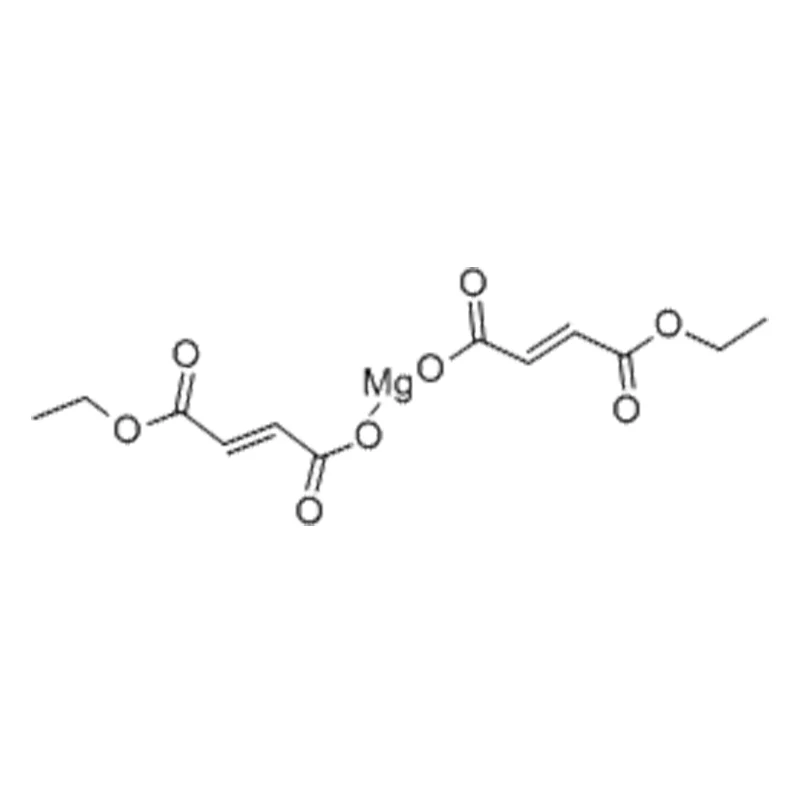
Calcium and magnesium are the two most common physiologically benign counterions for carboxylic acids. FuMaric Acid Monoethyl Ester MagnesiuM Salt offers distinct advantages over its calcium counterpart: lower molecular weight (310.54 vs. 326.31 for the calcium salt), meaning a higher loading of the active monoester per gram. While the calcium salt (CAS 62008‑22‑4) is widely used as a stable, crystalline form of the monoester, FuMaric Acid Monoethyl Ester MagnesiuM Salt is particularly valuable because magnesium is an essential mineral involved in hundreds of enzymatic reactions. Magnesium salts are often preferred in nutritional supplements and certain pharmaceutical formulations where calcium might interfere (e.g., in patients with hypercalcemia or on calcium‑channel blockers). FuMaric Acid Monoethyl Ester MagnesiuM Salt can be used interchangeably with the calcium salt in most synthetic applications, but its different solubility and thermal behavior (lower decomposition temperature, 169 °C vs. 285 °C) may offer processing benefits in specific formulations. For these reasons, FuMaric Acid Monoethyl Ester MagnesiuM Salt is a compelling choice for both process chemistry and nutritional product development.
|
Parameter |
Specification |
|
CAS Number |
83918-60-9 |
|
IUPAC Name |
Magnesium (E)-but-2-enedioate monoethyl ester (2:1) |
|
Synonyms |
Fumaric acid monoethyl ester magnesium salt; Monoethyl fumarate magnesium salt; Magnesium ethyl fumarate |
|
Molecular Formula |
C₁₂H₁₄MgO₈ |
|
Molecular Weight |
310.54 g/mol |
|
Melting Point |
169 °C (dec.) |
|
Storage |
Sealed in dry container, room temperature, away from strong acids and bases |
|
SMILES |
CCOC(=O)\C=C\C(=O)O[Mg]OC(=O)\C=C\C(=O)OCC |
|
Hazard Symbols |
Xi (Irritant) |
|
Risk Codes |
36/37/38 – Irritating to eyes, respiratory system and skin |
|
Safety Statements |
26 – In case of eye contact, rinse with plenty of water and seek medical advice; 36 – Wear suitable protective clothing |
|
WGK Germany |
WGK 1 (slightly hazardous to water) |
|
Storage Class |
11 – Combustible solids |
|
Hazard Categories |
Eye irritation Category 2; Dermal irritation Category 2; Skin sensitizer Category 1; STOT-SE Category 3 (respiratory tract irritation) |
|
Purity |
≥98.0% (HPLC or titration) |
|
Advantage |
What It Means for You |
|
Higher active content |
Lower molecular weight means more monoethyl fumarate per gram — more efficient for large-scale reactions. |
|
Physiologically benign counterion |
Magnesium is an essential nutrient, making this salt suitable for nutritional supplements and certain pharmaceutical formulations. |
|
Crystalline solid |
Easy to weigh, handle, and store — no sticky oils or waxy residues. |
|
Controlled release of monoester |
Upon acidification, the free monoester is generated in situ, ideal for one-pot reactions. |
|
Scalable and economical |
Manufactured from cheap starting materials (fumaric acid, ethanol, magnesium base). |
|
Reduced irritation |
Less irritating than the free monoester acid; dust is the main concern. |
This compound carries multiple hazard classifications:
|
Hazard Category |
Classification |
|
Eye irritation |
Category 2 (causes serious eye irritation) |
|
Skin irritation |
Category 2 (causes skin irritation) |
|
Skin sensitization |
Category 1 (may cause allergic skin reaction) |
|
STOT-SE |
Category 3 (may cause respiratory irritation) |
|
Storage class |
11 – Combustible solid |
● Eyes: Safety goggles (mandatory).
● Skin: Chemical-resistant gloves (nitrile). If you have a history of skin allergies, take extra precautions due to skin sensitizer classification.
● Respiratory: Use in a fume hood. Avoid breathing dust.
● First aid:
1. Eye contact – rinse with water for 15 min (S26).
2. Skin contact – wash with soap and water. If rash or irritation develops, seek medical advice (skin sensitizer).
3. Inhalation – move to fresh air.
● Storage: Keep container tightly sealed in a dry place at room temperature. Store away from ignition sources (combustible solid). Avoid contact with strong mineral acids (releases irritating free monoester).
● Disposal: Collect as chemical waste. WGK 1 indicates low water hazard, but best practice is not to flush down drains.
A: Both are free‑flowing crystalline powders. The magnesium salt has a lower decomposition temperature (169 °C vs. 285 °C) , so avoid heating above 150 °C. It also has a slightly lower molecular weight, giving higher active content per gram. The main difference is the counterion – choose based on your formulation or biological requirements.
A: It is possible but not ideal. The magnesium salt has low solubility in organic solvents. The preferred method is to liberate the free monoester by suspending the salt in ethyl acetate/water and adding dilute HCl (2 eq relative to Mg). Extract the free monoester into the organic layer, dry, and concentrate. Then activate the carboxylic acid with HATU/EDC as usual.
Looking for a magnesium‑based alternative to the standard calcium fumarate salt? Cosperpharm supplies CAS 83918‑60‑9 with verified purity, full safety documentation, and flexible packaging options. Whether you need 5 grams for a formulation pilot or 5 kilograms for production, we deliver consistent quality and responsive support.
Address
No. 2 Yangguang 3rd Road, Duodao Chemical Cycle Industrial Park, Jingmen City, Hubei Province, China
Tel

![1-[2,3-Bis[(9Z,12Z)-octadeca-9,12-dien-1-yloxy]propyl]pyrrolidine](https://www.cosperpharma.com/upload/8820/1-2-3-bis-9z-12z-octadeca-9-12-dien-1-yloxy-propyl-pyrrolidine-349384.webp "1-[2,3-Bis[(9Z,12Z)-octadeca-9,12-dien-1-yloxy]propyl]pyrrolidine")
![1,2,4-Triazolo[4,3-a]pyridin-3(2H)-one](https://www.cosperpharma.com/upload/8820/1-2-4-triazolo-4-3-a-pyridin-3-2h-one-440735.webp "1,2,4-Triazolo[4,3-a]pyridin-3(2H)-one")