
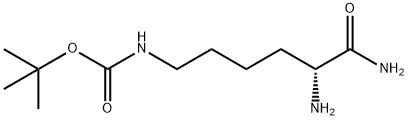
H-D-Lys(Boc)-NH2 is a single-enantiomer, orthogonally protected D-lysine derivative featuring a free α-amino group, a C-terminal carboxamide, and a Boc-protected ε-amino side chain. As a key chiral synthon, H-D-Lys(Boc)-NH2 enables the incorporation of D-lysine residues into peptide backbones via solid-phase or solution-phase coupling. The Boc protecting group in H-D-Lys(Boc)-NH2 permits acid-labile orthogonal deprotection, allowing selective unmasking of the ε-amine when required. The D-configuration of H-D-Lys(Boc)-NH2 is a validated strategy for conferring proteolytic resistance to peptides, as D-amino acid incorporation produces peptides with distinct protease susceptibility profiles. The free-base C-terminal amide form of H-D-Lys(Boc)-NH2 eliminates the need for counter-ion management and avoids unintended carboxylate reactivity during coupling, directly impacting synthetic yield and purity. This makes H-D-Lys(Boc)-NH2 an essential building block for peptide therapeutics, peptidomimetics, and chiral peptide nucleic acid (PNA) research.
Product Parameters
|
Parameter |
Specification |
|
Product Name |
H-D-Lys(Boc)-NH2 |
|
CAS Number |
96138-49-7 |
|
Molecular Formula |
C₁₁H₂₃N₃O₃ |
|
Molecular Weight |
|
|
Density |
1.079 ± 0.06 g/cm³ (predicted) |
|
Boiling Point |
440.3 ± 40.0 °C at 760 mmHg (predicted) |
|
pKa |
12.88±0.46 |
Why Cosperpharm?
When your peptide therapeutic development, chiral peptide synthesis, or drug discovery program requires protected D-amino acid building blocks, Cosperpharm delivers H-D-Lys(Boc)-NH2 with the enantiopurity, documentation, and supply flexibility that pharmaceutical customers demand.
Enantiopurity defines peptide function. The D-configuration of H-D-Lys(Boc)-NH2 distinguishes it from its L-enantiomer and is the foundation of its utility in conferring proteolytic resistance. Any racemization or L-contamination will compromise the biological properties of your peptide. Our analytical release protocol includes chiral HPLC verification and optical purity confirmation — because peptide function depends on the absolute stereochemistry of this building block.
Orthogonal protection for complex peptide synthesis. The Boc group on the ε-amine of H-D-Lys(Boc)-NH2 permits acid-labile orthogonal deprotection, enabling selective unmasking when required. The free-base C-terminal amide form eliminates counter-ion management issues and avoids unintended carboxylate reactivity during coupling— advantages that directly impact your synthetic yield and purity.
Documentation that supports your regulatory filings. Every reference-grade shipment includes a Certificate of Analysis (COA) with batch-specific HPLC purity, chiral purity verification, and identity confirmation by NMR. Custom quality agreements, stability summaries, and additional analytical data are available upon request.
Flexible supply for all development stages. Cosperpharm supplies H-D-Lys(Boc)-NH2 from 10mg–100mg quantities for medicinal chemistry research and peptide scouting, to 1g–5g batches for process development, to multi-gram quantities for preclinical and commercial peptide manufacturing. R&D samples ship within 5–7 business days; bulk orders ship within 2–3 weeks.
Product Advantages
Single-Enantiomer D-Configuration
H-D-Lys(Boc)-NH2 features (R)-configuration at the α-carbon, distinguishing it from L-lysine derivatives. D-Amino acid incorporation is a validated strategy for conferring proteolytic resistance to peptides.
️ Orthogonal Protection Strategy
The Boc-protected ε-amino side chain of H-D-Lys(Boc)-NH2 permits acid-labile orthogonal deprotection, enabling selective unmasking when required. This orthogonal protection is essential for complex peptide synthesis.
Free-Base C-Terminal Amide Form
The free-base C-terminal amide form of H-D-Lys(Boc)-NH2 eliminates the need for counter-ion management and avoids unintended carboxylate reactivity during coupling, directly impacting synthetic yield and purity.
Key Chiral Synthon for Peptide Synthesis
H-D-Lys(Boc)-NH2 is a key chiral synthon for incorporating D-lysine residues into peptide backbones via solid-phase or solution-phase coupling.
Broad Application in Peptide Therapeutics
H-D-Lys(Boc)-NH2 is used in peptide therapeutics, protease-resistant peptide design, chiral peptide nucleic acid (PNA) research, and drug discovery programs.
Product Quality Assurance
Cosperpharm has established a comprehensive quality assurance system for H-D-Lys(Boc)-NH2 that meets the rigorous expectations of peptide therapeutic development and research reagent applications:
Thorough analytical characterization. Each batch undergoes multi-technique analytical release testing: HPLC purity (≥97.0%; ≥98.0% available), chiral purity verification, identity confirmation by NMR and MS, and physical appearance verification.
Full batch traceability. From raw material procurement through synthesis, purification, and final packaging, every step is fully documented and traceable. Each batch receives a unique lot number with retention samples maintained in accordance with Cosperpharm quality procedures.
Documentation ready for regulatory submission. Every shipment includes a Certificate of Analysis (COA) with batch-specific purity and characterization data, and a Material Safety Data Sheet (SDS). Custom quality agreements, stability summaries, and additional analytical data are available upon request.
Contact Us
Whether you're developing protease-resistant peptide therapeutics, conducting chiral peptide nucleic acid research, or scaling up peptide manufacturing, Cosperpharm is your trusted source for H-D-Lys(Boc)-NH2. Get in touch to discuss your requirements and let us support your next breakthrough.
Address
No. 2 Yangguang 3rd Road, Duodao Chemical Cycle Industrial Park, Jingmen City, Hubei Province, China
Tel

![1-[2,3-Bis[(9Z,12Z)-octadeca-9,12-dien-1-yloxy]propyl]pyrrolidine](https://www.cosperpharma.com/upload/8820/1-2-3-bis-9z-12z-octadeca-9-12-dien-1-yloxy-propyl-pyrrolidine-349384.webp "1-[2,3-Bis[(9Z,12Z)-octadeca-9,12-dien-1-yloxy]propyl]pyrrolidine")
![1,2,4-Triazolo[4,3-a]pyridin-3(2H)-one](https://www.cosperpharma.com/upload/8820/1-2-4-triazolo-4-3-a-pyridin-3-2h-one-440735.webp "1,2,4-Triazolo[4,3-a]pyridin-3(2H)-one")