
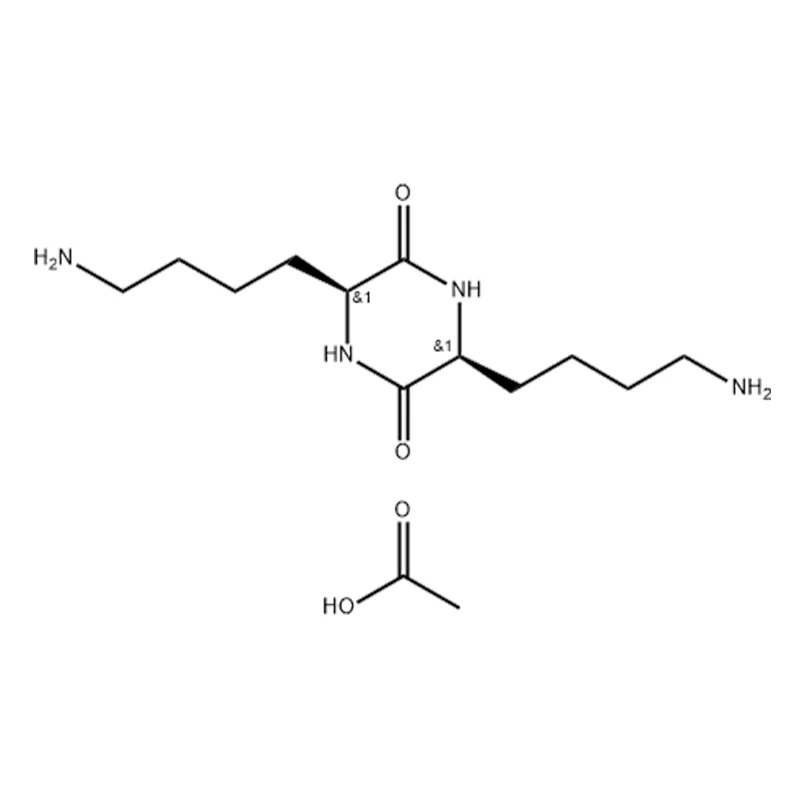
MDS-09-01 is a chiral diketopiperazine diacetate salt, chemically identified as (3S,6S)-3,6-bis(4-aminobutyl)piperazine-2,5-dione diacetate. This compound is formally the head-to-tail cyclodimerization product of L-lysine, with the acetate counterions protonating the pendant primary amine groups to enhance both aqueous solubility and long-term storage stability. MDS-09-01 is of particular significance in pharmaceutical quality control as a potential process-related impurity or synthetic intermediate in drug substances that incorporate lysine-derived diketopiperazine scaffolds—structural motifs that have been extensively explored in drug delivery applications, particularly in lipid nanoparticle formulations where the amino groups facilitate conjugation to PEG-lipids and targeting ligands. The availability of MDS-09-01 as a fully characterized reference standard enables analytical laboratories to validate HPLC methods capable of resolving and quantifying this specific impurity, supporting compliance with ICH Q3A guidelines for pharmaceutical development.
|
Parameter |
Specification |
|
Product Name |
MDS-09-01 |
|
Chemical Name |
(3S,6S)-3,6-bis(4-aminobutyl)piperazine-2,5-dione diacetate |
|
CAS Number |
115012-20-9 |
|
Molecular Formula |
C₁₆H₃₂N₄O₆ |
|
Molecular Weight |
376.46 g/mol |
|
Purity (HPLC) |
≥95.0% |
|
Physical Form |
Solid (acetate salt form) |
|
Storage Condition |
-20°C, sealed under inert atmosphere, protected from moisture |
MDS-09-01, as the diacetate salt of (3S,6S)-3,6-bis(4-aminobutyl)piperazine-2,5-dione, is the cyclodimerization product of L-lysine.
A representative synthetic approach begins with L-lysine monohydrochloride, which is first esterified to the corresponding methyl ester using thionyl chloride in methanol. The resulting L-lysine methyl ester is then subjected to cyclization under basic conditions—typically using sodium methoxide in a refluxing high-boiling solvent such as toluene or xylene to drive off the methanol by-product—to form the diketopiperazine ring via intermolecular head-to-tail condensation of two lysine ester molecules. The resulting (3S,6S)-3,6-bis(4-aminobutyl)piperazine-2,5-dione free base is subsequently treated with two equivalents of acetic acid to afford the diacetate salt. Purification is typically achieved by recrystallization or column chromatography to obtain the final product with ≥95% purity.
A: MDS-09-01 is primarily applied as a reference marker in the development, validation, and routine execution of HPLC and UPLC methods. It supports impurity profiling, method specificity assessment, and the preparation of regulatory submissions for pharmaceuticals synthesized using lysine-based intermediates or diketopiperazine scaffolds, including certain lipid nanoparticle drug delivery systems.
A: Each shipment includes a Certificate of Analysis (COA) with purity data, analytical chromatograms, and a Material Safety Data Sheet (MSDS). DMF-ready documentation packages and tailored quality agreements can be arranged to support regulatory submissions.
Store MDS-09-01 at -20°C in a tightly sealed container, protected from light and moisture at all times. Allow the sealed package to equilibrate to ambient temperature for at least one hour before opening to prevent moisture condensation. The compound is hygroscopic due to the presence of protonated primary amine groups; therefore, storage under an inert atmosphere (argon or nitrogen) is strongly recommended. Adherence to the storage recommendations specified in the Certificate of Analysis is essential for maintaining product integrity throughout its documented shelf life.
If you would like to run a preliminary evaluation first, milligram-scale samples are available for method feasibility work and system suitability testing. Just mention your interest when you reach out.
Address
No. 2 Yangguang 3rd Road, Duodao Chemical Cycle Industrial Park, Jingmen City, Hubei Province, China
Tel

![1-[2,3-Bis[(9Z,12Z)-octadeca-9,12-dien-1-yloxy]propyl]pyrrolidine](https://www.cosperpharma.com/upload/8820/1-2-3-bis-9z-12z-octadeca-9-12-dien-1-yloxy-propyl-pyrrolidine-349384.webp "1-[2,3-Bis[(9Z,12Z)-octadeca-9,12-dien-1-yloxy]propyl]pyrrolidine")
![1,2,4-Triazolo[4,3-a]pyridin-3(2H)-one](https://www.cosperpharma.com/upload/8820/1-2-4-triazolo-4-3-a-pyridin-3-2h-one-440735.webp "1,2,4-Triazolo[4,3-a]pyridin-3(2H)-one")