
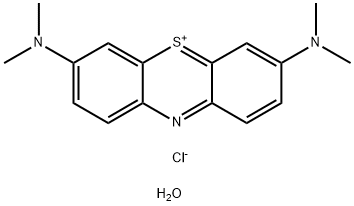
Methylene Blue Trihydrate finds many uses in biology and chemistry, acting as a GCS inhibitor, biological stain, and redox indicator. Methylene Blue Trihydrate also inhibits tau filament formation, making it relevant to neurodegenerative disease research. Additionally, Methylene Blue Trihydrate is reported to bind to the M2 subtype of muscarinic receptors in rat cardiac myocytes and thus exhibit antimuscarinic effects. In clinical settings, Methylene Blue Trihydrate is used to treat methemoglobinemia by restoring normal hemoglobin function, as well as in surgical procedures to visualize tissues. Methylene Blue Trihydrate also has antimicrobial properties, making it useful in treating infections, and is studied for its neuroprotective effects in neurodegenerative diseases and its potential as a photosensitizer in cancer therapy.
Product Parameters
|
Parameter |
Specification |
|
Product Name |
Methylene Blue Trihydrate |
|
CAS Number |
|
|
Molecular Formula |
|
|
Molecular Weight |
373.87 g/mol |
|
Appearance |
Green solid |
|
Melting Point |
|
|
Density |
|
|
Bulk Density |
|
|
Flash Point |
|
|
pKa |
|
|
Water Solubility |
|
|
Solubility |
Function
(1)Methemoglobinemia: Low concentrations of methylene blue are employed to treat methemoglobinemia caused by nitrites, chlorates, quinones, quinone imines, anilines, and nitrobenzenes;
(2)Cyanide poisoning: High concentrations of methylene blue can be administered for cyanide poisoning;
(3)Combined use with local anesthetics for localized analgesia;
(4) In recent years, it has also been clinically investigated for treating septic and traumatic shock, cancer, and herpes zoster. Pharmacological studies have demonstrated that methylene blue exhibits detoxifying, analgesic, antibacterial, antiviral, and antitumor effects, as well as the ability to correct hemodynamic disturbances in patients with septic shock and treat priapism.
Application
1. In the industrial field, methylene blue trihydrate belongs to the category of dye compounds. Industrial-grade methylene blue is commonly used for dyeing cotton, silk, paper, as well as for coloring bamboo and wood, and for manufacturing inks and color deposits. Additionally, it is frequently employed as a bacterial stain agent and indicator.
2. Methylene blue trihydrate has been utilized in the medical field for a long time. Due to its redox properties, it can be employed to treat poisoning by cyanide, nitrite, aniline, or acetylaniline, as well as methemoglobinemia caused by sulfonamide drugs. In recent years, researchers have also investigated the applications of methylene blue and its metabolites in various bacterial and viral infections, cancers, and central nervous system disorders such as depression, schizophrenia, and Alzheimer's disease.
3. In the field of aquaculture, methylene blue trihydrate serves as a disinfectant for aquatic products. Its mechanism involves the formation of an ionic compound in aqueous solution that competes with microbial enzyme systems for hydrogen ions, thereby inactivating enzymes and rendering microorganisms incapable of survival. It also exhibits therapeutic efficacy against fish diseases such as microcercosis, trichuriasis, red mouth disease, hydatidosis, and larvae necrosis disease in Penaeus vannamei. Additionally, it can be utilized as an antifungal agent to reduce mortality rates during fish transportation.
4. Studies in the field of skin care have demonstrated that methylene blue trihydrate (MTB) also exhibits significant potential for dermatological applications. Methylene blue can scavenge free radicals and stimulate cell proliferation in both young and aged dermal fibroblasts, thereby contributing to enhanced skin vitality, improved skin elasticity, promotion of collagen synthesis, and protection of the skin matrix through degradation by matrix metalloproteinases. Consequently, methylene blue holds promise as a valuable active ingredient in anti-aging cosmetics.
Hazard
Contact Us
Address
No. 2 Yangguang 3rd Road, Duodao Chemical Cycle Industrial Park, Jingmen City, Hubei Province, China
Tel