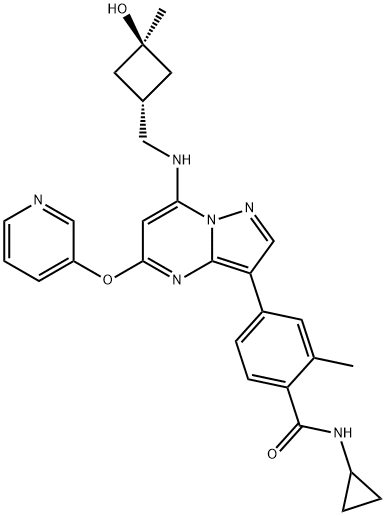
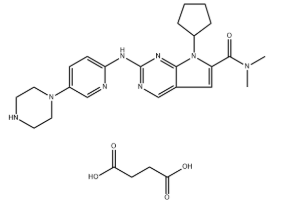
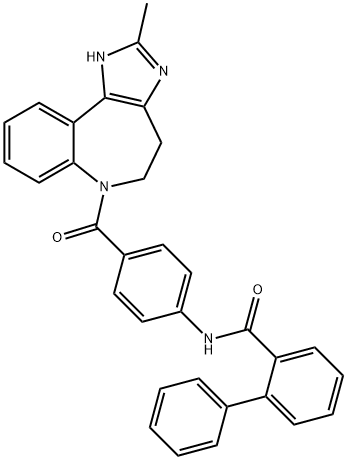
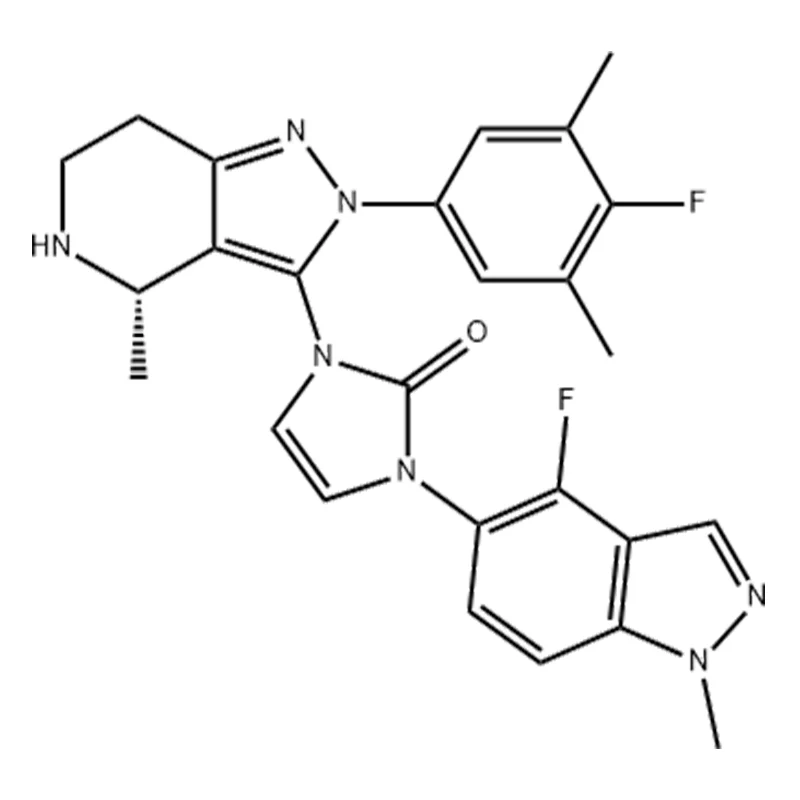
Luvixasertib (CFI-402257) is a highly selective, orally bioavailable small-molecule inhibitor of threonine tyrosine kinase (TTK), also known as monopolar spindle 1 (Mps1). TTK/Mps1 is a dual-specificity protein kinase critical for the spindle assembly checkpoint (SAC) during mitosis. Structurally, Luvixasertib has the CAS number 1610759-22-2 and a molecular weight of approximately 477 g/mol.
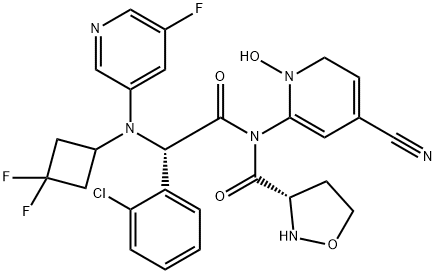
Ivosidenib (AG-120) is an orally active, potent, selective, and reversible inhibitor of mutant isocitrate dehydrogenase 1 (mIDH1) enzyme. Structurally, Ivosidenib has the molecular formula C₂₈H₂₂ClF₃N₆O₃ and a molecular weight of 582.96 g/mol. The molecule contains a pyrrolidine-2-carboxamide core with a 4-cyanopyridin-2-yl substituent at the N1 position, a (5-fluoropyridin-3-yl) group at the N-acyl position, and a (2-chlorophenyl)-2-((3,3-difluorocyclobutyl)amino)-2-oxoethyl side chain.
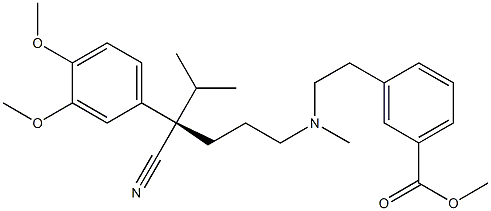
Etripamil (MSP-2017) is a short-acting L-type calcium-channel antagonist designed for intranasal administration in the treatment of paroxysmal supraventricular tachycardia (PSVT). Structurally, Etripamil has the molecular formula C₂₇H₃₆N₂O₄ and a molecular weight of 452.59 g/mol. The molecule contains a central methyl 3-(2-{(4S)-4-cyano-4-(3,4-dimethoxyphenyl)-4-(propan-2-yl)butylamino}ethyl)benzoate core, featuring a chiral (4S)-configured cyano-dimethoxyphenyl-butyl amine moiety linked to a methyl benzoate via an ethylamino bridge.
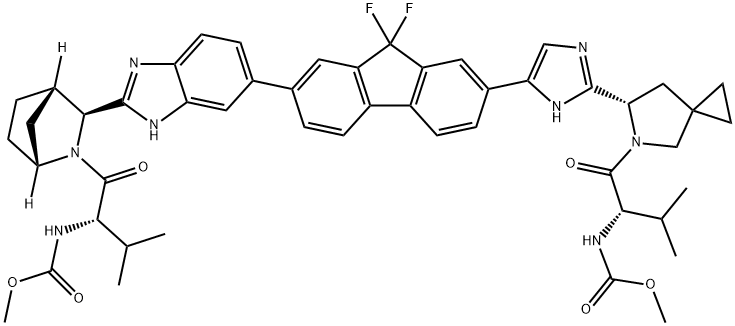
Ledipasvir (GS-5885) is a direct-acting antiviral (DAA) medication used in combination with sofosbuvir (under the trade name Harvoni®) for the treatment of chronic hepatitis C genotype 1 infection. Structurally, Ledipasvir is a complex benzimidazole derivative featuring a molecular formula of C₄₉H₅₄F₂N₈O₆ and a molecular weight of 889.0 g/mol.
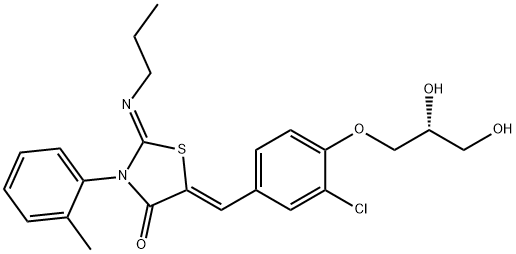
Ponesimod (ACT-128800) is an orally active, selective sphingosine-1-phosphate receptor 1 (S1P₁) modulator that functions as a functional antagonist. Structurally, Ponesimod features a thiazolidin-4-one core with a (Z)-configured benzylidene substituent bearing a 3-chloro-4-((R)-2,3-dihydroxypropoxy) phenyl group, alongside a propylimino group and an o-tolyl substituent on the thiazolidine ring.
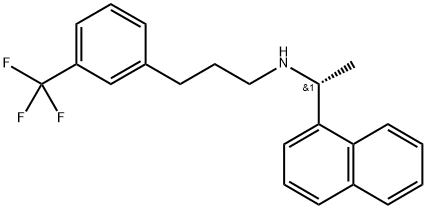
Cinacalcet (CAS 226256-56-0) is a calcimimetic agent that acts as an allosteric agonist of the calcium-sensing receptor (CaSR). Chemically, Cinacalcet is N-[(1R)-1-naphthalen-1-ylethyl]-3-[3-(trifluoromethyl)phenyl]propan-1-amine, featuring a chiral amine center with (R) configuration that is essential for its biological activity. The molecule consists of a naphthylethylamine moiety linked via a propyl chain to a trifluoromethyl-substituted phenyl ring.
We use cookies to offer you a better browsing experience, analyze site traffic and personalize content. By using this site, you agree to our use of cookies. Privacy Policy