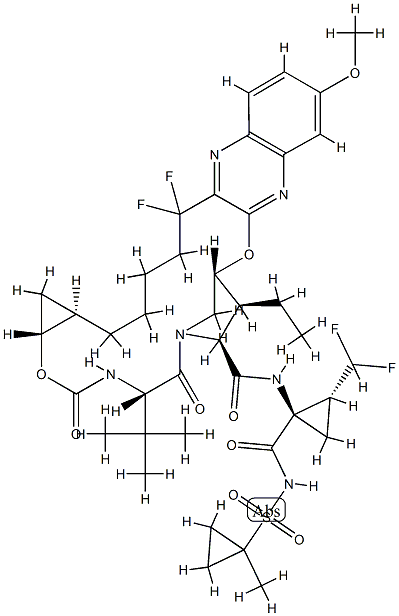
Voxilaprevir (CAS 1535212-07-7) is a macrocyclic, reversible inhibitor of the hepatitis C virus (HCV) NS3/4A serine protease. Developed by Gilead Sciences, Voxilaprevir is a fluorinated macrocyclic compound featuring a complex pentacyclic scaffold with a molecular formula of C₄₀H₅₂F₄N₆O₉S. The structure of Voxilaprevir incorporates a difluoromethyl cyclopropyl sulfonylcarbamoyl moiety and a tert-butyl group, which together contribute to its high-affinity binding to the NS3/4A protease active site.
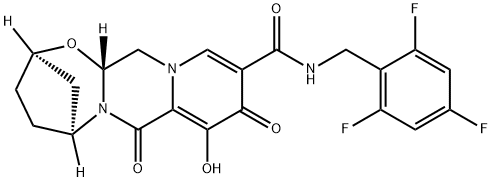
Bictegravir (CAS 1611493-60-7) is a second-generation HIV-1 integrase strand transfer inhibitor (INSTI) developed by Gilead Sciences. Chemically, it is a monocarboxylic acid amide derivative featuring a complex polycyclic core that incorporates a pyrimidine ring, a quinoline ring, and a tetrahydrofuran ring. The molecular structure of Bictegravir is characterized by a rigid, tricyclic scaffold that extends residence time on the integrase-DNA complex, a property that underpins its exceptional potency against HIV-1 strains resistant to earlier integrase inhibitors such as raltegravir, elvitegravir, and dolutegravir.
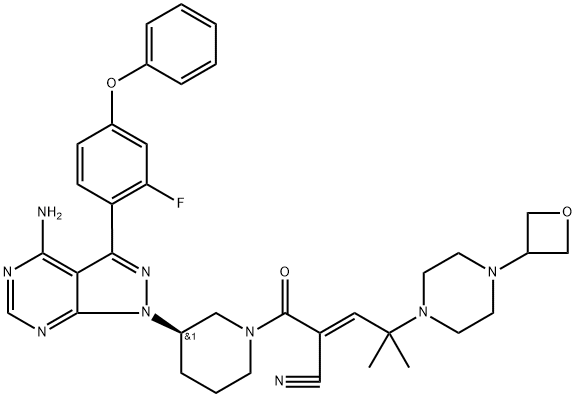
Rilzabrutinib (PRN1008) is a reversible covalent, selective, and orally active inhibitor of Bruton‘s tyrosine kinase (BTK). Structurally, Rilzabrutinib features a pyrazolo[3,4‑d]pyrimidine core with a 2‑fluoro‑4‑phenoxyphenyl substituent, a piperidine ring bearing an α,β‑unsaturated nitrile warhead, and a piperazinyl‑oxetanyl side chain.
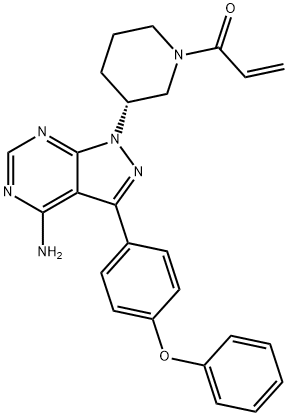
Ibrutinib (PCI‑32765) is a first‑in‑class, orally bioavailable, irreversible small‑molecule inhibitor of Bruton‘s tyrosine kinase (BTK). Structurally, Ibrutinib features a pyrazolo[3,4‑d]pyrimidine core with a 4‑phenoxyphenyl substituent at the 3‑position, an aminopyrimidine moiety, and a piperidine ring bearing an acrylamide Michael acceptor. This molecular architecture enables Ibrutinib to form a covalent bond with Cys481 in the ATP‑binding pocket of BTK through the acrylamide warhead, resulting in irreversible enzyme inhibition.
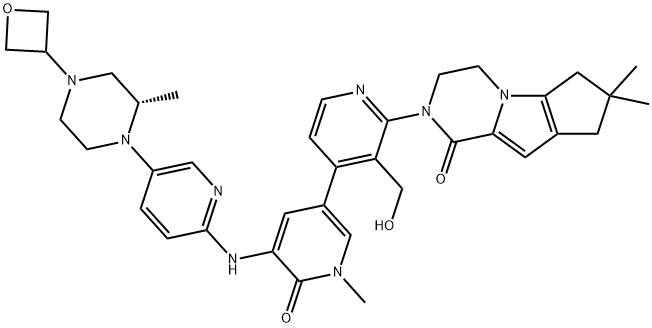
Fenebrutinib (GDC‑0853, RG7845) is a potent, selective, orally available, and non‑covalent Bruton‘s tyrosine kinase (BTK) inhibitor developed by Roche/Genentech. Structurally, Fenebrutinib features a complex fused heterocyclic core with a hydroxymethyl‑substituted bipyridinyl scaffold, a piperazinyl‑oxetanyl substituent, and a cyclopenta‑pyrrolo‑pyrazinone moiety.
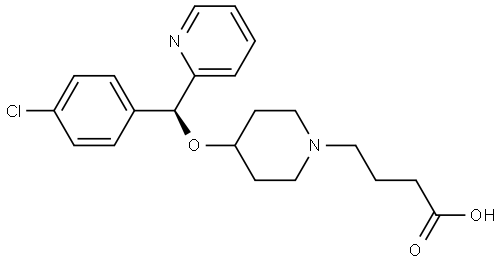
Bepotastine is a second‑generation, non‑sedating, selective histamine H1 receptor antagonist belonging to the piperidine chemical class. Structurally, Bepotastine features a piperidine ring substituted with a (4‑chlorophenyl)(pyridin‑2‑yl)methoxy group at the 4‑position and a butanoic acid side chain at the 1‑position, with a single stereocenter at the benzylic carbon.
We use cookies to offer you a better browsing experience, analyze site traffic and personalize content. By using this site, you agree to our use of cookies. Privacy Policy