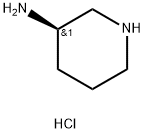
(R)-3-Aminopiperidine Dihydrochloride (CAS 334618-23-4) is the dihydrochloride salt of (R)-3‑aminopiperidine, featuring a chiral piperidine scaffold with a primary amine at the 3‑position in the R‑configuration. The molecule consists of a six‑membered piperidine ring with a free amino group at C3, protonated and stabilised by two chloride counterions, molecular formula C₅H₁₄Cl₂N₂ and molecular weight 173.08 g/mol.
(R)-3-Aminopiperidine Dihydrochloride is a critical chiral intermediate in the synthesis of several clinically important drug classes, most notably dipeptidyl peptidase‑4 (DPP‑4) inhibitors such as alogliptin and other gliptin‑class antidiabetic agents. The free primary amine of (R)-3-Aminopiperidine Dihydrochloride enables diverse chemical transformations including acylation, reductive amination, sulfonylation, and urea formation—reactions fundamental to medicinal chemistry and API synthesis. As a chiral compound with established absolute configuration, (R)-3-Aminopiperidine Dihydrochloride is indispensable for maintaining enantiopurity in pharmaceutical manufacturing. In quality control contexts, it serves as an impurity reference standard for analytical method development and QC testing. The compound is also employed as a building block in the synthesis of novel fine chemicals, agrochemicals, and chemical auxiliaries. With its high water solubility and crystalline nature, (R)-3-Aminopiperidine Dihydrochloride offers excellent handling characteristics for both research and production.
Product Parameter
Parameter
Specification
Product Name
(R)-3-Aminopiperidine Dihydrochloride
CAS Number
334618234
Molecular Formula
C₅H₁₄Cl₂N₂
Molecular Weight
173.08 g/mol
Appearance
White to light yellow powder to crystal
Melting Point
206.0–210.0 °C
Water Solubility
Soluble
Storage Condition
Room temperature,Inert atmosphere
Application
(R)-3-aminopiperidine dihydrochloride has been used as a reactant for the preparation of dipeptidyl peptidase IV inhibitors derived from alogliptin.
Used as a reactant for N-arylation of heterocyclic diamines in reagents; a reactant for the synthesis of substituted quinolones, which can reduce the risk of phototoxicity.
Synthetic Route
There are several main synthetic methods for (R)-3-aminopiperidine dihydrochloride: 1. Using 3-aminopyridine as the starting material, racemic 3-aminopiperidine is obtained via catalytic hydrogenation reduction, and then resolved with a chiral reagent to obtain (R)-3-aminopiperidine. This method has a low yield, and requires an autoclave and expensive catalysts for the catalytic reduction of 3-aminopyridine, which is relatively difficult in actual operation; 2. Using D-ornithine hydrochloride as the starting material, it reacts with thionyl chloride at a temperature between -78 and 45℃, and the crude (R)-3-aminopiperidin-2-one is obtained through a strongly basic anion exchange resin. After purification, it is reduced to (R)-3-aminopiperidine with LiAlH4, and finally converted into the hydrochloride salt. This method uses the chiral raw material ornithine as the starting material, but racemization occurs during the synthesis process. Meanwhile, ornithine is expensive, the reaction is carried out at a deep low temperature (-78℃), which leads to poor operability. In addition, the easily explosive lithium aluminum hydride from Chemicalbook is used, which increases the operating cost; 3. Using nicotinamide as the raw material, the target product is obtained through catalytic hydrogenation reduction, Boc protection, Hofmann degradation, chiral resolution, and deprotection to form the hydrochloride salt. The reaction conditions of this route are milder than those of the previous several routes. Although the conditions for the catalytic hydrogenation of nicotinamide are relatively harsh, there is great room for improvement; 4. Using racemic 3-piperidinecarboxamide as the raw material, (S)-3-piperidinecarboxamide is decomposed by the bacterium (Cupriavidus sp. KNK-J915) to obtain (R)-3-piperidinecarboxamide, which is then subjected to Boc protection of the amino group, Hofmann degradation, and deprotection to form the hydrochloride salt. This method is relatively novel: the bacterium (Cupriavidus sp. KNK-J915) decomposes the S-configuration isomer as a carbon source to obtain the R-configuration isomer of the opposite configuration. However, the separation process for bacterial decomposition has very high requirements and the operating cost is high, so it is temporarily difficult to realize large-scale industrial production at present.
Dihydrochloride salt – Exceptional water solubility, improved crystallinity, and enhanced storage stability.
Key DPP‑4 inhibitor intermediate – Essential building block for alogliptin and other gliptins.
Versatile utility – Also used in agrochemicals, fine chemicals, and chemical auxiliaries.
Contact Us
Need (R)-3-Aminopiperidine Dihydrochloride for your DPP‑4 inhibitor program? Cosperpharm is your source for high‑quality chiral intermediates. Contact us today—we‘re ready to support your research, development, and production needs.
Hot Tags: (R)-3-Piperidinamine dihydrochloride, China, Manufacturer, Supplier, Factory
We use cookies to offer you a better browsing experience, analyze site traffic and personalize content. By using this site, you agree to our use of cookies.Privacy Policy