
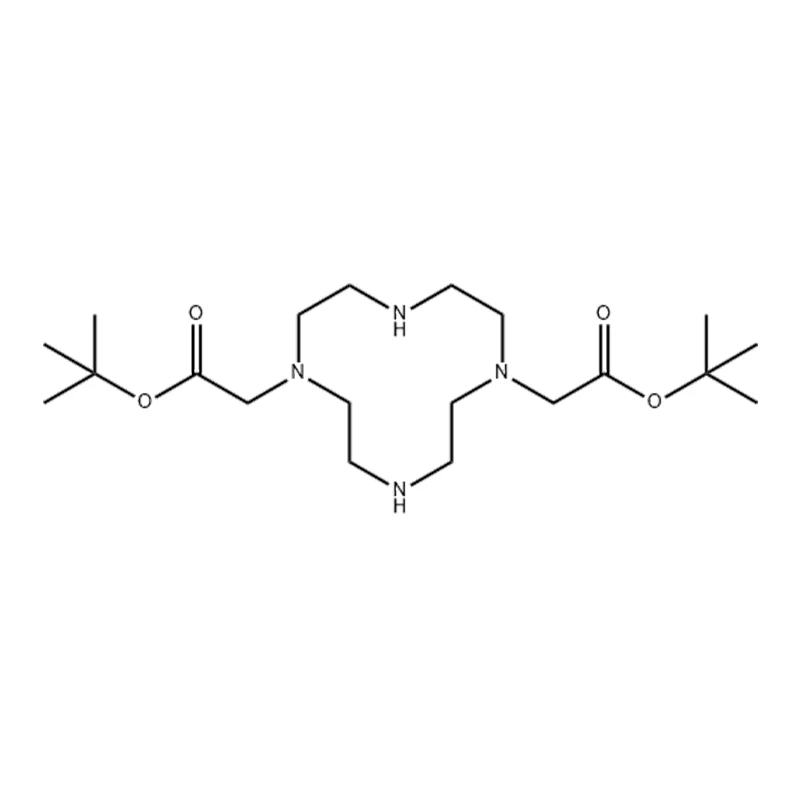
1,7-Bis(tert-butoxycarbonylmethyl)-1,4,7,10-tetraazacyclododecane is a key intermediate in the synthesis of bifunctional chelating agents derived from the cyclen macrocycle. By pre-installing two protected acetate arms in a trans geometry, 1,7-Bis(tert-butoxycarbonylmethyl)-1,4,7,10-tetraazacyclododecane allows chemists to introduce different substituents at the remaining 4- and 10-positions in a controlled manner, enabling the construction of asymmetric DOTA-like ligands (DOTA = 1,4,7,10-tetraazacyclododecane-1,4,7,10-tetraacetic acid). This regioselective approach is widely exploited in the preparation of targeted MRI contrast agents, radiometal complexes for PET and SPECT imaging, and luminescent lanthanide probes where one or two arms of the cyclen scaffold must be conjugated to a targeting vector or fluorophore while the remaining arms coordinate the metal ion. 1,7-Bis(tert-butoxycarbonylmethyl)-1,4,7,10-tetraazacyclododecane is commercially available from multiple chemical suppliers and is routinely used in academic and industrial research laboratories developing metal-based diagnostics and therapeutics. Because the tert-butyl protecting groups of 1,7-Bis(tert-butoxycarbonylmethyl)-1,4,7,10-tetraazacyclododecane are cleanly removed with TFA or HCl in organic solvents, the compound integrates seamlessly into standard solid-phase and solution-phase synthesis protocols for cyclen-derived chelators.
|
Parameter |
Specification |
|
Product Name |
1,7-Bis(tert-butoxycarbonylmethyl)-1,4,7,10-tetraazacyclododecane |
|
CAS Number |
162148-48-3 |
|
Molecular Formula |
C₂0H₄0N₄O₄ |
|
Molecular Weight |
400.56 g/mol |
|
Purity (HPLC) |
Typically ≥95% or ≥97% depending on supplier |
|
Physical Form |
Solid |
|
Solubility |
Soluble in acetone, acetonitrile, ethyl Acetate, chloroforme, cyclohexane. Insoluble in water. |
|
Storage Condition |
under inert gas (nitrogen or Argon) at 2–8 °C |
Sodium hydrogen phosphate (14.0 g, 98.6 mmol) was added to a solution of wheelringtanningin (5.00 g, 29.0 mmol) in H₂O–1,4-dioxane (50:20 v/v, 70 ml), and the pH was adjusted to 2.5 by adding hydrochloric acid (water solution, 12 M). Over room temperature for 2 hours, benzyl chloroformate (10.0 ml, 70.1 mmol) was added dropwise to the stirred solution in dioxane (20 ml), followed by further stirring for 18 h, yielding a colorless solution containing white precipitate. The solvent was removed under reduced pressure, and the residue was dissolved in H₂O (100 ml). The aqueous phase was then adjusted to pH 7 by addition of 1 M KOH (water solution). The aqueous phase was extracted twice with ether (2 × 100 ml) and twice with CH₂Cl₂ (2 × 100 ml). The CH₂Cl₂ extracts were combined, dried with MgSO₄, filtered, and the filtrate was concentrated under reduced pressure to yield a colorless oil. This substance was repeatedly washed with diethyl ether and concentrated under reduced pressure (3 × 50 ml), yielding 1,4,7,10-tetrazetocyclododecan-1,7-dicarboxylic acid dibenzyl ester as a colorless crystalline solid (9.47 g, 21.5 mmol, 74%).
Under argon atmosphere in anhydrous CH₃CN (25 mL), 1,4,7,10-tetraza-cycododecane-1,7-dicarboxylic acid dibenzyl ester 31 (2.65 g, 6.02 mmol), tert-butyl bromoacetate (2.64 g, 2.00 mL, 13.5 mmol) and CS₂CO₃ (5.88 g, 18.1 mmol) were heated under reflux for 18 hours. The reaction mixture was cooled to room temperature, filtered via syringe, and the filtrate was concentrated under reduced pressure to yield a residual yellow oil. The crude product was purified by column chromatography on silica gel using a gradient elution system (from CH₂Cl₂ to a mixture of 1.5% CH₃OH:CH₂Cl₂ with incremental amounts of 0.1% CH₃OH), yielding 4,10-bis(tert-butylcarbonyl)methyl-1,4,7,10-tetraza-cycododecane-1,7-dicarboxylic acid dibenzyl ester as a yellow oily substance (2.46 g, 3.68 mmol, 61%).
The mixture of 4,10-bis(tert-butoxycarbonylmethyl)-1,4,7,10-tetrazacyclodecane-1,7-dicarboxylic acid dibenzyl ester (2.46 g, 3.68 mmol) and Pr(OH)₂/C (0.25 g) in a CH₃OH–H₂O solution (3:1 v/v) was shaken for 48 hours under 40 psi H₂ pressure in a palladium hydrogenation flask. The resulting mixture was filtered through diatomaceous earth to yield a colorless solution, which was then concentrated under reduced pressure to obtain the target compound 1,7-Di-(N-tert-butoxycarbonylmethyl)-1,4,7,10-tetrazacyclodecane as a colorless crystalline solid (1.46 g, 0.365 mmol, 99%).
Q1: What metal ions can this compound chelate after deprotection?
A: Following deprotection, the resulting DO2A chelator forms stable complexes with a wide range of metal ions including Gd³⁺ (MRI contrast agents), ⁶⁸Ga and ⁶⁴Cu (PET imaging), ¹⁷⁷Lu and ⁹⁰Y (targeted radionuclide therapy), and ¹¹¹In (SPECT imaging).
Q2: What is the solubility of this compound?
A: 1,7-Bis(tert-butoxycarbonylmethyl)-1,4,7,10-tetraazacyclododecane is soluble in organic solvents including acetone, acetonitrile, ethyl acetate, chloroform, cyclohexane, and dichloromethane. It is insoluble in water.
Each batch undergoes:
● Gas chromatography (GC) – purity ≥97.0%
● Non‑aqueous titration – purity ≥97.0%
● Refractive index – confirmatory analysis
● ¹H NMR – structural verification
● Appearance – colorless to light yellow to light orange clear liquid
A comprehensive COA, MSDS (with full GHS information), and certificate of origin accompany every shipment.
Ready to integrate 1,7-Bis(tert-butoxycarbonylmethyl)-1,4,7,10-tetraazacyclododecane into your next molecular imaging project? Need a custom quantity or purity grade for your chelator development program? Contact Cosperpharm today for a quote, lead time information, or to discuss your specific application requirements.
Address
No. 2 Yangguang 3rd Road, Duodao Chemical Cycle Industrial Park, Jingmen City, Hubei Province, China
Tel

![1-[2,3-Bis[(9Z,12Z)-octadeca-9,12-dien-1-yloxy]propyl]pyrrolidine](https://www.cosperpharma.com/upload/8820/1-2-3-bis-9z-12z-octadeca-9-12-dien-1-yloxy-propyl-pyrrolidine-349384.webp "1-[2,3-Bis[(9Z,12Z)-octadeca-9,12-dien-1-yloxy]propyl]pyrrolidine")
![1,2,4-Triazolo[4,3-a]pyridin-3(2H)-one](https://www.cosperpharma.com/upload/8820/1-2-4-triazolo-4-3-a-pyridin-3-2h-one-440735.webp "1,2,4-Triazolo[4,3-a]pyridin-3(2H)-one")