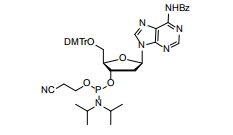

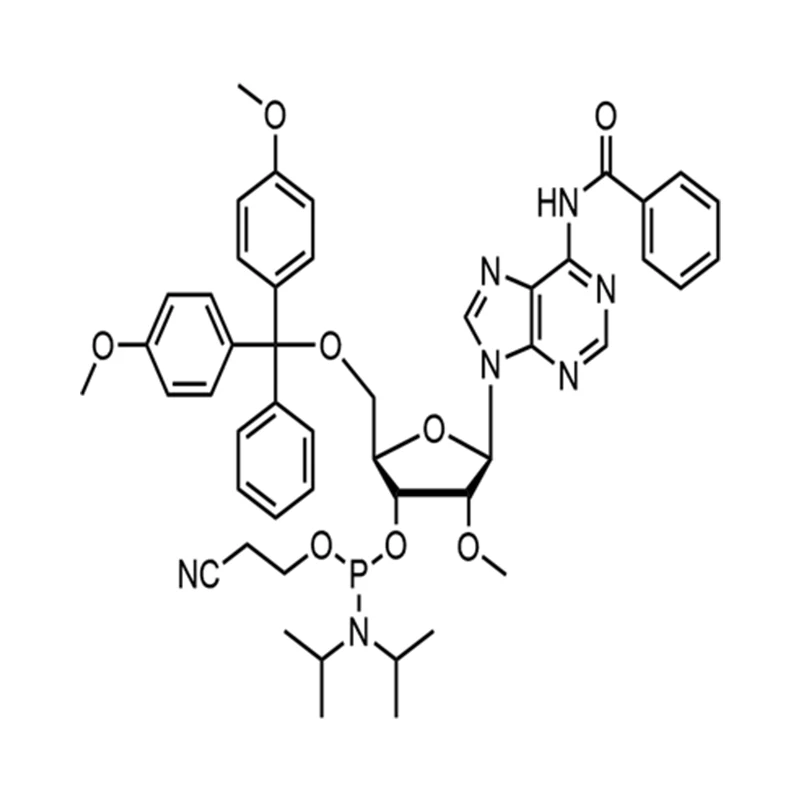
2′-O-Methyl-rA(N-Bz) Phosphoramidite is a modified phosphoramidite monomer that can be used for oligonucleotide synthesis. The 2′-O-methyl modification confers considerable nuclease resistance to oligonucleotides while preserving the hydrogen bonding properties of RNA/RNA duplexes more faithfully than DNA/RNA hybrids. In RNA interference (RNAi) applications, 2′-O-Methyl-rA(N-Bz) Phosphoramidite is frequently incorporated into the sense and antisense strands of small interfering RNA (siRNA) duplexes to enhance serum stability and reduce off‑target effects without compromising RNAi activity. 2′-O-Methyl-rA(N-Bz) Phosphoramidite also serves as a critical building block in the chemical synthesis of RNA oligonucleotides containing site‑specific 2′-O-methyladenosine modifications; the protective groups (DMT at 5′, Bz at N6, CE phosphoramidite at 3′) allow stepwise assembly of RNA strands with high fidelity and control on automated DNA/RNA synthesizers. Beyond RNA therapeutics, 2′-O-Methyl-rA(N-Bz) Phosphoramidite has found application in the synthesis of phosphate‑branched RNA models for studying unusual RNA architectures and in the preparation of thermally stabilized fluorescent oligonucleotide probes.
|
Parameter |
Specification |
|
Product Name |
2′-O-Methyl-rA(N-Bz) Phosphoramidite |
|
CAS Number |
110782-31-5 |
|
Molecular Formula |
C₄₈H₅₄N₇O₈P |
|
Molecular Weight |
887.96 g/mol |
|
Purity (HPLC) |
≥98% (J&K); 99.74% (Biozol) |
|
Physical Form |
powder |
|
Appearance |
White to off-white powder |
|
Storage Temperature |
Sealed in dry,2-8℃ |
|
Water Solubility |
Soluble in DMSO, DCM, acetonitrile for oligonucleotide synthesis |
|
Stability |
Stable under recommended storage conditions; moisture-sensitive |
|
Advantage |
Detail |
|
Production Strength |
GMP-certified campus spanning 100+ mu, 3 multi-purpose workshops, 6 D-grade clean zone production lines, and 150+ reactors (20L–5000L), supporting high/low temp, anaerobic & hydrogenation; kg to ton scale production. |
|
Fast Delivery |
R&D samples: one week; commercial orders: 1–2 months after payment. Express (DHL/FedEx) or air/sea freight available. |
|
Global Partners |
Trusted by 30+ pharmaceutical companies in USA, Europe, India, Brazil, and Southeast Asia; long-term cooperation with generic drug manufacturers, CROs, and impurity standard distributors. |
|
Licensed Exporter |
Valid drug import/export license — no compliance delays. |
|
Dual Quality Grades |
Both research/pharma grade(≥98%)and high-purity impurity grade(≥99%)available to meet diverse customer needs. |
The 2′-O-methyl modification at the ribose 2′-position is one of the most extensively validated chemical modifications in oligonucleotide therapeutics. Oligonucleotides incorporating 2′-O-Methyl-rA(N-Bz) Phosphoramidite exhibit markedly enhanced resistance to endo- and exonucleases compared to unmodified RNA, with improved thermal stability of RNA/RNA duplexes (increased Tm) without compromising Watson–Crick base-pairing specificity. This modification has been successfully deployed in FDA‑approved oligonucleotide drugs and numerous clinical‑stage candidates.
The benzoyl (Bz) protecting group on the N6 exocyclic amine of the adenine base prevents undesired side reactions during the phosphoramidite coupling cycle, such as branching or chain‑termination events caused by depurination or acylation. The Bz group is cleanly removed under standard oligonucleotide deprotection conditions (concentrated ammonia, 55°C, 8–16 hours, or AMA), yielding the native adenine base without detectable byproducts.
The 2′-O-methyl substitution locks the ribose sugar into a C3′-endo (North) conformation — the same conformation adopted by RNA in A‑form duplexes. This conformational pre‑organization reduces the entropic penalty upon hybridization to complementary RNA targets, resulting in higher binding affinity (higher Tm) for 2′-O‑methyl‑modified oligonucleotides relative to DNA or unmodified RNA of the same sequence.
2′-O-Methyl-rA(N-Bz) Phosphoramidite carries the same 5′-O-DMT and N6-Bz protecting groups used in standard RNA phosphoramidites, along with a β-cyanoethyl (CE) phosphoramidite at the 3′-position. This design ensures seamless integration into existing automated DNA/RNA synthesizer workflows without requiring specialized deprotection protocols or modified coupling conditions.
2′-O-Methyl-rA(N-Bz) Phosphoramidite is used across multiple oligonucleotide therapeutic platforms: siRNA (sense and antisense strand modifications), antisense oligonucleotides (ASOs) for gene silencing, aptamers for targeted delivery and diagnostic applications, and modified RNA probes for molecular diagnostics. The 2′-O-methyl modification is also extensively utilized in CRISPR‑Cas guide RNAs to enhance stability and editing efficiency.
2′-O-Methyl-rA(N-Bz) Phosphoramidite is used to introduce 2′-O-methyladenosine modifications into the sense and/or antisense strands of small interfering RNA (siRNA) duplexes to enhance serum stability, reduce off‑target effects mediated by the RNAi machinery (e.g., passenger strand loading), and decrease immunostimulation (TLR7/8 activation). The 2′-O-methyl modification is a standard component of many clinically advanced siRNA platforms.
2′-O-Methyl-rA(N-Bz) Phosphoramidite is widely incorporated into antisense oligonucleotides for gene silencing applications. The 2′-O-methyl modification confers nuclease resistance to ASOs in biological fluids and enhances binding affinity to complementary RNA targets without disrupting RNase H-mediated cleavage mechanisms (when positioned in 2′-O‑methyl/2′-deoxy gapmer designs).
2′-O-Methyl-rA(N-Bz) Phosphoramidite serves as a building block for the solid‑phase chemical synthesis of RNA oligonucleotides containing site‑specific 2′-O-methyladenosine residues. The protecting groups (5′-O‑DMT, N6‑Bz, CE phosphoramidite) are compatible with standard RNA synthesis cycles and deprotection conditions (NH₃, 55°C, 8–16 h, or AMA), allowing seamless integration into established synthesis workflows.
2′-O-methyl modifications improve the thermal stability of fluorescent probes (e.g., molecular beacons, TaqMan probes) used in real‑time PCR and in situ hybridization. 2′-O-Methyl-rA(N-Bz) Phosphoramidite enables the introduction of stabilizing modifications into probe sequences, increasing the signal‑to‑noise ratio and enabling more robust detection of low‑abundance RNA targets.
2′-O-methyl nucleotides exhibit improved nuclease resistance, extended in vivo half‑life, and enhanced target binding affinity compared to unmodified RNA aptamers. 2′-O-Methyl-rA(N-Bz) Phosphoramidite is a key building block for generating 2′-O-methyl‑modified aptamer libraries via solid‑phase synthesis.
2′-O-methyl modifications placed at specific positions in CRISPR‑Cas gRNAs can enhance stability, reduce immunogenicity, and improve editing efficiency in cells and in vivo. 2′-O-Methyl-rA(N-Bz) Phosphoramidite enables the site‑specific introduction of 2′-O-methyladenosine residues into chemically synthesized gRNAs.
Researchers studying unusual RNA architectures, such as phosphate‑branched RNA, utilize 2′-O-Methyl-rA(N-Bz) Phosphoramidite to prepare model oligonucleotides containing a single free 2′-OH group for investigating the hydrolytic stability of branched phosphotriester linkages under physiological conditions.
2′-O-Methyl-rA(N-Bz) Phosphoramidite is used in systematic studies of the thermal stability (Tm) of modified oligonucleotide duplexes, including the characterization of positional effects of 2′-O-methyl modifications on duplex melting temperature and hybridization thermodynamics.
Process Development Process chemists and oligonucleotide synthesis specialists use 2′-O-Methyl-rA(N-Bz) Phosphoramidite to optimize coupling conditions, deprotection protocols, and purification methods for large‑scale manufacturing of 2′-O-methyl‑modified nucleic acid therapeutics. Cosperpharm provides batch‑specific analytical data to support process validation and scale‑up activities.
2′-O-Methyl-rA(N-Bz) Phosphoramidite is used as a reference standard in the development of HPLC and LC‑MS methods for quantifying modified nucleoside content in oligonucleotide drug substances and drug products, as well as for identifying synthesis‑related impurities (e.g., incomplete DMT removal, depurination products, phosphite oxidation byproducts).
Need reliable, high‑purity 2′-O-Methyl-rA(N-Bz) Phosphoramidite for your next oligonucleotide synthesis project? Cosperpharm‘s team is ready to assist with product specifications, documentation needs, and supply chain solutions tailored to your application.
Address
No. 2 Yangguang 3rd Road, Duodao Chemical Cycle Industrial Park, Jingmen City, Hubei Province, China
Tel

![1-[2,3-Bis[(9Z,12Z)-octadeca-9,12-dien-1-yloxy]propyl]pyrrolidine](https://www.cosperpharma.com/upload/8820/1-2-3-bis-9z-12z-octadeca-9-12-dien-1-yloxy-propyl-pyrrolidine-349384.webp "1-[2,3-Bis[(9Z,12Z)-octadeca-9,12-dien-1-yloxy]propyl]pyrrolidine")
![1,2,4-Triazolo[4,3-a]pyridin-3(2H)-one](https://www.cosperpharma.com/upload/8820/1-2-4-triazolo-4-3-a-pyridin-3-2h-one-440735.webp "1,2,4-Triazolo[4,3-a]pyridin-3(2H)-one")