
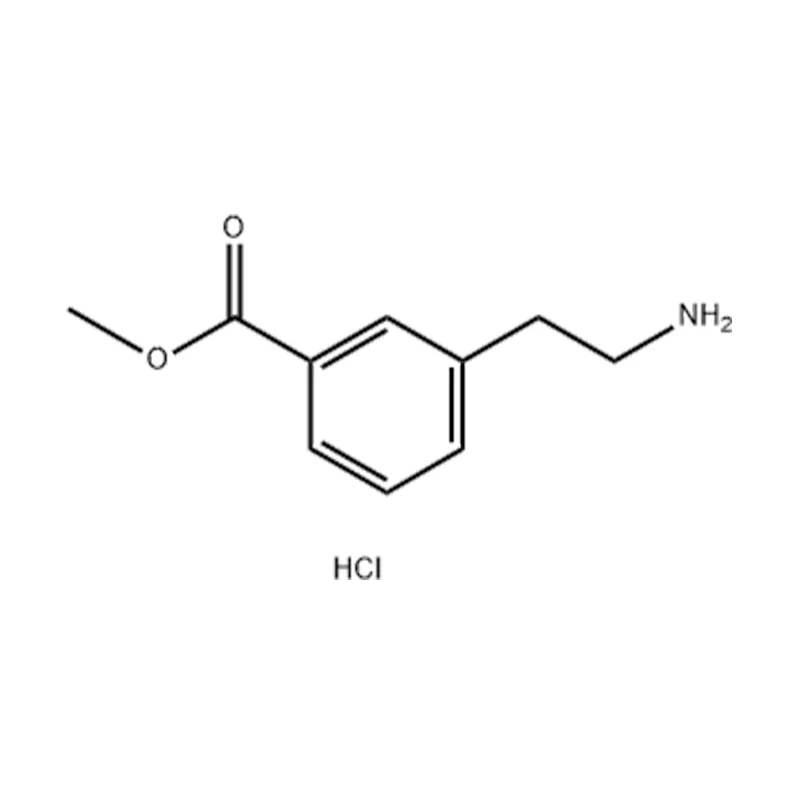
3-(2-Aminoethyl)benzoic acid methyl ester HCl is a core building block in medicinal chemistry programs where an ethylamino linker is needed to separate an aromatic carboxylate from a downstream pharmacophore. Because the amino group of 3-(2-Aminoethyl)benzoic acid methyl ester HCl is protonated and non‑nucleophilic as supplied, chemists can carry out selective ester aminolysis or hydrolysis under controlled pH without needing orthogonal protecting groups. The meta topology of 3-(2-Aminoethyl)benzoic acid methyl ester HCl is highly sought after in the design of serotonin receptor ligands, integrin antagonists, and peptidomimetic scaffolds, where a 1,3‑disubstituted benzene ring imparts a distinct exit‑vector geometry. Manufacture of 3-(2-Aminoethyl)benzoic acid methyl ester HCl under strict quality control ensures that any residual benzylic or homocoupled impurities remain below limits of concern for pharma‑grade intermediate supply.
|
Parameter |
Specification |
|
Product Name |
3-(2-Aminoethyl)benzoic acid methyl ester HCl |
|
CAS Number |
167846-36-8 |
|
Molecular Formula |
C₁₀H₁₄ClNO₂ |
|
Molecular Weight |
215.68 g/mol |
|
Appearance |
White to off-white crystalline powder |
|
Melting Point |
154–158°C (typical) |
|
Purity (HPLC) |
≥98.0% |
|
Water Content (KF) |
≤0.5% |
|
Solubility |
Freely soluble in water, methanol, DMSO; sparingly soluble in ethyl acetate |
|
Storage Condition |
2–8°C, tightly sealed, protected from moisture and light |
|
Shelf Life |
24 months under recommended storage |
1. Bifunctional, No Protection Needed – The protonated amine is stable during ester manipulations; neutralization releases the free amine for coupling on demand.
2. Water‑Soluble Salt Form – The hydrochloride form dissolves directly in aqueous media, simplifying setup for enzymatic resolution or bioconjugation.
3. Meta‑Substitution Pattern – Delivers a 1,3‑disubstituted phenyl geometry that is difficult to access via direct functionalization of benzoic acid derivatives.
4. High Crystallinity – The crystalline powder is easy to weigh accurately and free from the static or clumping issues of many aliphatic amine salts.
5. Versatile Chemistry – Participate in amide bond formation, reductive amination, sulfonylation, and, after ester hydrolysis, metal‑catalyzed decarboxylative couplings.
Q1: How do I liberate the free amine for coupling?
A: Dissolve the salt in water, add saturated sodium bicarbonate to pH 8‑9, and extract with ethyl acetate or dichloromethane. Dry over Na₂SO₄ and concentrate to obtain the free base, which should be used promptly.
Q2: How hygroscopic is the powder?
A: It is moderately hygroscopic. Prolonged exposure to humid air can cause clumping. We recommend handling in a glovebox or quickly weighing in a low‑humidity environment.
1.Serotonin Receptor Modulator Synthesis
Meta‑ethylamino benzoate esters are key intermediates in 5‑HT₁A and 5‑HT₂A ligand programs.
2.Integrin Antagonist Assembly
The ethylamino spacer is used to tether carboxylate pharmacophores to aromatic caps in RGD‑mimetic compounds.
3.Peptidomimetic Building Block
Serves as a constrained phenylalanine or tyrosine surrogate after ester-to-acid conversion.
4.ADC Linker Chemistry
The amine and ester provide orthogonal attachment points for payload‑linker constructs.
5.Parallel Amide Library Production
The amine can be derivatised in a high‑throughput fashion, while the ester is kept for later diversification or left as a polarity handle.
To request a sample, obtain a formal quote for kilogram quantities, or discuss how this meta‑substituted amino ester can shorten your synthetic sequence, reach out to the Cosperpharm commercial team — we typically respond to technical inquiries within one business day.
Address
No. 2 Yangguang 3rd Road, Duodao Chemical Cycle Industrial Park, Jingmen City, Hubei Province, China
Tel

![1-[2,3-Bis[(9Z,12Z)-octadeca-9,12-dien-1-yloxy]propyl]pyrrolidine](https://www.cosperpharma.com/upload/8820/1-2-3-bis-9z-12z-octadeca-9-12-dien-1-yloxy-propyl-pyrrolidine-349384.webp "1-[2,3-Bis[(9Z,12Z)-octadeca-9,12-dien-1-yloxy]propyl]pyrrolidine")
![1,2,4-Triazolo[4,3-a]pyridin-3(2H)-one](https://www.cosperpharma.com/upload/8820/1-2-4-triazolo-4-3-a-pyridin-3-2h-one-440735.webp "1,2,4-Triazolo[4,3-a]pyridin-3(2H)-one")