
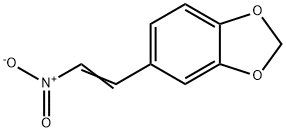
3,4-Methylenedioxy-beta-nitrostyrene is a research chemical that has been identified as a Syk (spleen tyrosine kinase) inhibitor, making it a valuable tool for studying signaling pathways in immunology and inflammation research . The nitroalkene functionality of 3,4-Methylenedioxy-beta-nitrostyrene serves as a Michael acceptor, enabling the compound to undergo conjugate addition reactions with nucleophiles, which is exploited in the synthesis of various derivatives. As a key intermediate in organic synthesis, 3,4-Methylenedioxy-beta-nitrostyrene provides access to 3,4-methylenedioxyphenyl-substituted compounds via nitroalkene transformations. The light sensitivity of 3,4-Methylenedioxy-beta-nitrostyrene requires storage in the dark and handling under low-light conditions to prevent degradation . Additionally, 3,4-Methylenedioxy-beta-nitrostyrene is classified as a poison for transportation purposes (UN2811, Class 6.1, Packing Group III), requiring appropriate shipping precautions .
|
Parameter |
Specification |
|
Product Name |
3,4-Methylenedioxy-beta-nitrostyrene |
|
CAS Number |
|
|
Molecular Formula |
|
|
Molecular Weight |
|
|
Appearance |
Crystalline solid |
|
Melting Point |
|
|
Solubility |
|
|
Storage Condition |
–20°C, under nitrogen, dry, protected from light |
MNS (3,4-Methylenedioxy-β-nitrostyrene, MDBN) is a tyrosine kinase inhibitor that inhibits Syk, Src and p97 with IC50 values of 2.5 μM, 29.3 μM and 1.7 μM, respectively.
MNS (3,4-methyl-enedioxy-β-nitrostyrene) completely inhibits platelet aggregation induced by 2 μM U46619 (thromboxane A2 analog), 5 μM ADP, 100 μM arachidonic acid (AA), 10 μg/ml collagen, and 0.1 U/ml thrombin, with IC50 values of 2.1 μM, 4.1 μM, 5.8 μM, 7.0 μM, and 12.7 μM, respectively, and this effect is concentration-dependent. MNS inhibits platelet aggregation induced by the calcium ionophore A23187 (1 μM) or the protein kinase C (PKC) activator PDBu (200 nM), with IC50 values of 25.9 μM and 4.8 μM, respectively. Compared with platelets treated with PGE1, platelets treated with MNS (20 μM) show reduced thrombin-induced P-selectin expression. Treatment of platelets with MNS (20 μM) significantly inhibits thrombin-induced but not PDBu-induced MARCKS phosphorylation. After platelets are treated with MNS (20 μM) and stimulated with thrombin or collagen for 0.5 minutes or 3 minutes, MNS significantly inhibits protein tyrosine phosphorylation. MNS stimulates the degradation of UbG76V-GFP and ODD-Luc, with IC50 values of 1.6 μM and 5.9 μM, respectively. MNS inhibits MG132-induced receptor accumulation, with an IC50 of 2.1 μM. MNS inhibits Gram-positive bacteria (Staphylococcus aureus and Enterococcus faecalis) and Gram-negative bacteria (Escherichia coli and Pseudomonas aeruginosa), with a minimum inhibitory concentration (MICs) of 128 mg/L. MNS is more effective than Genistein in inhibiting platelet aggregation and protein tyrosine phosphorylation. MNS (3,4-Methylenedioxy-β-nitrostyrene) and 3,4-dimethoxy-β-nitrostyrene. MNS (20 μM) is equally effective in inhibiting platelet aggregation and inhibiting ATP release from platelets stimulated by thrombin or collagen, and this effect is concentration-dependent. MNS (20 μM) inhibits thrombin-induced binding of PAC-1 to human platelets
Syk Kinase Inhibitor for Research
3,4-Methylenedioxy-beta-nitrostyrene has been identified as a Syk (spleen tyrosine kinase) inhibitor, making it a valuable tool for studying signaling pathways in immunology and inflammation research .
Versatile Michael Acceptor
The nitroalkene functionality of 3,4-Methylenedioxy-beta-nitrostyrene serves as a Michael acceptor, enabling conjugate addition reactions with various nucleophiles for the synthesis of diverse derivatives.
Key Intermediate for Organic Synthesis
3,4-Methylenedioxy-beta-nitrostyrene provides access to 3,4-methylenedioxyphenyl-substituted compounds via nitroalkene transformations, including reductions to phenethylamines and cycloaddition reactions.
High-Purity Research Chemical
Cosperpharm supplies 3,4-Methylenedioxy-beta-nitrostyrene at high purity (≥98%) with comprehensive analytical characterization, suitable for biochemical research, medicinal chemistry, and synthesis applications .
From kinase research to organic synthesis, your success depends on the quality of your chemical building blocks. Cosperpharm delivers 3,4-Methylenedioxy-beta-nitrostyrene with the purity, stability, and supply reliability you need. Contact our team today to discuss your requirements.
Address
No. 2 Yangguang 3rd Road, Duodao Chemical Cycle Industrial Park, Jingmen City, Hubei Province, China
Tel

![1-[2,3-Bis[(9Z,12Z)-octadeca-9,12-dien-1-yloxy]propyl]pyrrolidine](https://www.cosperpharma.com/upload/8820/1-2-3-bis-9z-12z-octadeca-9-12-dien-1-yloxy-propyl-pyrrolidine-349384.webp "1-[2,3-Bis[(9Z,12Z)-octadeca-9,12-dien-1-yloxy]propyl]pyrrolidine")
![1,2,4-Triazolo[4,3-a]pyridin-3(2H)-one](https://www.cosperpharma.com/upload/8820/1-2-4-triazolo-4-3-a-pyridin-3-2h-one-440735.webp "1,2,4-Triazolo[4,3-a]pyridin-3(2H)-one")