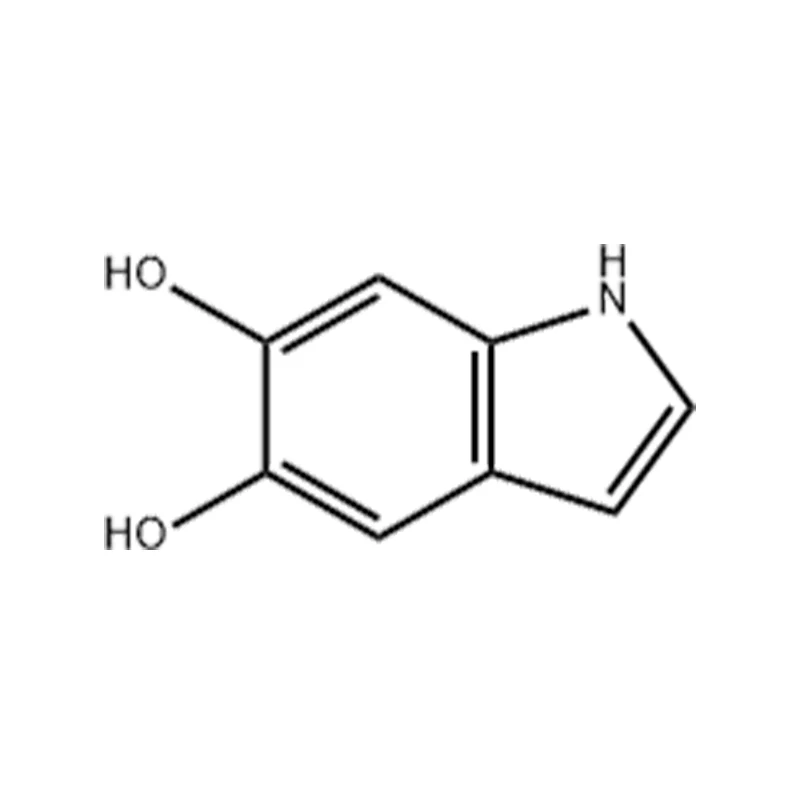
5,6-Dihydroxyindole is an ultimate precursor of eumelanin, the black pigment responsible for human hair and skin coloration. As a key intermediate in the melanogenesis pathway, 5,6-Dihydroxyindole is generated from dopachrome through spontaneous decarboxylation and serves as a substrate for further oxidative polymerization into eumelanin. In pharmaceutical research, 5,6-Dihydroxyindole has been recognized as an analytical reference standard for melanogenesis‑related studies, with documented applications in analytical method development, method validation (AMV), and quality‑controlled testing. The biological activity profile of 5,6-Dihydroxyindole extends beyond pigmentation, with reports of broad‑spectrum antibacterial, antifungal, antiviral, and antiparasitic effects, alongside dose‑dependent cytotoxic activity against certain pathogens. In melanoma research, urinary levels of 5,6-Dihydroxyindole and its O‑methylated derivatives serve as diagnostic biomarkers, with elevated excretion observed in melanoma patients compared to healthy individuals. For researchers studying melanin biosynthesis, pigment chemistry, or melanoma biomarkers, 5,6-Dihydroxyindole represents an indispensable reference material and chemical tool.
|
Parameter |
Specification |
|
Product Name |
5,6-Dihydroxyindole |
|
CAS Number |
3131-52-0 |
|
Molecular Formula |
C₈H₇NO₂ |
|
Molecular Weight |
149.15 g/mol |
|
Purity |
≥95.0% — ≥96.0% |
|
Physical Form |
Crystalline solid / powder |
|
Appearance |
Light beige to off-white / pale yellow powder |
|
Melting Point |
140 °C (decomposes) |
|
Density |
1.510 g/cm³ (relative density) |
|
Storage Condition |
–20 °C, sealed, under inert atmosphere (N₂ or Ar), protected from light |
|
Shelf Life |
12 months (powder at –20 °C under inert atmosphere) |
As a permanent hair dye, 5,6-dihydroxyindole operates through the same mechanism as para-phenylenediamine and its derivatives: it acts on keratin fibers in hair, resulting in pronounced coloring. The dye penetrates deep into the hair matrix, ensuring stable color retention after washing and minimal degradation under sunlight exposure. Historically, para-phenylenediamine and its derivatives have been the primary effective blackening components in hair dyes; however, these substances are carcinogenic, teratogenic, and allergenic, posing health risks to users. As an effective alternative, 5,6-dihydroxyindole is naturally produced by living organisms and exhibits no toxicity or adverse side effects.
The synthesis of 5,6-Dihydroxyindole can be accomplished through a biomimetic approach starting from L‑DOPA (L‑3,4‑dihydroxyphenylalanine), proceeding through the formation of dopachrome followed by spontaneous decarboxylation and aromatization. A simplified procedure adapted from the literature is described below.
Step 1 — Generation of dopachrome:
Dissolve L‑DOPA in an aqueous buffer at pH 6.5. Add an oxidizing agent such as potassium ferricyanide (K₃Fe(CN)₆) to initiate oxidation. Dopachrome is generated in situ as a red‑orange intermediate.
Step 2 — Decarboxylation to 5,6‑Dihydroxyindole:
At pH 6.5, dopachrome undergoes spontaneous decarboxylative rearrangement to form 5,6-Dihydroxyindole. The reaction mixture is allowed to proceed until decarboxylation is complete.
Step 3 — Isolation and purification:
Extract 5,6-Dihydroxyindole from the reaction mixture using an appropriate organic solvent (e.g., ethyl acetate). Purify by column chromatography or recrystallization. Isolation yields of approximately 40% (based on L‑DOPA starting material) have been reported.
1. Eumelanin Biosynthesis Research
As an ultimate precursor of eumelanin, 5,6-Dihydroxyindole is used to study the oxidative polymerization mechanisms that produce the black pigment in human hair, skin, and eyes. Researchers employ this compound to investigate melanogenesis pathway regulation, the enzymatic and non‑enzymatic steps leading to pigment formation, and the structure‑function relationships of melanin polymers.
2.Melanoma Biomarker Reference Standard
Urinary levels of 5,6-Dihydroxyindole and its O‑methylated derivatives are elevated in melanoma patients, making this compound a valuable reference standard for analytical method development, method validation (AMV), and quality‑controlled testing in diagnostic biomarker research.
3.Antimicrobial Activity Screening
Published studies report that 5,6-Dihydroxyindole exhibits broad‑spectrum antibacterial, antifungal, antiviral, and antiparasitic activity. This compound is used in screening campaigns to evaluate its effects against a range of pathogens, with documented dose‑dependent cytotoxic activity.
4.Synthetic Melanin Production
5,6-Dihydroxyindole serves as a monomeric precursor for the chemical synthesis of melanin‑like polymers. These synthetic melanins have applications in biomaterials research, including the development of UV‑protective coatings, drug delivery systems, and biocompatible pigments.
5.Analytical Method Development for Indolic Metabolites
For researchers developing HPLC, LC‑MS, or GC‑MS methods for the detection and quantification of indolic compounds in biological samples (urine, plasma, tissue homogenates), 5,6-Dihydroxyindole serves as a reference standard for system suitability, calibration curve construction, and method validation.
Exploring the chemistry of melanin biosynthesis or developing analytical methods for melanoma biomarkers? Whatever your research with 5,6-Dihydroxyindole entails, Cosperpharm is here to supply the high‑quality material you need — along with the technical support and reliable delivery your timeline demands. Contact us for a quote, lead time information, or to discuss your specific application requirements.
Address
No. 2 Yangguang 3rd Road, Duodao Chemical Cycle Industrial Park, Jingmen City, Hubei Province, China
Tel

![1-[2,3-Bis[(9Z,12Z)-octadeca-9,12-dien-1-yloxy]propyl]pyrrolidine](https://www.cosperpharma.com/upload/8820/1-2-3-bis-9z-12z-octadeca-9-12-dien-1-yloxy-propyl-pyrrolidine-349384.webp "1-[2,3-Bis[(9Z,12Z)-octadeca-9,12-dien-1-yloxy]propyl]pyrrolidine")
![1,2,4-Triazolo[4,3-a]pyridin-3(2H)-one](https://www.cosperpharma.com/upload/8820/1-2-4-triazolo-4-3-a-pyridin-3-2h-one-440735.webp "1,2,4-Triazolo[4,3-a]pyridin-3(2H)-one")