
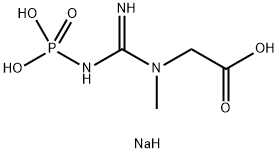
Creatine Phosphate Disodium Salt is a high-energy phosphate compound that plays a central role in cellular energy metabolism as a temporal ATP buffer in muscle and brain tissues . As the disodium salt of phosphocreatine, Creatine Phosphate Disodium Salt is the form most commonly used in biochemical research, cell culture applications, and pharmaceutical formulation due to its excellent water solubility and stability. Creatine Phosphate Disodium Salt functions as a substrate for creatine kinase, which catalyzes the reversible transfer of a phosphoryl group between phosphocreatine and ADP, providing a rapid means of ATP regeneration during periods of high energy demand. Creatine Phosphate Disodium Salt is widely used in cell culture media to support cellular energy metabolism, as a biochemical reagent in enzyme assays, and as a reference standard in pharmaceutical analysis for formulations containing phosphocreatine .
|
Parameter |
Specification |
|
Product Name |
Creatine Phosphate Disodium Salt |
|
CAS Number |
922-32-7 |
|
Molecular Formula |
|
|
Molecular Weight |
|
|
Appearance |
|
|
Density |
|
|
pH |
|
|
LogP |
|
|
Surface Tension |
|
|
Vapor Pressure |
|
|
Storage Condition |
2–8 °C |
Phosphocreatine is an important energy-supplying substance in the metabolism of muscle contraction. It is the chemical energy reserve of smooth muscle and striated muscle, and is used for the re-synthesis of ATP. Phosphocreatine disodium is its medicinal form.
Creatine phosphate sodium can be used as a myocardial protective agent. It exerts a variety of important physiological effects in the body in the form of creatine phosphate, and is widely used for myocardial protection of patients under cardiac ischemia or during cardiac surgery, as well as for the treatment of cardiovascular diseases such as heart failure, myocardial infarction and arrhythmia. It can improve the cardiac function and heart rate variability of patients with ischemic cardiomyopathy. It can not only provide energy for myocardial cells when they suffer from ischemia and hypoxia, but also protect myocardial cell membranes from the invasion of harmful substances such as oxygen free radicals. It has a postoperative myocardial protective effect on patients with valvular heart disease complicated by cardiac insufficiency, and is conducive to the postoperative recovery of cardiac function in such patients. Using it for the comprehensive treatment of myocardial damage after neonatal asphyxia can significantly improve myocardial enzymes and electrocardiogram, and has good efficacy and safety.
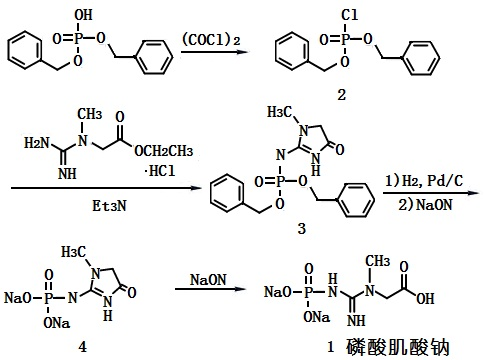
Using dibenzyl phosphate as the raw material, it reacts with oxalyl chloride to obtain dibenzyl phosphorochloridate (2). The dibenzyl phosphoryl creatine ethyl ester obtained from the reaction of 2 with creatine ethyl ester hydrochloride under the action of triethylamine is cyclized to dibenzyl phosphoryl creatinine (3). 3 undergoes palladium on carbon-catalyzed hydrogenolysis to remove the benzyl group, then reacts with sodium hydroxide to obtain disodium creatinol phosphate (4), and 4 is hydrolyzed under the action of sodium hydroxide to obtain 1.
Contraindicated in patients with hypersensitivity to any component of this product; high doses (5~10g/d) are prohibited for patients with chronic renal insufficiency. Rapid intravenous injection of more than 1 Chemicalbook g may cause a decrease in blood pressure. High-dose administration leads to excessive phosphate intake, which may affect calcium metabolism and the secretion of hormones that regulate homeostasis, and impair renal function and purine metabolism.
Whether you are studying cellular energy metabolism or developing cardiac protection formulations, Cosperpharm provides the high-quality phosphocreatine you need. Reach out to discuss your Creatine Phosphate Disodium Salt requirements today.
Address
No. 2 Yangguang 3rd Road, Duodao Chemical Cycle Industrial Park, Jingmen City, Hubei Province, China
Tel