
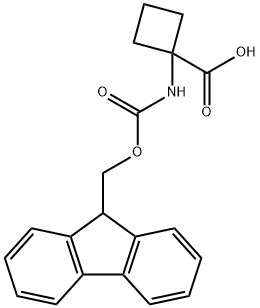
Fmoc-1-Aminocyclobutane-1-Carboxylic Acid is a specialized Fmoc‑protected non‑natural amino acid building block widely utilized in solid‑phase peptide synthesis. Fmoc-1-Aminocyclobutan-1-Carboxylic Acid features a four‑membered cyclobutane ring that introduces conformational rigidity into peptide sequences, which is particularly advantageous for designing cyclic peptides and peptidomimetics with enhanced metabolic stability. Fmoc-1-Aminocyclobutane-1-Carboxylic Acid is frequently employed in structure–activity relationship (SAR) studies where spatial pre‑organization of amino acid side chains is critical for target engagement. Additionally, Fmoc-1-Aminocyclobutane-1-Carboxylic Acid serves as a versatile precursor in the synthesis of conformationally constrained peptide libraries for drug discovery programs across oncology, CNS disorders, and infectious diseases, where its unique cyclobutane scaffold enables access to novel chemical space not attainable with standard proteinogenic amino acids.
Product Parameters
|
Parameter |
Specification |
|
Product Name |
Fmoc-1-Aminocyclobutane-1-Carboxylic Acid / Fmoc-Ac4c-OH |
|
CAS Number |
885951-77-9 |
|
Molecular Formula |
C₂₀H₁₉NO₄ |
|
Molecular Weight |
337.37 g/mol |
|
Appearance |
White to yellow solid |
|
Melting Point |
193.00–196.00 °C |
|
Boiling Point |
574.7 ± 29.0 °C |
|
Density |
1.35 ± 0.10 g/cm³ (predicted) |
|
pKa |
4.08±0.20 |
|
Storage Temperature |
Sealed in dry,2–8 °C |
FAQ
Q1: What is the difference between Fmoc-1-Aminocyclobutane-1-Carboxylic Acid and Fmoc-Ac4c-OH?
A: These are the same compound. Ac4c is an abbreviation for 1‑aminocyclobutane‑1‑carboxylic acid (also known as cyclovaline), where “Ac” denotes the cyclobutyl ring and the numeric “4” indicates the four‑membered ring size. Both names are used interchangeably in the literature and commercial catalogs. The IUPAC name is 1‑({[(9H‑fluoren‑9‑yl)methoxy]carbonyl}amino)cyclobutane‑1‑carboxylic acid.
Q2: Is this compound soluble in common peptide synthesis solvents?
A: Yes. The compound is soluble in common organic solvents including DMF, DCM, NMP, and DMSO, which are standard for Fmoc‑SPPS applications. This solubility profile enhances its versatility in synthetic applications and structural analyses across biochemistry research fields.
Application Scenarios
Fmoc Solid‑Phase Peptide Synthesis (Fmoc‑SPPS)
The compound serves as a standard building block for automated or manual Fmoc‑SPPS, enabling the incorporation of a conformationally constrained cyclobutane amino acid into peptide sequences. Compatible with standard deprotection (20% piperidine/DMF) and coupling (HBTU/HOBt/DIEA, HATU, PyBOP) protocols.
Conformationally Constrained Peptide Library Synthesis
Used in combinatorial chemistry and parallel synthesis to generate peptide libraries containing this rigid cyclic amino acid. Enables systematic exploration of the relationship between backbone conformation and biological activity in hit‑to‑lead optimization campaigns.
Structure–Activity Relationship (SAR) Studies
Incorporation of the cyclobutane scaffold into peptide leads allows medicinal chemists to probe the bioactive conformation and spatial requirements for target engagement. Essential for optimizing potency, selectivity, and pharmacokinetic properties.
Stable Peptide Drug Candidate Design
The cyclobutane ring confers proteolytic stability by restricting backbone flexibility and hindering recognition by endo‑ and exopeptidases. Used in the design of metabolically stable peptide therapeutics with extended half‑lives.
Cyclic Peptide and Peptidomimetic Synthesis
The rigid cyclobutane scaffold serves as a conformational lock within macrocyclic structures, enabling the design of constrained cyclic peptides with defined three‑dimensional architectures. Particularly valuable for targeting protein–protein interactions (PPIs).
Protein–Protein Interaction (PPI) Analysis
The pre‑organized geometry of the cyclobutane ring reduces entropic penalties upon binding, enabling the design of high‑affinity peptide probes for mapping protein interaction interfaces and validating therapeutic targets.
Bioconjugation and Targeted Drug Delivery
Used to attach peptides to surfaces, nanoparticles, or other biomolecules for developing targeted drug delivery systems and diagnostic tools. The rigid scaffold maintains conformational integrity upon conjugation.
Chemical Biology and Probe Development
Serves as a building block for photoaffinity probes, fluorescently labeled peptides, and activity‑based probes for studying enzyme mechanisms and protein function in complex biological systems.
Material Science and Polymer Chemistry
The cyclobutane ring imparts specific chemical properties to advanced materials, including polymers for coatings, adhesives, and functionalized surfaces.
Process Development and Scale‑Up
Pharmaceutical process chemists use this building block for reaction optimization, impurity mapping, and development of scalable commercial manufacturing routes for peptide‑based therapeutics. Cosperpharm provides characterization data and process support for seamless scale‑up.
Product Quality Assurance
Cosperpharm has established a comprehensive quality assurance system for Fmoc-1-Aminocyclobutane-1-Carboxylic Acid that meets the rigorous expectations of both research‑scale peptide synthesis and GMP‑compatible manufacturing:
Thorough analytical characterization. Each batch undergoes multi‑technique analytical release testing: HPLC purity (≥95–99% area normalization, with full chromatographic traceability), appearance verification (white to off‑white powder), melting point verification, water content determination (Karl Fischer), residual solvent analysis (GC), and identity confirmation by LC‑MS or NMR.
Full batch traceability with retention samples. From raw material procurement through Fmoc protection, purification, drying, and final packaging, every step is fully documented and traceable. Each batch receives a unique lot number with sufficient retention samples maintained in accordance with Cosperpharm quality procedures.
Stability monitoring program. Cosperpharm conducts ongoing stability studies under recommended storage conditions (2–8 °C and –20 °C, under inert atmosphere). Stability summaries are updated regularly, with full data packages available to support customer regulatory submissions.
Documentation ready for regulatory submission. Every shipment includes a Certificate of Analysis (COA) with batch‑specific purity and characterization data, a Material Safety Data Sheet (SDS), and customs documentation for international delivery. For customers preparing regulatory filings, Cosperpharm provides DMF‑ready documentation packages, method validation reports, stability data, and custom quality agreements upon request.
Customer‑initiated quality audits. Qualified customers are welcome to audit Cosperpharm’s manufacturing, quality control, and documentation facilities. Please contact our regulatory team to schedule an audit. ISO compliance documentation is available upon request.
Contact Us
Looking for a reliable source of Fmoc-1-Aminocyclobutane-1-Carboxylic Acid for your peptide synthesis campaign or drug discovery program? Cosperpharm offers competitive pricing, global shipping, and responsive technical support. Whether you need a small research sample or multi‑kilogram quantities for commercial production, reach out to our team for a quote or to discuss your project requirements.
Address
No. 2 Yangguang 3rd Road, Duodao Chemical Cycle Industrial Park, Jingmen City, Hubei Province, China
Tel

![1-[2,3-Bis[(9Z,12Z)-octadeca-9,12-dien-1-yloxy]propyl]pyrrolidine](https://www.cosperpharma.com/upload/8820/1-2-3-bis-9z-12z-octadeca-9-12-dien-1-yloxy-propyl-pyrrolidine-349384.webp "1-[2,3-Bis[(9Z,12Z)-octadeca-9,12-dien-1-yloxy]propyl]pyrrolidine")
![1,2,4-Triazolo[4,3-a]pyridin-3(2H)-one](https://www.cosperpharma.com/upload/8820/1-2-4-triazolo-4-3-a-pyridin-3-2h-one-440735.webp "1,2,4-Triazolo[4,3-a]pyridin-3(2H)-one")