
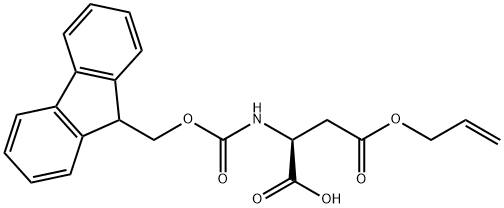
Fmoc-Asp(OAll)-OH is a cornerstone orthogonal building block in Fmoc solid‑phase peptide synthesis (SPPS), specifically engineered for synthesizing aspartate‑modified peptides, branched structures, and cyclic peptides. The Fmoc group of Fmoc-Asp(OAll)-OH provides base‑labile protection for the α‑amino group, while the α‑allyl ester serves as a selectively removable handle that remains stable under standard Fmoc removal conditions (20% piperidine in DMF) and can be cleaved with Pd(Ph₃P)₄ in the presence of allyl scavengers — leaving the free side‑chain carboxyl available for on‑resin branching, conjugation, or cyclization. Fmoc-Asp(OAll)-OH has established itself as an indispensable building block for chemists synthesizing complex peptide architectures, including branched peptides, head‑to‑tail cyclic peptides, and peptide–drug conjugates where orthogonal deprotection sequences are essential. The strategic importance of Fmoc-Asp(OAll)-OH extends beyond basic research into commercial peptide API manufacturing, where its reliable orthogonal protection properties enable scalable synthesis of therapeutically relevant peptide candidates requiring aspartate α‑position modifications. With well‑characterized physical properties and broad availability at high purity, Fmoc-Asp(OAll)-OH continues to be a preferred choice for both academic and industrial peptide chemists seeking robust orthogonal protection strategies in complex peptide synthesis campaigns.
Product Parameters
|
Parameter |
Specification |
|
Product Name |
Fmoc-Asp(OAll)-OH |
|
CAS Number |
146982-24-3 |
|
Molecular Formula |
C₂₂H₂₁NO₆ |
|
Molecular Weight |
395.41 g/mol |
|
Appearance |
White to off-white to pale yellow |
|
Melting Point |
111–115 °C |
|
Boiling Point |
638.5 ± 55.0 °C at 760 mmHg |
|
Density |
1.286 ± 0.06g/cm³ (predicted) |
|
Water Solubility |
Slightly soluble |
Product Advantages
Dual Orthogonal Protection — Fmoc + Allyl Ester
Fmoc-Asp(OAll)-OH features two fully orthogonal protecting groups: the base‑labile Fmoc group for α‑amino protection and the palladium‑labile allyl ester for α‑carboxyl protection. This orthogonal design enables a sequential deprotection strategy unmatched in synthetic flexibility — remove Fmoc with 20% piperidine while the allyl ester remains intact, then selectively cleave the allyl ester with Pd(Ph₃P)₄ without affecting Fmoc or tBu groups — allowing chemists to build complex peptide architectures, including branched peptides, head‑to‑tail cyclic peptides, and peptide–drug conjugates, with precision and efficiency.
Free Side‑Chain Carboxylic Acid for On‑Resin Branching
The unprotected side‑chain carboxyl group of aspartic acid in Fmoc-Asp(OAll)-OH serves as an immediate handle for on‑resin modifications after deprotection. After sequential removal of the Fmoc and allyl groups, the side‑chain carboxyl is free for amide coupling, esterification, or conjugation with fluorophores, PEG chains, or drug molecules — enabling rapid construction of complex peptide conjugates without additional protection/deprotection cycles.
Enabling Head‑to‑Tail Cyclization and Branched Peptides
Fmoc-Asp(OAll)-OH is the preferred building block for synthesizing head‑to‑tail cyclic peptides via the allyl ester/Fmoc orthogonal protection strategy. After solid‑phase linear assembly, the allyl ester is cleaved with Pd(0) catalysis, the Fmoc group is removed, and cyclization is performed between the free α‑amine and the free α‑carboxyl — all while side‑chain protecting groups remain intact. This same strategy enables synthesis of branched peptides where the aspartyl α‑position serves as a branching point for dendrimer‑type architectures.
High Purity and Well‑Defined Physical Properties
Cosperpharm supplies Fmoc-Asp(OAll)-OH with verified purity (≥98.0% HPLC), confirmed optical rotation ([α]²⁰/D −27 ± 2°), and a reproducible melting point (111–115 °C) — properties that are critical for reproducible SPPS performance, particularly in automated synthesizers where consistent solubility and coupling efficiency are paramount.
Broad Utility in Peptide Therapeutics Manufacturing
Fmoc-Asp(OAll)-OH is widely employed in the synthesis of therapeutic peptides and peptide conjugates requiring orthogonal protection at the aspartyl α‑position. Applications range from the production of branched peptide APIs for metabolic diseases, cyclic peptide candidates for oncology, and peptide–drug conjugates (PDCs) for targeted delivery — underscoring the exceptional synthetic versatility of this orthogonal building block in modern peptide drug development.
Synthetic Route
1. In a three-necked flask, mix tetrahydrofuran with aspartic acid; add phosphoxychloride dropwise under low temperature and allow the reaction to proceed for 6 hours. Filter to obtain the solid intermediate.
2. Wash the solid intermediate with anhydrous ether, dry it, then react it with propyl alcohol under controlled temperature and time conditions. After completion of the reaction, adjust the pH to 7 using triethylamine to precipitate the solid.
3. Wash the solid with ether and dry to yield intermediate L-Asp-OAl1.
4. Dissolve L-Asp-OAl1 in sodium bicarbonate solution, add acetone and Fmoc-O-Su, maintain pH around 9, and react under low temperature for 3 hours.
5. After reaction, wash with anhydrous ether, extract the product with ethyl acetate, followed by acidification, washing, drying, and concentration to dryness.
6. Finally, crystallize from petroleum ether to obtain the target product N-fluoromethoxycarbonyl-L-aspartic acid 4-allyl ester.
FAQ
A: Fmoc-Asp(OAll)-OH has two protecting groups: the Fmoc group protects the α‑amino group, while the allyl (OAll) ester protects the α‑carboxyl group. The aspartyl side‑chain carboxyl remains unprotected as a free carboxylic acid. This dual orthogonal protection enables selective deprotection sequences: Fmoc is removed with 20% piperidine in DMF, and the allyl ester is selectively cleaved with Pd(0) catalysts (e.g., Pd(Ph₃P)₄) in the presence of allyl scavengers.
Q2: Why are two protecting groups needed on aspartic acid?
A: Standard Fmoc SPPS of linear peptides uses Fmoc‑Asp(OtBu)‑OH, where the side‑chain is protected with a tBu group. Fmoc-Asp(OAll)-OH provides an orthogonal protection strategy that allows selective manipulation of the α‑position after Fmoc removal. This is essential for synthesizing branched peptides (where additional chains are coupled at the α‑position), head‑to‑tail cyclic peptides (where the α‑amine and α‑carboxyl are cyclized), and peptide–drug conjugates requiring selective modification at the α‑site.
Contact us
Whether you are scaling up a cyclic peptide candidate, developing a branched peptide vaccine, or simply need a reliable supply of orthogonal building blocks for your SPPS workflow — Cosperpharm makes it straightforward to secure Fmoc-Asp(OAll)-OH at the right quality, at the right scale, and on your timeline. Contact us today to discuss your requirements, request documentation, or place an order.
Address
No. 2 Yangguang 3rd Road, Duodao Chemical Cycle Industrial Park, Jingmen City, Hubei Province, China
Tel

![1-[2,3-Bis[(9Z,12Z)-octadeca-9,12-dien-1-yloxy]propyl]pyrrolidine](https://www.cosperpharma.com/upload/8820/1-2-3-bis-9z-12z-octadeca-9-12-dien-1-yloxy-propyl-pyrrolidine-349384.webp "1-[2,3-Bis[(9Z,12Z)-octadeca-9,12-dien-1-yloxy]propyl]pyrrolidine")
![1,2,4-Triazolo[4,3-a]pyridin-3(2H)-one](https://www.cosperpharma.com/upload/8820/1-2-4-triazolo-4-3-a-pyridin-3-2h-one-440735.webp "1,2,4-Triazolo[4,3-a]pyridin-3(2H)-one")