
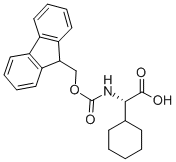
Fmoc-Chg-OH (Fmoc‑L‑cyclohexylglycine) is a glycine derivative containing an Fmoc protecting group that is widely utilized in peptide synthesis and drug design. Fmoc-Chg-OH features a rigid cyclohexyl side chain that introduces steric hindrance and conformational restriction into peptide sequences, enabling the formation of specific folded structures with enhanced stability. Fmoc-Chg-OH is particularly valuable in designing stable peptide drug candidates, modulating the spatial arrangement of peptide chains, and studying protein–protein interactions. Fmoc-Chg-OH has been used in drug development with promising results in the treatment of autoimmune diseases and cancer, and its unique cyclohexyl side chain allows researchers to construct peptide sequences with defined folding patterns. Due to its structural rigidity and hydrophobic nature, Fmoc-Chg-OH is indispensable for constructing peptide sequences with enhanced metabolic stability and target affinity.
Product Parameters
|
Parameter |
Specification |
|
Product Name |
Fmoc-Chg-OH (Fmoc-L-cyclohexylglycine) |
|
CAS Number |
161321-36-4 |
|
Molecular Formula |
C₂₃H₂₅NO₄ |
|
Molecular Weight |
379.45 g/mol |
|
Appearance |
White to off white solid |
|
Melting Point |
183 °C |
|
Boiling Point |
602.9 ± 38.0 °C at 760 mmHg |
|
Density |
1.238g/cm³ (predicted) |
|
Solubility |
DMSO 90 mg/mL (25 °C); DMSO 80 mg/mL with sonication |
Why Cosperpharm?
Peptide chemists incorporating non‑natural, conformationally constraining amino acids like L‑cyclohexylglycine face unique challenges — reduced coupling efficiency, potential epimerization, and difficulties predicting secondary structure effects. Cosperpharm supplies Fmoc-Chg-OH with the purity documentation and technical expertise to overcome these challenges.
High purity that supports reproducible synthesis. The rigid cyclohexyl side chain in Fmoc-Chg-OH introduces significant steric bulk that can complicate coupling steps if impurities are present or if the material has undergone racemization. Our analytical release protocol includes HPLC purity verification (≥95% to ≥99.9% by area normalization), melting point determination (178–183 °C), residual solvent analysis, free amine content testing, and chiral purity assessment — because the optical integrity of this building block directly affects the biological activity of your final peptide.
Documentation that supports research and development programs. Every shipment includes a Certificate of Analysis (COA) with batch‑specific HPLC purity, melting point data, water content, and chromatographic traceability. For customers preparing regulatory submissions or operating under GMP, Cosperpharm provides DMF‑ready documentation packages, stability summaries, custom quality agreements, and method validation support upon request.
Flexible supply across all phases of drug discovery. Cosperpharm supplies Fmoc-Chg-OH across the full range of applications — from 1g–25g for exploratory peptide synthesis and SAR studies, to 50g–100g for process development and scale‑up, to kilogram quantities for commercial peptide manufacturing. R&D samples ship within 5–7 business days; bulk orders ship within 2–3 weeks.
Technical support for cyclohexylglycine incorporation. Our process chemistry team can advise on optimized coupling conditions for Fmoc-Chg-OH — including choice of coupling reagents (HATU or PyBOP recommended), extended reaction times, double coupling cycles for hindered positions, and deprotection monitoring — because we have incorporated this constrained building block into numerous peptide sequences across multiple therapeutic areas.
Global reach with transparent pricing. Cosperpharm ships to pharmaceutical manufacturers, CROs, and academic laboratories worldwide, with full customs documentation included. Volume discounts apply at larger scales, and we communicate lead times upfront — no hidden fees, no unexpected delays.
Application Scenarios
Fmoc Solid‑Phase Peptide Synthesis (Fmoc‑SPPS)
Standard building block for automated or manual Fmoc‑SPPS, enabling incorporation of L‑cyclohexylglycine into peptide sequences. Compatible with standard deprotection (20% piperidine/DMF) and coupling (HATU, PyBOP, HBTU/HOBt/DIEA) protocols.
Conformationally Constrained Peptide Library Synthesis
The rigid cyclohexyl side chain imposes well‑defined steric constraints, making it valuable for generating peptide libraries with specific folded or structured conformations for screening against biological targets.
Modulation of Peptide Conformation and Spatial Arrangement
The cyclohexyl side chain can be used to fine‑tune the three‑dimensional architecture of peptide sequences. Used in the construction of specific folded or structured peptide sequences for optimal target binding.
Protease‑Resistant Therapeutic Peptide Design
Incorporation of L‑cyclohexylglycine confers proteolytic stability by sterically shielding adjacent amide bonds from enzymatic recognition and cleavage. Essential for developing long‑acting peptide therapeutics with extended plasma half‑lives.
Autoimmune Disease and Cancer Drug Development
Fmoc-Chg-OH has been used in drug development with promising results in the treatment of autoimmune diseases and cancer. Used to study target protein–ligand interaction mechanisms and develop peptide‑based therapeutics.
Antibiotic Development (LspA Inhibition)
Derivatives have been utilized in the synthesis of cyclic peptide antibiotics that inhibit lipoprotein signal peptidase II (LspA), a key enzyme in bacterial lipoprotein processing essential for bacterial cell wall synthesis.
Mutant p53 Reactivator Research
Derivatives of cyclohexylglycine have been studied as reactivators of mutant p53 proteins in cancer research, with potential applications for patients with various solid tumors.
Protein–Protein Interaction (PPI) Studies
The rigid cyclohexyl side chain reduces entropic penalties upon binding, enabling the design of high‑affinity peptide probes for mapping protein interaction interfaces and validating therapeutic targets.
Structure–Activity Relationship (SAR) Studies
The sterically demanding cyclohexyl side chain allows medicinal chemists to probe the hydrophobic and steric requirements for target binding. Used to optimize potency, selectivity, and pharmacokinetic properties.
Nanoparticle Functionalization and Drug Delivery
Used to functionalize nanoparticles, enhancing their properties for drug delivery and imaging applications. The Fmoc group can be removed to expose the free amino group for conjugation.
Process Development and Scale‑Up
Pharmaceutical process chemists use this building block for reaction optimization, impurity mapping, and development of scalable commercial manufacturing routes for peptide‑based therapeutics. Cosperpharm provides characterization data and process support for seamless scale‑up.
Quality Assurance at Cosperpharm
Each batch undergoes:
Gas chromatography (GC) – purity ≥97.0%
Non‑aqueous titration – purity ≥97.0%
Refractive index – confirmatory analysis
¹H NMR – structural verification
Appearance – colorless to light yellow to light orange clear liquid
A comprehensive COA, MSDS (with full GHS information), and certificate of origin accompany every shipment.
Contact Us
Whether you are designing conformationally constrained peptide therapeutics, developing antibiotics targeting LspA, or exploring cyclohexylglycine derivatives for autoimmune disease or cancer research, Cosperpharm delivers Fmoc-Chg-OH with the purity, documentation, and supply reliability you need. From small‑scale research samples to multi‑kilogram GMP‑compatible batches, our team is ready to support your project. Contact us today to discuss your requirements or request a competitive quote.
Address
No. 2 Yangguang 3rd Road, Duodao Chemical Cycle Industrial Park, Jingmen City, Hubei Province, China
Tel

![1-[2,3-Bis[(9Z,12Z)-octadeca-9,12-dien-1-yloxy]propyl]pyrrolidine](https://www.cosperpharma.com/upload/8820/1-2-3-bis-9z-12z-octadeca-9-12-dien-1-yloxy-propyl-pyrrolidine-349384.webp "1-[2,3-Bis[(9Z,12Z)-octadeca-9,12-dien-1-yloxy]propyl]pyrrolidine")
![1,2,4-Triazolo[4,3-a]pyridin-3(2H)-one](https://www.cosperpharma.com/upload/8820/1-2-4-triazolo-4-3-a-pyridin-3-2h-one-440735.webp "1,2,4-Triazolo[4,3-a]pyridin-3(2H)-one")