
Product Description
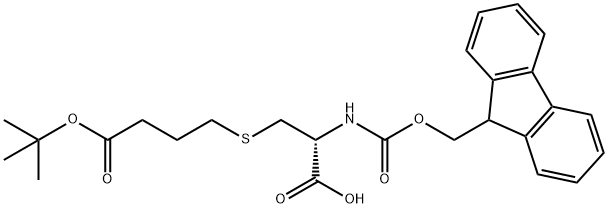
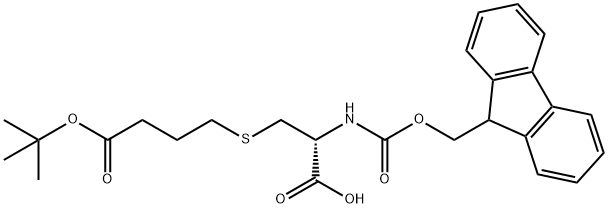
Fmoc-Cys(PrCOOtBu)-OH is a highly specialized amino acid building block engineered for advanced Fmoc solid-phase peptide synthesis applications requiring orthogonal protection of the cysteine side‑chain. The native thiol group of cysteine is highly reactive — it possesses strong nucleophilicity, can be readily acylated to form thioethers, and is susceptible to oxidation to disulfide bonds under ambient conditions, all of which must be protected during peptide assembly. Fmoc-Cys(PrCOOtBu)-OH addresses these challenges by incorporating the thiol into a stable thioether linkage with a 4-(tert-butoxy)-4-oxobutyl chain, effectively preventing unwanted oxidation and side reactions. The tert-butyl ester at the side‑chain terminus provides acid-labile protection, enabling selective unmasking under standard TFA cleavage conditions employed in SPPS work‑ups. This design makes Fmoc-Cys(PrCOOtBu)-OH an essential tool for peptide chemists requiring precise control over cysteine modifications, including the construction of branched architectures, the introduction of PEGylated linkers, and the synthesis of peptide–drug conjugates where the cysteine side‑chain serves as the conjugation handle.
Product Parameters
Parameter
Specification
Product Name
Fmoc-Cys(PrCOOtBu)-OH
CAS
102971-73-3
Molecular Formula
C₂₆H₃₁NO₆S
Purity
485.6 g/mol
Appearance
White to off-white to pale yellow Solid / Crystalline powder
Boiling Point
673.8±55.0℃
Density
1.237±0.06g/cm3
pKa
3.47±0.10
Storage Condition
2–8 °C, under inert atmosphere, protected from light
Synthetic Route
The general procedure for synthesizing (R)-2-((9H-fluorofluoren-9-yl)methoxy)carbonyl)amino)-3-(4-(tert-butoxy)-4-oxobutyl)thiopropionic acid from chloroformic acid-9-fluoromethyl ester and S-(4-(tert-butoxy)-4-oxobutyl)-L-cysteine is as follows: S-(4-(tert-butoxy)-4-oxobutyl)-L-cysteine (2 g, 7.60 mmol) was dissolved in a 10% Na₂CO₃ aqueous solution, to which the THF solution of Chemicalbook chloroformic acid-9-fluoromethyl ester (2.94 g, 11.4 mmol) was added slowly. The reaction mixture was stirred overnight at room temperature. Upon completion, the pH was adjusted to 4–5 with a 10% citric acid aqueous solution. THF was removed by reduced-pressure distillation, and the remaining solution was extracted with CH₂Cl₂. The organic phase was successively washed with saturated NaCl solution, dried with anhydrous Na₂SO₄, and concentrated. The crude product was purified by silica gel column chromatography, yielding the target compound (550 mg, yield 15%).
Product Advantages
1. Orthogonal Side‑Chain Protection via Thioether Linkage. The native cysteine thiol is chemically masked within a stable thioether linkage, completely preventing disulfide formation and unwanted nucleophilic side reactions during chain assembly. The side‑chain carboxyl group is protected as a tert-butyl ester, enabling acid‑labile orthogonal deprotection under standard TFA cleavage conditions. This dual‑protection strategy is essential for the assembly of complex peptides where the cysteine side‑chain requires subsequent functionalization (e.g., PEGylation, conjugation to drugs or fluorophores) after orthogonal unmasking.
2. Fully Fmoc‑Compatible for Standard SPPS Workflows. Fmoc-Cys(PrCOOtBu)-OH is engineered for seamless integration into any standard Fmoc solid‑phase peptide synthesis platform. The Fmoc group is removed under mild basic conditions (20% piperidine in DMF) without disturbing the acid‑labile side‑chain tert‑butyl ester, maintaining orthogonal protection throughout the assembly. This compatibility eliminates the need for specialized deprotection reagents or customized SPPS protocols, reducing development time and simplifying scale‑up.
3. Facile Conjugation and Branching. The side‑chain carboxyl group, after TFA‑mediated deprotection, serves as a versatile point of attachment for further chemical modifications — including the introduction of fluorescent labels for imaging, PEG chains for enhanced solubility and pharmacokinetics, or drug payloads for peptide‑drug conjugate (PDC) development. The linear 4‑carbon spacer between the thioether and the carboxylic acid provides sufficient flexibility for conjugation reactions while maintaining structural integrity during chain assembly.
4. Enhancing Peptide Solubility and Delivery. The introduction of the 4-(tert‑butoxycarbonylpropyl)thioether group has been shown to improve peptide properties in select therapeutic contexts. One described derivative has demonstrated efficacy as a cyclooxygenase inhibitor with potential applications in reducing inflammation, and its peptide‑based formulations have been investigated for use in ulcer therapy. While this represents a specialized application, it underscores the therapeutic potential of the cysteine side‑chain engineering enabled by Fmoc-Cys(PrCOOtBu)-OH.
5. Enabling C‑terminal Peptide Modifications. The free C‑terminal carboxylic acid of Fmoc-Cys(PrCOOtBu)-OH can be functionalized on the solid support prior to N‑terminal Fmoc removal, enabling the construction of C‑terminally modified peptides, amides, or esters. This flexibility expands the range of peptide architectures that can be accessed from a single building block.
6. Compatible with High‑Throughput Synthesis. The fully protected nature of Fmoc-Cys(PrCOOtBu)-OH makes it suitable for automated, high‑throughput SPPS platforms where chemical stability and predictable coupling kinetics are essential. Its consistent performance in robotic synthesis workflows supports rapid peptide library generation for drug discovery and structure–activity relationship (SAR) studies.
FAQ
Q1: Why is the thiol of cysteine protected this way rather than with Trt or Acm?
A: Traditional cysteine protecting groups such as Trt (trityl) and Acm (acetamidomethyl) are designed to mask the thiol directly, but they require specific removal conditions (TFA for Trt, iodine or silver salts for Acm) and may not offer orthogonal access to the side‑chain for conjugation. Fmoc-Cys(PrCOOtBu)-OH instead converts the thiol into a stable thioether linkage with a pendant carboxyl group that can be unmasked under standard TFA cleavage conditions. This design provides an orthogonal handle for further functionalization (e.g., conjugation, PEGylation) after the peptide is cleaved from the resin, which is not easily achieved with traditional thiol‑masking groups.
Contact us
From early‑discovery peptide libraries to commercial‑scale API manufacturing, Fmoc-Cys(PrCOOtBu)-OH is your gateway to cysteine‑engineered peptide therapeutics. Contact Cosperpharm today to discuss your requirement.
Address
No. 2 Yangguang 3rd Road, Duodao Chemical Cycle Industrial Park, Jingmen City, Hubei Province, China
Tel

![1-[2,3-Bis[(9Z,12Z)-octadeca-9,12-dien-1-yloxy]propyl]pyrrolidine](https://www.cosperpharma.com/upload/8820/1-2-3-bis-9z-12z-octadeca-9-12-dien-1-yloxy-propyl-pyrrolidine-349384.webp "1-[2,3-Bis[(9Z,12Z)-octadeca-9,12-dien-1-yloxy]propyl]pyrrolidine")
![1,2,4-Triazolo[4,3-a]pyridin-3(2H)-one](https://www.cosperpharma.com/upload/8820/1-2-4-triazolo-4-3-a-pyridin-3-2h-one-440735.webp "1,2,4-Triazolo[4,3-a]pyridin-3(2H)-one")