
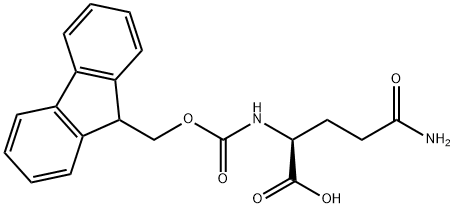
Fmoc-Gln-OH is a cornerstone reagent in Fmoc solid-phase peptide synthesis (Fmoc SPPS), serving as the protected form of L-glutamine for the incorporation of this amino acid into synthetic peptides and proteins. As an Fmoc-protected amino acid, Fmoc-Gln-OH enables the stepwise assembly of peptide chains on solid support, with the Fmoc group providing temporary protection of the α-amino group that can be removed under mild piperidine treatment without affecting acid-labile side-chain protecting groups or the peptide-resin linkage. Fmoc-Gln-OH is widely employed in both research and industrial peptide synthesis, including the production of therapeutic peptides, peptide-based drug candidates, and peptide antigens for immunological studies. The glutamine residue introduced by Fmoc-Gln-OH plays critical roles in numerous biologically active peptides, contributing to hydrogen bonding networks, stabilizing peptide conformations, and participating in key molecular recognition events. Fmoc-Gln-OH is available in multiple purity grades, with Novabiochem® grade products typically offering ≥99.0% HPLC purity and enantiomeric purity ≥99.5%.
Product Parameters
|
Parameter |
Specification |
|
Product Name |
Fmoc-Gln-OH |
|
CAS Number |
|
|
Molecular Formula |
|
|
Molecular Weight |
|
|
Appearance |
|
|
Melting Point |
|
|
Boiling Point |
|
|
Density |
1.3116 g/cm³ |
Synthetic Route
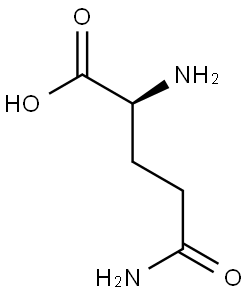 +
+ 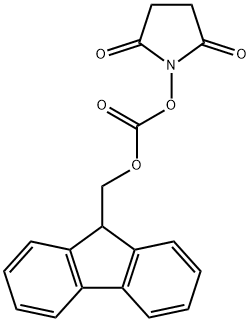 →
→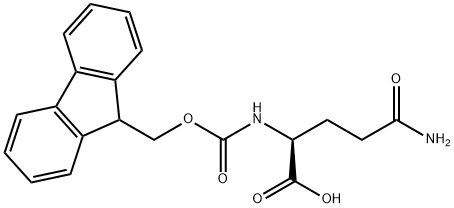
To a solution of stirred L-glutamine (1.75 g, 12 mmol) and sodium carbonate (1.27 g, 12 mmol) in 30 mL of water, slowly add the solution of 9-fluoromethyl-N-succinimide carbonate (Fmoc-OSu, 3.0 g, 8.9 mmol) dissolved in 60 mL of tetrahydrofuran (THF). The reaction mixture was stirred overnight at room temperature. Subsequently, THF was removed by vacuum distillation. The residue was diluted with 100 mL of 1 N hydrochloric acid, filtered, and the precipitated white solid was collected. This solid was further recrystallized in a mixed aqueous solution of DMF and 0.1 N Chemicalbook hydrochloric acid, yielding the target product (-2-[(9H-fluororen-9-yl)methoxy]carbonyl)-amino)-5-amino-5-oxovaleric acid as a white powder (2.76 g, yield 84%). The product was characterized by 1H-NMR (90 MHz, DMSO-d6), with chemical shifts of: 12.47 (1H, s); 7.89–7.20 (10H, m); 6.68 (1H, s, br); 4.22–3.90 (4H, m); and 2.25–1.86 (4H, m).
Storage Conditions
Store Fmoc-Gln-OH in a tightly sealed container at 2–8 °C in a dry, dark environment. Alternatively, the compound may be stored at room temperature in a cool, dark place (<15 °C). Keep the container protected from light and stored in a clean, well-ventilated area away from strong oxidizing agents, strong bases, and sources of ignition. The compound is hygroscopic; therefore, desiccated storage is recommended and the container should be opened only in a low-humidity environment.
Shelf life: 3 years when stored at –20 °C in a sealed container under inert atmosphere; 2 years when stored at 4 °C; 1 year when stored at room temperature in a cool, dark place.
Handling precautions: Use only in a fume hood. Wear chemical-resistant gloves, safety goggles, and a lab coat. Avoid generating dust or aerosols. Do not eat, drink or smoke in work areas. After handling, wash hands thoroughly. Contaminated clothing should be removed and washed before reuse. Refer to the Safety Data Sheet (SDS) for complete safety information.
Application Scenarios
Fmoc Solid-Phase Peptide Synthesis (SPPS)
Fmoc-Gln-OH is a primary building block for introducing L-glutamine into peptides synthesized via Fmoc SPPS. It is used in both manual and automated peptide synthesizers for research, process development, and commercial peptide manufacturing.
Therapeutic Peptide Manufacturing
Fmoc-Gln-OH is used in the synthesis of therapeutic peptides and peptide-based drug candidates. The glutamine residue plays critical roles in hydrogen bonding, conformational stability, and molecular recognition in numerous bioactive peptides.
Peptide Antigen and Vaccine Development
Fmoc-Gln-OH enables the synthesis of peptide antigens for immunological studies, vaccine development, and antibody generation. Synthetic peptides incorporating glutamine are widely used as immunogens and in epitope mapping studies.
Neuropeptide and Hormone Synthesis
Fmoc-Gln-OH is used in the synthesis of neuropeptides, peptide hormones, and growth factors where glutamine residues contribute to biological activity and receptor binding specificity.
Antimicrobial Peptide Research
Fmoc-Gln-OH is employed in the synthesis of antimicrobial peptides (AMPs) for studying structure-activity relationships and developing new antimicrobial therapeutics.
Contact Us
Whether you are scaling up a peptide therapeutic for clinical trials, developing a novel peptide drug candidate, or simply need a reliable source of Fmoc-Gln-OH for your research, Cosperpharm is here to support your success. Our team is ready to provide quotes, technical support, and documentation tailored to your specific requirements. Reach out today—we look forward to partnering with you.
Address
No. 2 Yangguang 3rd Road, Duodao Chemical Cycle Industrial Park, Jingmen City, Hubei Province, China
Tel

![1-[2,3-Bis[(9Z,12Z)-octadeca-9,12-dien-1-yloxy]propyl]pyrrolidine](https://www.cosperpharma.com/upload/8820/1-2-3-bis-9z-12z-octadeca-9-12-dien-1-yloxy-propyl-pyrrolidine-349384.webp "1-[2,3-Bis[(9Z,12Z)-octadeca-9,12-dien-1-yloxy]propyl]pyrrolidine")
![1,2,4-Triazolo[4,3-a]pyridin-3(2H)-one](https://www.cosperpharma.com/upload/8820/1-2-4-triazolo-4-3-a-pyridin-3-2h-one-440735.webp "1,2,4-Triazolo[4,3-a]pyridin-3(2H)-one")