
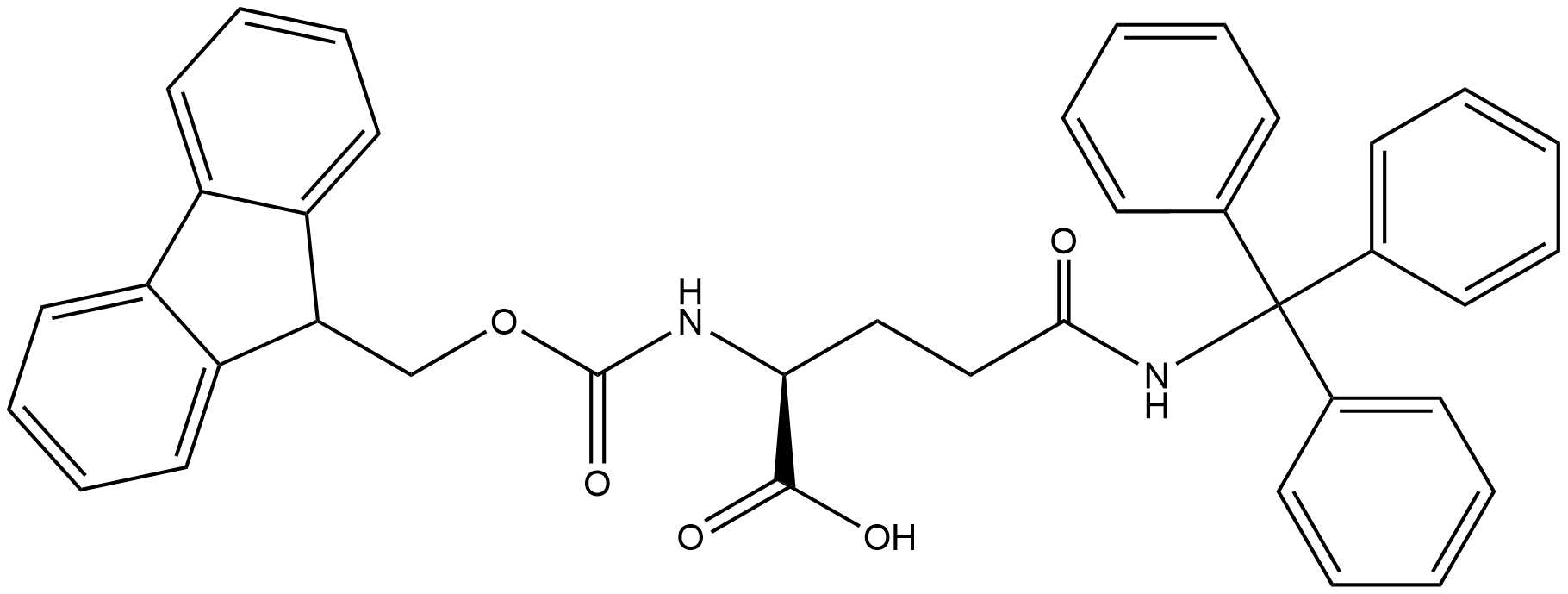
Fmoc-Gln(Trt)-OH is the reagent of choice for the introduction of glutamine residues in Fmoc solid-phase peptide synthesis. Fmoc-Gln(Trt)-OH incorporates trityl protection at the glutamine side chain amide, which effectively prevents the formation of unwanted side products during activation and coupling reactions. Fmoc-Gln(Trt)-OH exhibits good solubility in most organic solvents including chloroform, dichloromethane, ethyl acetate, DMSO, and acetone. Fmoc-Gln(Trt)-OH has been shown to result in significantly purer peptides than other derivatives used for the introduction of glutamine, making it the preferred choice for high-quality peptide synthesis.
Product Parameters
|
Parameter |
Specification |
|
Product Name |
Fmoc-Gln(Trt)-OH (Nα-Fmoc-Nδ-trityl-L-glutamine) |
|
CAS Number |
132327-80-1 |
|
Molecular Formula |
|
|
Molecular Weight |
610.7 g/mol |
|
Appearance |
|
|
Melting Point |
165–172 °C |
|
Boiling Point |
|
|
Density |
1.256±0.06 g/cm³ (predicted) |
|
pKa |
3.73±0.10 |
|
Storage Condition |
2-8℃ |
Product Advantages
Dual Protection for Superior Peptide Purity
Fmoc-Gln(Trt)-OH features both Fmoc protection at the Nα-amino group and trityl protection at the Nδ-side chain amide. This dual-protection strategy effectively prevents unwanted side reactions during peptide synthesis, including dehydration and cyclization of the glutamine side chain. The result is significantly purer peptides compared to other glutamine derivatives.
Excellent Solubility for Efficient Coupling
Fmoc-Gln(Trt)-OH exhibits good solubility in most organic solvents commonly used in peptide synthesis, including DMF, dichloromethane, chloroform, ethyl acetate, DMSO, and acetone. This excellent solubility enables efficient coupling reactions even at high concentrations.
Standard Fmoc SPPS Compatibility
Fmoc-Gln(Trt)-OH is fully compatible with standard Fmoc solid-phase peptide synthesis protocols. The Fmoc group is removed under standard basic conditions (20% piperidine in DMF), and the trityl group is cleaved during the final acidolytic cleavage step (typically TFA cleavage), releasing the fully deprotected glutamine residue.
High Purity for Reliable Results
Fmoc-Gln(Trt)-OH is supplied at ≥98.0% purity (HPLC), with very low levels of dipeptide, free amino acids, and acetic acid impurities. High purity is essential for achieving high overall yields and minimizing side products in peptide synthesis.
Preferred Reagent for Glutamine Incorporation
Fmoc-Gln(Trt)-OH is widely recognized as the reagent of choice for introducing glutamine residues in Fmoc SPPS. Its use results in significantly purer peptides than other glutamine derivatives, making it the preferred choice for high-quality peptide synthesis.
Scalable Supply for All Development Stages
Cosperpharm supplies Fmoc-Gln(Trt)-OH at multiple quality levels to support peptide research from early-stage discovery through commercial manufacturing. Our rigorous quality control ensures batch-to-batch consistency for reproducible peptide synthesis results.
Synthetic Routine
At room temperature, 9-BBN-protected glutamine (1 mmol) was vigorously stirred in acetonitrile (2 mL). Sodium hydrogen phosphate (3 mmol, 426 mg) was added to the resulting reaction mixture, followed by gradual addition of trifluoroperoxacetic acid (6 mL, 0.5 min in CH₃CN). The reaction progress was monitored via TLC until complete consumption of reactants. The reaction was quenched by adding a 20% Na₂SO₃ aqueous solution (1 mL). Solvent was removed under rotary evaporator; the residue was dissolved in dioxane (15 mL) and water (5 mL), then treated with solid sodium bicarbonate (5 mmol, 420 mg). The solution was cooled to 0°C, and 9-fluoromethyl-N-succinimide carbonate was added. The mixture was stirred under water ice bath for 30 minutes until complete conversion of amino acids occurred, after which volatiles were removed. Twenty mL of water was added, and pH was adjusted to 3 using 1 M H₂SO₄. The aqueous phase was extracted three times with dichloromethane (4 × 15 mL); combined extracts were dried with anhydrous Na₂SO₄, filtered to remove the drying agent, and concentrated under vacuum. The residue was purified by silica gel column chromatography using dichloromethane/methanol/0.1% formic acid as eluent to yield the target product.
Application
Fmoc-Gln(Trt)-OH is an amino acid derivative that can be utilized in fundamental biochemical research and organic synthesis processes.
Contact Us
Need Fmoc-Gln(Trt)-OH for your peptide synthesis project? Cosperpharm provides the quality, documentation, and supply reliability that peptide chemists and pharmaceutical manufacturers trust. From gram-scale research quantities to kilogram-scale production batches, we deliver consistent quality with transparent lead times. Contact us today—we are ready to support your peptide synthesis needs.
Address
No. 2 Yangguang 3rd Road, Duodao Chemical Cycle Industrial Park, Jingmen City, Hubei Province, China
Tel

![1-[2,3-Bis[(9Z,12Z)-octadeca-9,12-dien-1-yloxy]propyl]pyrrolidine](https://www.cosperpharma.com/upload/8820/1-2-3-bis-9z-12z-octadeca-9-12-dien-1-yloxy-propyl-pyrrolidine-349384.webp "1-[2,3-Bis[(9Z,12Z)-octadeca-9,12-dien-1-yloxy]propyl]pyrrolidine")
![1,2,4-Triazolo[4,3-a]pyridin-3(2H)-one](https://www.cosperpharma.com/upload/8820/1-2-4-triazolo-4-3-a-pyridin-3-2h-one-440735.webp "1,2,4-Triazolo[4,3-a]pyridin-3(2H)-one")