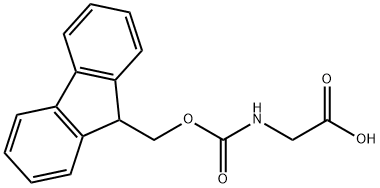
Fmoc-Gly-OH is the fundamental protected glycine building block for Fmoc-based solid-phase peptide synthesis. As the simplest amino acid with only a hydrogen atom as its side chain, glycine imposes no steric constraints on peptide backbone conformation, making Fmoc-Gly-OH a versatile building block for sequence positions requiring conformational flexibility. The Fmoc group is cleanly removed by piperidine treatment during SPPS, allowing sequential chain assembly without racemization concerns. Fmoc-Gly-OH is widely used in both research and process-scale peptide production, with documented applications in the synthesis of peptides related to nucleolin and other biologically active sequences. Beyond traditional peptide synthesis, Fmoc-Gly-OH serves as a key starting material for the preparation of glycine-containing peptidomimetics, glycoconjugates, and peptide-based drug delivery systems, and is essential for constructing glycine-rich linker sequences in peptide–drug conjugates and biomaterials.
Product Parameters
|
Parameter |
Specification |
|
Product Name |
Fmoc-Gly-OH |
|
CAS Number |
29022-11-5 |
|
Molecular Formula |
C₁₇H₁₅NO₄ |
|
Molecular Weight |
297.31 g/mol |
|
Appearance |
White to off-white powder |
|
Melting Point |
174–175 °C |
|
Solubility |
Soluble in DMF (10% clear solution), methanol, DMSO |
|
pKa |
3.89±0.10 (predicted) |
|
Storage Condition |
2–8 °C, sealed, dry |
Synthetic Routes
The specific steps for synthesizing Fmoc-Gly-OH are as follows: 3.0 g of glycine was dissolved in 115 mL of 10% Na₂CO₃ solution and cooled to-4°C to 0°C. Then, 11.2 g of Fmoc-Cl was dissolved in 35.0 mL of acetone and added dropwise to the mixture. After addition, the mixture was stirred under ice bath for 30 minutes followed by stirring at room temperature for 2.0 hours. Reaction progress was monitored by thin-layer chromatography. Upon completion of the reaction, the product was poured into 400 mL of water and extracted twice with ether; after cooling, pH was adjusted to approximately 2 using concentrated hydrochloric acid, yielding a large amount of white solid. The solid was then extracted three times with 50 mL of ethyl acetate, dried with anhydrous magnesium sulfate, solvent removed by reduced-pressure distillation, and precipitated with petroleum ether, yielding 11.5 g of Fmoc-glycine. Purification yielded a product with purity of 97.35% as determined by high-performance liquid chromatography (HPLC).
Application Scenarios
1. General Peptide Synthesis
Fmoc-Gly-OH is the most fundamental building block in Fmoc SPPS, used as a starting material for synthesizing essentially any peptide sequence containing glycine. It is widely used in medical, environmental, and industrial research due to its unique properties.
2. GLP-1 Analog Synthesis
Essential for constructing the glycine-rich linker regions in GLP-1 analogs and other incretin mimetics, where glycine residues provide the necessary backbone flexibility for receptor activation.
3. Peptide Linker and Spacer Construction
Fmoc-Gly-OH is the building block of choice for constructing flexible glycine linkers (e.g., (Gly)₃, (Gly)₄, (Gly)₅) in peptide–drug conjugates, bispecific peptides, and peptide–polymer conjugates, where minimal steric hindrance and optimal flexibility are required.
4. Nucleolin-Related Peptide Synthesis
The use of Fmoc-Gly-OH was found to be essential for the synthesis of peptides related to nucleolin, a multifunctional protein involved in ribosome biogenesis and cell proliferation.
5. Peptide-Based Biomaterials
Used in the synthesis of self-assembling peptide hydrogels and other biomaterials, where glycine residues contribute to the formation of beta-sheet structures and provide mechanical flexibility.
6. Peptidomimetic Synthesis
Fmoc-Gly-OH serves as the starting material for the synthesis of glycine-containing peptidomimetics and unnatural amino acid derivatives, enabling the development of proteolytically stable therapeutic peptides.
7. Method Development and QC Reference
For analytical method development, QC testing, and process validation in peptide manufacturing, Fmoc-Gly-OH serves as a well-characterized reference standard for establishing chromatographic methods and system suitability testing.
8. Academic and Industrial Research
Fmoc-Gly-OH is a standard reagent in peptide research laboratories worldwide, used in training, method development, and routine peptide synthesis across all application areas.
Quality Assurance at Cosperpharm
Each batch undergoes:
Gas chromatography (GC) – purity ≥97.0%
Non‑aqueous titration – purity ≥97.0%
Refractive index – confirmatory analysis
¹H NMR – structural verification
Appearance – colorless to light yellow to light orange clear liquid
A comprehensive COA, MSDS (with full GHS information), and certificate of origin accompany every shipment.
Contact Us
Sometimes the simplest building block is the easiest to overlook — but not at Cosperpharm. We stock Fmoc-Gly-OH in ready‑to‑ship quantities from grams to kilograms, all with verified purity (≥98%) and low residual solvents. Need it urgently? R&D samples ship within 5‑7 business days. Bulk orders, volume discounts, or custom packaging? Just ask. Email Cosperpharm today — we make sure your glycine integrations are effortless and affordable.
Address
No. 2 Yangguang 3rd Road, Duodao Chemical Cycle Industrial Park, Jingmen City, Hubei Province, China
Tel

![1-[2,3-Bis[(9Z,12Z)-octadeca-9,12-dien-1-yloxy]propyl]pyrrolidine](https://www.cosperpharma.com/upload/8820/1-2-3-bis-9z-12z-octadeca-9-12-dien-1-yloxy-propyl-pyrrolidine-349384.webp "1-[2,3-Bis[(9Z,12Z)-octadeca-9,12-dien-1-yloxy]propyl]pyrrolidine")
![1,2,4-Triazolo[4,3-a]pyridin-3(2H)-one](https://www.cosperpharma.com/upload/8820/1-2-4-triazolo-4-3-a-pyridin-3-2h-one-440735.webp "1,2,4-Triazolo[4,3-a]pyridin-3(2H)-one")