
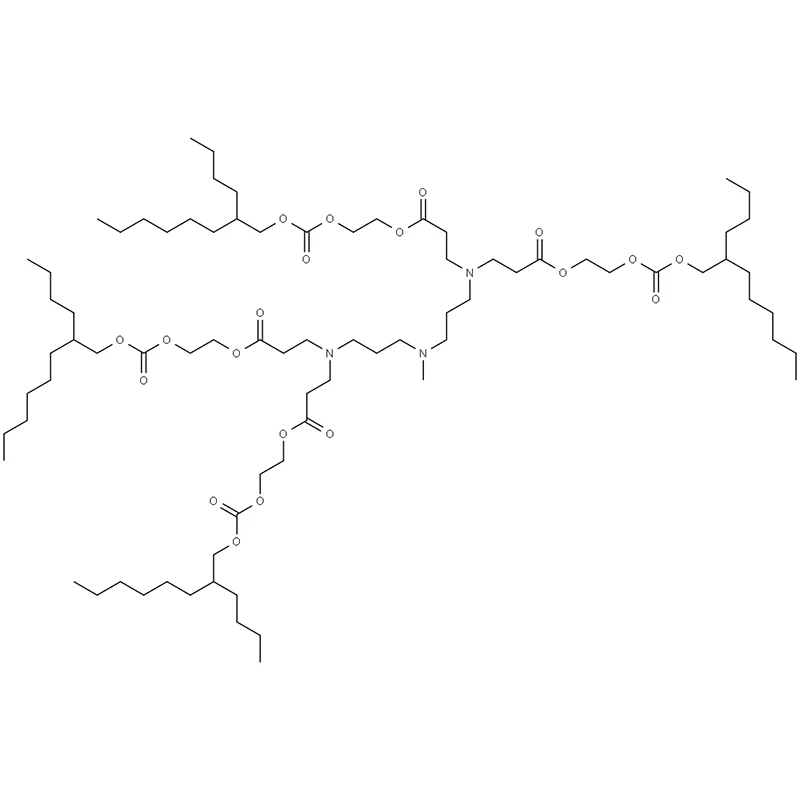
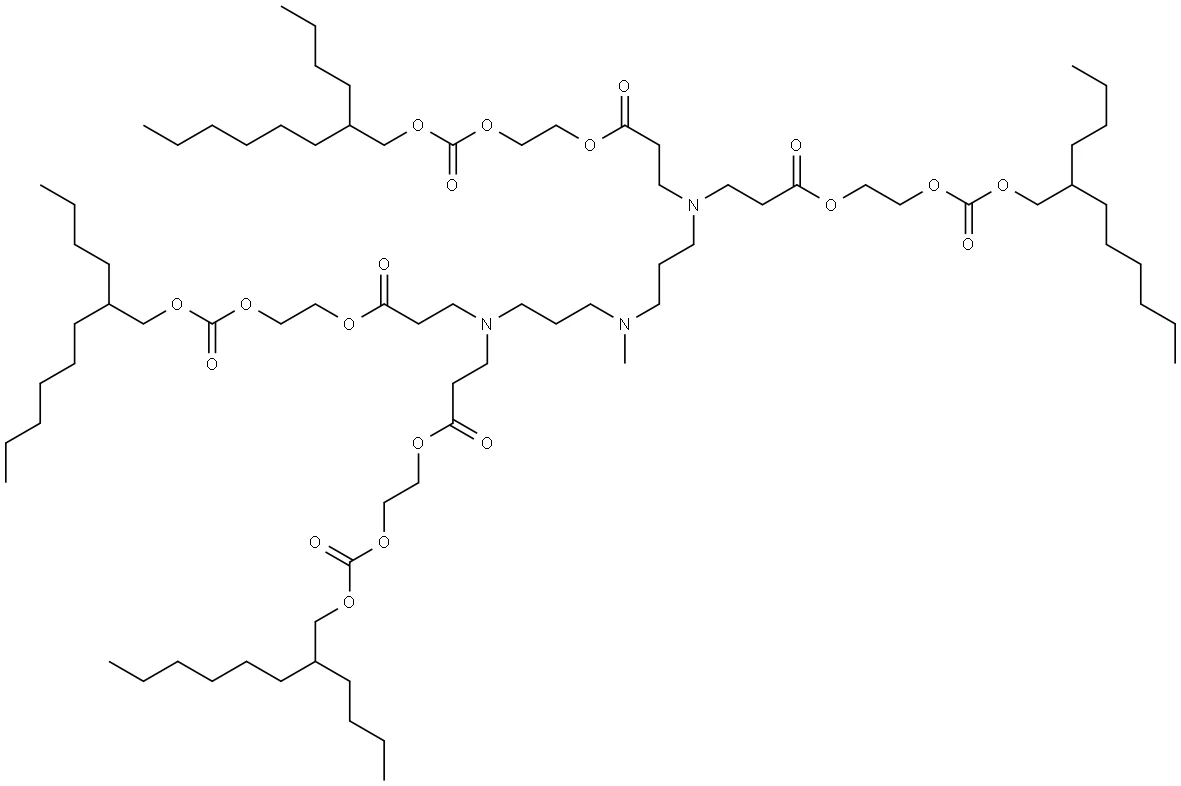
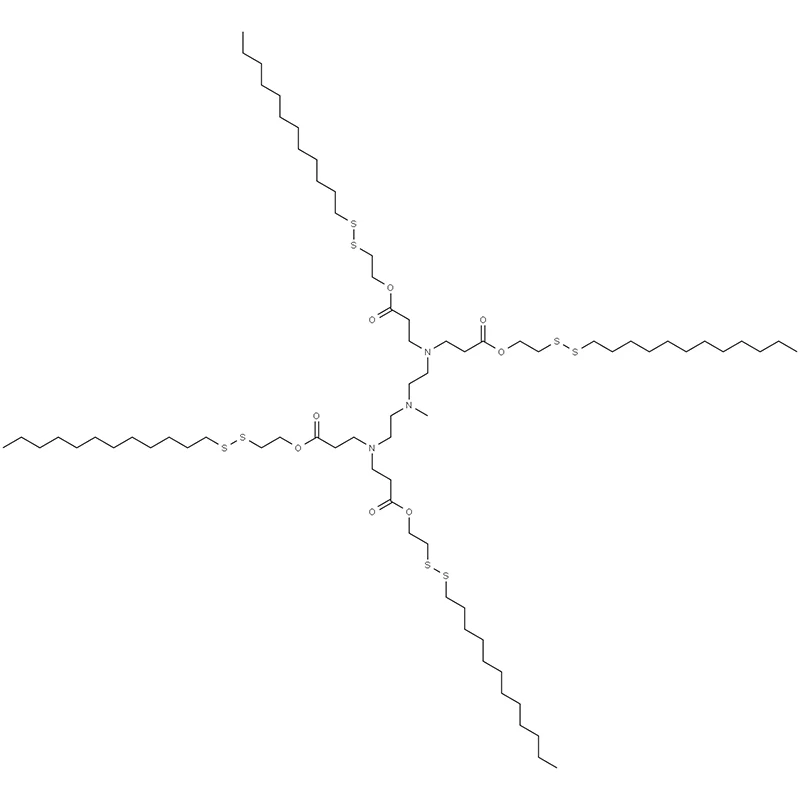
Lipid 88 is an ionizable cationic lipid that has been successfully used in the generation of lipid nanoparticles (LNPs) for the delivery of mRNA in vivo. Preclinical studies have demonstrated that Lipid 88‑based LNPs encapsulating mRNA encoding the SARS‑CoV‑2 spike glycoprotein elicit robust humoral and cellular immune responses. Lipid 88 LNPs increased anti‑spike IgG titers in bronchoalveolar lavage fluid and elevated the percentage of CD8⁺, CD8⁺CD44⁺, CD4⁺, and CD4⁺CD44⁺ T cells in the lungs and spleen of immunized mice. In a hamster model of SARS‑CoV‑2 Omicron infection, Lipid 88‑based LNPs prevented body weight loss, increased serum IgG and IgA titers, and reduced viral loads in lung and nasal washes. The multi‑amine structure of Lipid 88 allows it to remain charge‑neutral in the bloodstream while becoming progressively more cationic as the pH drops during endosomal maturation, enabling efficient cytoplasmic release of the mRNA cargo.
|
Parameter |
Specification |
|
Product Name |
Lipid 88 |
|
CAS Number |
2982842-99-7 |
|
Molecular Formula |
C₇₉H₁₄₇N₃O₂₀ |
|
Molecular Weight |
1459.02 g/mol |
|
Appearance |
Colorless to light yellow liquid |
|
Solubility |
Chloroform: sparingly soluble (1–10 mg/mL); Ethanol: sparingly soluble (1–10 mg/mL) |
|
pKa |
9.239±0.50 |
The synthesis of Lipid 88 involves the convergent assembly of a branched polyamine core followed by sequential amidation and esterification reactions to install multiple 2‑hexyldecanoate tails and PEG‑containing linkers. Given the complexity of the structure — containing 20 oxygen atoms and 84 rotatable bonds — the synthesis requires multiple steps of protection and deprotection, and purification is typically achieved by preparative HPLC. Detailed synthetic procedures for Lipid 88 are described in the primary literature and patent applications relating to ionizable lipid libraries for nucleic acid delivery.
Q1: What is the primary application of Lipid 88?
A: Lipid 88 is used as an ionizable cationic lipid in the generation of LNPs for mRNA delivery, particularly in vaccine development. It has been validated in preclinical models of SARS‑CoV‑2 infection.
Q2: How should Lipid 88 be stored?
A: Store Lipid 88 as a powder at –20 °C for long‑term storage (3 years) or at 4 °C for short‑term storage (2 years). For solutions, store at –20 °C for up to 2 years.
1. mRNA Vaccine Development for Emerging Pathogens
Lipid 88 has been validated in preclinical models of SARS‑CoV‑2 infection, demonstrating robust immunogenicity and protective efficacy. It is suitable for developing mRNA vaccines against viral pathogens, including emerging variants of concern.
2. Intranasal mRNA Vaccination
Lipid 88‑based LNPs have been shown to induce immune responses in the lungs and bronchoalveolar lavage fluid, making them attractive for intranasal or pulmonary delivery of mucosal vaccines.
3. T Cell‑Targeted Immunotherapy
The ability of Lipid 88 LNPs to increase CD8⁺ and CD4⁺ T cell populations in the lungs and spleen makes them a valuable tool for developing T cell‑targeted immunotherapies for cancer and infectious diseases.
4. Lipid Nanoparticle Formulation Optimization
Formulation scientists use Lipid 88 as a reference ionizable lipid for optimizing LNP manufacturing parameters, including lipid mixing ratios, microfluidic flow rates, and encapsulation efficiency.
5. Ionizable Lipid Structure‑Activity Studies
Medicinal chemists employ Lipid 88 as a benchmark compound in SAR studies exploring the influence of amine multiplicity, PEG linker length, and tail branching on LNP potency, toxicity, and tropism.
6. PEGylated Lipid Delivery Systems
The presence of multiple oxygen‑rich PEG‑like ether linkages in Lipid 88 enhances its compatibility with PEGylated lipid systems, making it suitable for developing long‑circulating LNPs with reduced protein adsorption and enhanced colloidal stability.
Cosperpharm invites researchers and process developers to inquire about Lipid 88 for vaccine and gene therapy applications. Whether you need a small reference sample for screening or kilogram‑scale material for preclinical toxicology studies, our team will design a supply plan tailored to your timeline and budget. Contact us to request a confidential discussion, a material transfer agreement, or a full documentation package including COA and stability summary.
Address
No. 2 Yangguang 3rd Road, Duodao Chemical Cycle Industrial Park, Jingmen City, Hubei Province, China
Tel

![1-[2,3-Bis[(9Z,12Z)-octadeca-9,12-dien-1-yloxy]propyl]pyrrolidine](https://www.cosperpharma.com/upload/8820/1-2-3-bis-9z-12z-octadeca-9-12-dien-1-yloxy-propyl-pyrrolidine-349384.webp "1-[2,3-Bis[(9Z,12Z)-octadeca-9,12-dien-1-yloxy]propyl]pyrrolidine")
![1,2,4-Triazolo[4,3-a]pyridin-3(2H)-one](https://www.cosperpharma.com/upload/8820/1-2-4-triazolo-4-3-a-pyridin-3-2h-one-440735.webp "1,2,4-Triazolo[4,3-a]pyridin-3(2H)-one")