
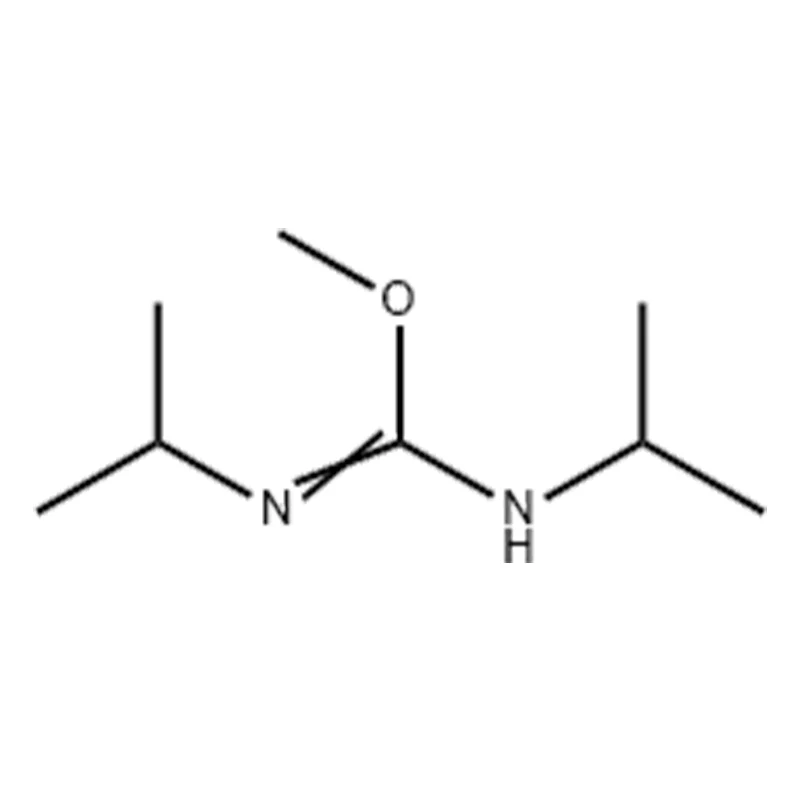
N,N'-Diisopropyl-O-methylisourea (CAS 54648-79-2) is a synthetic organic compound whose structure comprises a methyl group and two isopropyl groups attached to a central isourea core, resulting in a versatile and highly reactive building block essential for heterocyclic chemistry. A widely recognized application of N,N'-Diisopropyl-O-methylisourea is in the synthesis of proline betaine (stachydrine) and 4-hydroxyproline betaine (betonicine), two naturally occurring osmoprotectants that help organisms survive extreme osmotic stress — a role documented by multiple suppliers including Aladdin and Sigma-Aldrich. In this capacity, N,N'-Diisopropyl-O-methylisourea serves as a guanidinylating agent that transfers the N,N′-diisopropylcarbamimidoyl group to target amine substrates, a transformation crucial for constructing betaine frameworks.
Beyond betaine synthesis, N,N'-Diisopropyl-O-methylisourea is a versatile synthetic reagent for constructing diverse heterocyclic frameworks including pyrimidines, triazines, and carbazoles. Its chemical versatility is further underscored by documented reactions with amino acids and amines, which have served as model studies for understanding the mechanism of biotin-dependent carboxylations — a fundamental process in biochemistry. N,N'-Diisopropyl-O-methylisourea has also been recognized as a natural product that regulates enzyme activation by binding to amines on the enzyme's active site, highlighting its potential beyond synthetic applications.
In addition, N,N'-Diisopropyl-O-methylisourea acts primarily as a carbodiimide-type reagent, facilitating the formation of amide bonds through activation of carboxylic acids — a transformation crucial in peptide synthesis and drug development. From a handling perspective, the compound is a colorless to nearly colorless liquid at room temperature, distillable under reduced pressure (boiling point 50–52°C at 10 mmHg), making it easy to purify when necessary. Its solution-phase stability at low temperatures (2–8°C) under an inert atmosphere supports long-term storage and reliable use in multi-step synthesis campaigns.
|
Parameter |
Specification |
|
CAS Number |
54648-79-2 |
|
EINECS Number |
259-275-2 |
|
BRN Number |
1753052 |
|
NSC Number |
672441 |
|
Molecular Formula |
C₈H₁₈N₂O |
|
Molecular Weight |
158.24 g/mol |
|
Purity |
≥98% by GC/T |
|
Appearance |
Colorless to nearly colorless transparent liquid |
|
Boiling Point |
50–52 °C at 10 mmHg (lit.) |
|
Density |
0.872 g/mL at 20 °C (lit.) |
|
Refractive Index |
n20/D 1.436 (lit.) |
|
Flash Point |
96 °F (35.6 °C) — flammable |
|
pKa |
9.85 ± 0.50 (Predicted) |
|
Storage Condition |
2–8°C, refrigerated, under inert gas (nitrogen or argon), sealed, away from moisture and heat |
|
Solubility |
Soluble in common organic solvents (dichloromethane, THF, ethyl acetate, etc.) |
A: The compound is primarily used as a synthetic reagent in heterocyclic chemistry (synthesis of pyrimidines, triazines, carbazoles), as a guanidinylating agent for natural product synthesis (proline betaine and betonicine), as a carbodiimide-type coupling reagent for amide bond formation, and as a tool for biochemical mechanism studies.
A: Yes, N,N'-Diisopropyl-O-methylisourea has been identified as a natural product that regulates enzyme activation by binding to amines on enzyme active sites, giving it validated utility beyond its synthetic reagent function.
● Temperature: 2–8°C (refrigerated) — do not freeze
● Atmosphere: Store under inert gas (nitrogen or argon)
● Container: Keep container tightly closed, sealed, and airtight
● Protection: Store away from moisture, heat, and ignition sources
● Environmental conditions: Store in a dry, well-ventilated place
● Incompatibilities: Strong oxidizing agents, water/moisture, strong acids, strong bases
● Shelf life: 24 months when stored as recommended
Handling recommendation: Due to the compound‘s moisture sensitivity, always handle under a protective atmosphere. After opening, purge the container with dry nitrogen or argon before resealing. For long-term storage, aliquot into single-use vials to minimize exposure to air and moisture. Work in a fume hood, as the compound may release vapors at room temperature.
A medicinal chemistry team needs to generate a focused library of pyrimidine- or triazine-based compounds for screening against a biological target. N,N'-Diisopropyl-O-methylisourea serves as a condensation reagent that enables the assembly of the heterocyclic core in one pot, with the two isopropyl groups providing steric protection that prevents over-reaction and improves yields. The compound‘s documented utility in constructing pyrimidines, triazines, and carbazoles makes it a foundation for library generation.
A total synthesis group requires a guanidinylating agent for preparing proline betaine (stachydrine) and 4-hydroxyproline betaine (betonicine), two osmoprotective compounds with applications in stress biology research. The reaction of N,N'-Diisopropyl-O-methylisourea with proline derivatives provides a reliable route to these betaine frameworks, as documented by multiple suppliers including Sigma-Aldrich.
An organic chemist needs a carbodiimide-type coupling reagent for forming amide bonds under mild conditions without requiring aqueous work-up. N,N'-Diisopropyl-O-methylisourea activates carboxylic acids through O-alkylisourea intermediate formation, facilitating nucleophilic attack by amines. Unlike water-soluble carbodiimides (e.g., EDC), this lipophilic reagent is fully soluble in organic media, enabling peptide coupling in anhydrous, aprotic solvents.
A biochemistry lab studies the mechanism of biotin-dependent carboxylases — enzymes that catalyze essential carboxylation reactions in metabolism. Published studies have used the reaction of N,N'-Diisopropyl-O-methylisourea with amino acids and amines as a model system to understand the role of protonation vs. CO₂ transfer in these enzymatic processes, making the compound a validated tool for mechanistic enzymology.
A protein biochemist requires a reactive probe to study enzyme active site architecture. N,N'-Diisopropyl-O-methylisourea has been recognized as a natural product that regulates enzyme activity by binding to amines on the enzyme‘s active site, making it a candidate for active-site labeling studies and inhibitor design research.
A process chemist needs a carbodiimide-type coupling reagent with excellent solubility in non-polar organic solvents (toluene, dichloromethane, ethyl acetate). The two isopropyl groups on N,N'-Diisopropyl-O-methylisourea render it highly lipophilic, ensuring complete solubility in standard organic media and enabling efficient coupling in anhydrous reaction systems where water-miscible reagents would be problematic.
We are here to support your research and production.Whether you're developing a new synthetic route, scaling up a heterocyclic library, or need a reliable source of this specialized isourea reagent, Cosperpharm is your partner. Our customer success team typically responds within 24 hours on regular business days.
Address
No. 2 Yangguang 3rd Road, Duodao Chemical Cycle Industrial Park, Jingmen City, Hubei Province, China
Tel


![1-[2,3-Bis[(9Z,12Z)-octadeca-9,12-dien-1-yloxy]propyl]pyrrolidine](https://www.cosperpharma.com/upload/8820/1-2-3-bis-9z-12z-octadeca-9-12-dien-1-yloxy-propyl-pyrrolidine-349384.webp "1-[2,3-Bis[(9Z,12Z)-octadeca-9,12-dien-1-yloxy]propyl]pyrrolidine")
![1,2,4-Triazolo[4,3-a]pyridin-3(2H)-one](https://www.cosperpharma.com/upload/8820/1-2-4-triazolo-4-3-a-pyridin-3-2h-one-440735.webp "1,2,4-Triazolo[4,3-a]pyridin-3(2H)-one")