
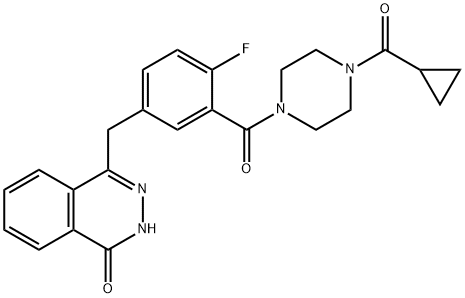
Olaparib is the first-in-class PARP1/2 inhibitor API that has established PARP inhibition as a clinically validated therapeutic strategy in oncology. As an orally bioavailable small molecule, Olaparib demonstrates potent enzymatic inhibition with IC₅₀ values of 5 nM for PARP1 and 1 nM for PARP2. The distinctive phthalazinone scaffold of Olaparib enables precise engagement with the PARP active site, while the piperazine ring and cyclopropanecarbonyl substituent contribute to its favorable pharmacokinetic properties. In pharmaceutical manufacturing, Olaparib requires stringent quality control to ensure batch-to-batch consistency, given its role as a life-saving therapy for patients with BRCA-mutant cancers. The synthetic route to Olaparib typically involves the construction of the phthalazinone scaffold through cyclization reactions, followed by functionalization of the piperazine ring. For generic manufacturers and research institutions, Olaparib represents both a high-value therapeutic API and a compound of significant synthetic interest, with ongoing efforts to develop more efficient and scalable manufacturing processes.
Product Parameters
|
Parameter |
Specification |
|
Product Name |
Olaparib |
|
CAS Number |
|
|
Molecular Formula |
|
|
Molecular Weight |
|
|
Appearance |
|
|
Density |
|
|
pKa |
12.07±0.40 |
|
Storage Condition |
−20 °C |
Pharmacological A ction
Pharmacokinetics
Oraparib is rapidly absorbed following oral administration in capsule formulation, with peak plasma concentrations typically achieved within 1 to 3 hours post-dose. No significant accumulation occurs with multiple doses (accumulation ratio of 1.4–1.5 compared to twice-daily administration), and steady-state exposure is reached within 3 to 4 days. Limited data suggest that across the dose range of 100 to 400 mg, the increase in systemic exposure (AUC) of oraparib is not proportional; however, the variability across trial PK data remains notable.
When administered concomitantly with a high-fat meal, it exhibited a delayed absorption rate (Tmax delayed by 2 hours), but did not significantly alter the extent of olaparib absorption (mean AUC increased by approximately 20%).
Distribution
Following a single 400 mg dose of olaparib, the mean (±standard deviation) apparent volume of distribution of olaparib at steady state was 167 ± 196 L. After administration at a dose of 400 mg twice daily, the in vitro protein binding of olaparib reached approximately 82%.
Metabolism
In vitro, CYP3A4 has been identified as the primary enzyme responsible for olaparib metabolism. Following oral administration of 14C-labeled olaparib to female patients, unchanged olaparib accounted for the majority (70%) of the circulating radioactivity in plasma. The drug is extensively metabolized in urine and feces, with unchanged drug radioactivity constituting 15% and 6%, respectively. Most metabolism occurs via oxidative reactions, resulting in the formation of metabolites that subsequently undergo glucuronidation or sulfation.
Excretion
Following a single 400 mg dose of olaparib, an average (mean ± standard deviation) terminal plasma half-life of 11.9 ± 4.8 hours and an apparent plasma clearance of 8.6 ± 7.1 L/h were observed.
Following a single dose of 14C-labeled olaparib, 86% of the administered radioactivity was recovered during the 7-day collection period, with 44% excreted in urine and 42% in feces. The majority of the material was excreted as metabolites.
According to preliminary data from studies specifically designed for renal impairment, when olaparib was administered to patients with mild renal impairment (CLcr = 50–80 mL/min; N = 14) compared to those with normal renal function (CLcr> 80 mL/min; N = 8), the mean AUC and Cmax of olaparib increased by 1.5-fold and 1.2-fold, respectively. No data were available for patients with CLcr <50 mL/min or those undergoing dialysis.
Contact Us
Address
No. 2 Yangguang 3rd Road, Duodao Chemical Cycle Industrial Park, Jingmen City, Hubei Province, China
Tel