
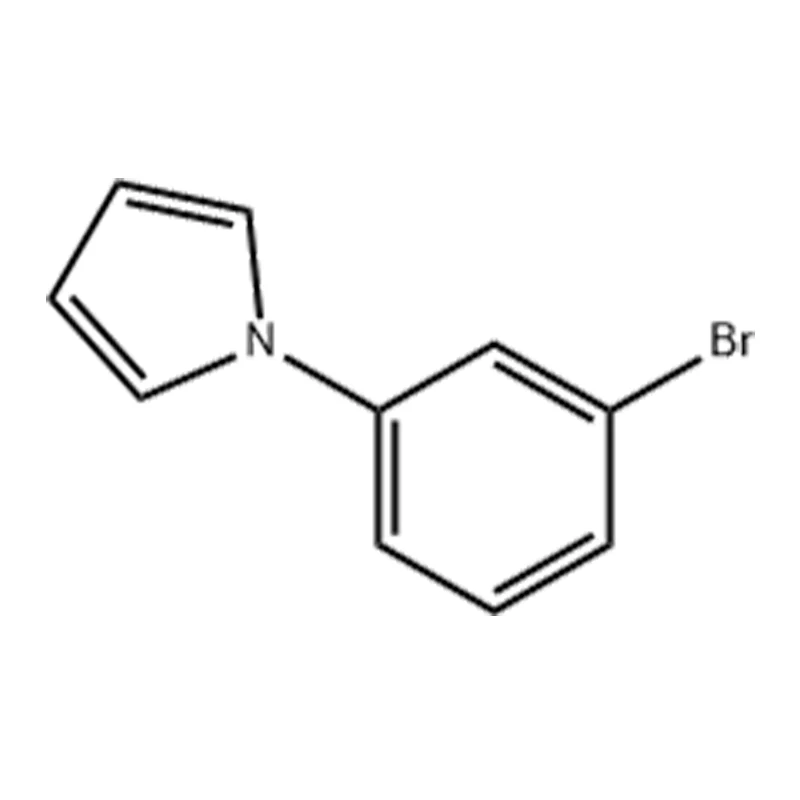
1-(3-Bromophenyl)-1H-pyrrole (CAS 107302-22-7) is a versatile, bench‑stable N‑aryl pyrrole building block for organic synthesis [0†L13-L15]. The compound is a solid at room temperature with a melting point of 60–66 °C and a boiling point of 294.9 °C at 760 mmHg.
In medicinal chemistry, the pyrrole scaffold is a privileged heterocyclic motif that appears in numerous natural products, drug molecules and agrochemicals. 1-(3-Bromophenyl)-1H-pyrrole has been investigated as a precursor to bioactive compounds and pharmaceuticals, and its structure allows for modifications that can lead to new drugs targeting various diseases [1†L11-L14][1†L34-L36]. It also shows promise in materials science owing to the electronic properties of the pyrrol system .
Synthetically, 1-(3-Bromophenyl)-1H-pyrrole contains a reactive bromine substituent that is ideally suited for transition‑metal‑catalyzed cross‑coupling reactions (Suzuki, Heck, Sonogashira, etc.), enabling rapid diversification of the molecular scaffold. The compound is available commercially with purities up to 98 %, and is supplied by multiple chemical distributors globally.
|
Parameter |
Specification |
|
CAS Number |
107302-22-7 |
|
IUPAC Name |
1-(3-bromophenyl)pyrrole |
|
Molecular Formula |
C₁₀H₈BrN |
|
Molecular Weight |
222.08 g/mol |
|
Purity |
≥95 % (GC); 98 % grade also available |
|
Appearance |
Solid |
|
Melting Point |
60–66 °C (observed); literature value 63 °C |
|
Boiling Point |
294.9 ± 23.0 °C (Predicted) |
|
Density |
1.38 ± 0.1 g/cm³ (Predicted) |
|
pKa |
−5.74 ± 0.70 (Predicted) |
|
Storage Condition |
Sealed in dry, room temperature |
|
Long-Term Storage |
Cool, dry place |
1-(3-Bromophenyl)-1H-pyrrole can be prepared by the reaction of 3‑bromobenzaldehyde with pyrrole in the presence of an acid catalyst, a common approach for constructing N‑aryl pyrroles via the Clauson‑Kaas reaction.
Green Procedure using Deep Eutectic Solvent (DES):
1. Add 3‑bromoaniline (1 mmol), 2,5‑dimethoxytetrahydrofuran (1.1 mmol) and L‑(+)‑tartaric acid/choline chloride‑based DES (1.5 g) into a 50 mL round‑bottom flask.

2. Stir the reaction mixture at 90 °C. Monitor the progress of the reaction by thin‑layer chromatography (TLC).
3. After completion of the reaction, cool the mixture to room temperature and extract the target product 1-(3-Bromophenyl)-1H-pyrrole with ethyl acetate.
4. After evaporation of the solvent, purify the residue by silica gel column chromatography to afford the pure product.
5. The DES can be dried under vacuum and reused in subsequent cycles.
● Temperature: Sealed in dry, room temperature (15–25 °C) ; avoid freezing.
● Container: Airtight, tightly sealed container.
● Protection: Store away from moisture, light, and strong oxidizing agents.
● Desiccation: Keep in a dry environment; the compound is stable under anhydrous conditions.
● Long‑term storage: Cool, dry place.
● Shelf life: 24 months when stored as recommended.
● Incompatibilities: Strong oxidizing agents, strong bases, strong acids.
Handling recommendation: As a solid, the compound is easy to weigh and handle. Use in a fume hood and avoid generating dust. After opening, reseal the container tightly to exclude moisture.
We look forward to supporting your research and production needs.If you have any questions regarding 1-(3-Bromophenyl)-1H-pyrrole or wish to request a quotation, please do not hesitate to reach out. Our sales and technical support teams are ready to assist you.
Address
No. 2 Yangguang 3rd Road, Duodao Chemical Cycle Industrial Park, Jingmen City, Hubei Province, China
Tel

![1-[2,3-Bis[(9Z,12Z)-octadeca-9,12-dien-1-yloxy]propyl]pyrrolidine](https://www.cosperpharma.com/upload/8820/1-2-3-bis-9z-12z-octadeca-9-12-dien-1-yloxy-propyl-pyrrolidine-349384.webp "1-[2,3-Bis[(9Z,12Z)-octadeca-9,12-dien-1-yloxy]propyl]pyrrolidine")
![1,2,4-Triazolo[4,3-a]pyridin-3(2H)-one](https://www.cosperpharma.com/upload/8820/1-2-4-triazolo-4-3-a-pyridin-3-2h-one-440735.webp "1,2,4-Triazolo[4,3-a]pyridin-3(2H)-one")