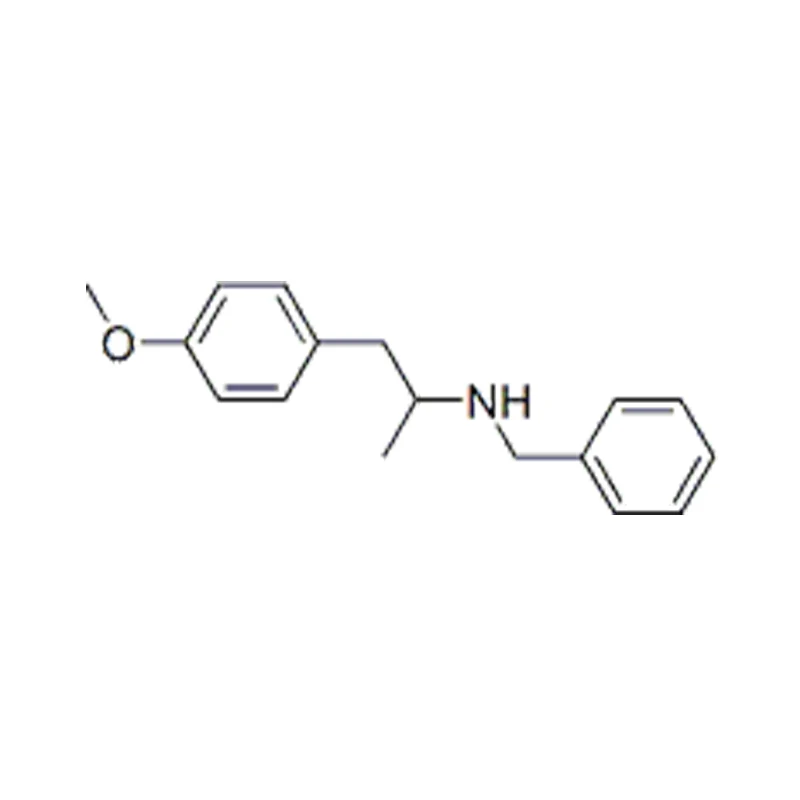
2-(Benzylamino)-1-(4-methoxyphenyl)-propane is the most widely employed chiral amine building block in the industrial synthesis of the long‑acting β₂‑agonist formoterol fumarate and its derivatives. In the convergent manufacturing route, the (2R)‑enantiomer of 2-(Benzylamino)-1-(4-methoxyphenyl)-propane opens the chiral epoxide to form the secondary amine backbone with complete stereochemical fidelity. Because the racemic form of 2-(Benzylamino)-1-(4-methoxyphenyl)-propane is readily resolved using inexpensive chiral acids such as (S)‑mandelic acid, it provides a highly scalable entry to the single enantiomer needed for API synthesis. The N‑benzyl group of 2-(Benzylamino)-1-(4-methoxyphenyl)-propane not only protects the amine during coupling but also improves the crystallinity of the resolution salt, simplifying isolation and purification.
|
Parameter |
Specification |
|
Product Name |
2-(Benzylamino)-1-(4-methoxyphenyl)-propane |
|
CAS Number |
43229-65-8 |
|
Molecular Formula |
C₁₇H₂₁NO |
|
Molecular Weight |
255.36 g/mol |
|
Appearance |
Colorless to pale yellow viscous oil or low-melting solid (free base) |
|
Boiling Point |
165–170°C at 0.5 mmHg (typical) |
|
Density |
~1.04 g/cm³ (estimated) |
|
Purity (GC/HPLC) |
≥98.0% (racemic); ≥99.0% (resolved enantiomer available on request) |
|
Solubility |
Freely soluble in ethanol, ethyl acetate, dichloromethane, toluene; insoluble in water |
|
Storage Condition |
2–8°C under nitrogen, protected from light and carbon dioxide |
|
Shelf Life |
18 months as free base; >24 months as mandelic acid salt |
Dissolve 1-(4-methoxyphenyl)prop-2-one (8.22 g, 50.0 mmol) and benzylamine (5.35 g, 50.0 mmol) in methanol, then add a 5% Pt/C catalyst (0.83 g). Stir the reaction mixture at 60 °C and carry out hydrogenation for 24 hours. Upon completion, remove the catalyst by filtration and evaporate the solvent under rotation to obtain the intermediate N-benzyl-1-(4-methoxyphenyl)prop-2-amine with a yield of 95%. The product was characterized by 1H NMR (400 MHz, CDCl₃): δ7.25 (ddd, J = 16.5, 11.1, 6; Chemical Book 8 Hz, 5H), δ7.07 (d, J = 8.5 Hz, 2H), δ6.83 (d, J = 8.5 Hz, 2H), δ3.86 (d, J = 13.3 Hz, 1H), δ3.79 (s, 3H), δ3.73 (d, J = 13.3 Hz, 1H), δ2.90 (dd, J = 13.0, 6.5 Hz, 1H), δ2.71 (dd, J = 13.5, 7.1 Hz, 1H), δ2.61 (dd, J = 13.5, 6.4 Hz, 1H), δ1.10 (d, J = 6.2 Hz, 3H). LC/MS (ESI m/z): 256.4 (M + H⁺).

Q: What is the best solvent for the epoxide opening reaction?
A: Isopropanol or DMF at 60–80°C is commonly used. We can provide a technical note with typical conditions.
Q: Does the free base absorb CO₂ from air?
A: Like many secondary amines, it can slowly form a carbamate. Storage under nitrogen and using fresh material for critical reactions is recommended.
1.Formoterol/Aformoterol API Synthesis
The (2R)‑amine opens the epoxide intermediate to construct the N‑(2‑hydroxy‑2‑phenylethyl)‑propylamine backbone.
2.Chiral Resolution Studies
The racemic amine is a classic substrate for evaluating new chiral acids and resolution methodologies.
3.SAR Studies on LABAs
The N‑benzyl group can be substituted or modified to generate libraries of long‑acting β₂‑agonists.
4.Process Development
Used as a benchmark nucleophile for optimizing epoxide aminolysis under scalable conditions.
5.Impurity Marker Synthesis
The (2S)‑enantiomer is used to prepare the diastereomeric impurity for pharmacopoeial methods.
Need a reliable amine partner for your next β₂‑agonist campaign? Reach out to Cosperpharm today — we can provide a side‑by‑side comparison of our racemic and resolved specifications, along with a quote for your required volume, usually within the same business day.
Address
No. 2 Yangguang 3rd Road, Duodao Chemical Cycle Industrial Park, Jingmen City, Hubei Province, China
Tel

![1-[2,3-Bis[(9Z,12Z)-octadeca-9,12-dien-1-yloxy]propyl]pyrrolidine](https://www.cosperpharma.com/upload/8820/1-2-3-bis-9z-12z-octadeca-9-12-dien-1-yloxy-propyl-pyrrolidine-349384.webp "1-[2,3-Bis[(9Z,12Z)-octadeca-9,12-dien-1-yloxy]propyl]pyrrolidine")
![1,2,4-Triazolo[4,3-a]pyridin-3(2H)-one](https://www.cosperpharma.com/upload/8820/1-2-4-triazolo-4-3-a-pyridin-3-2h-one-440735.webp "1,2,4-Triazolo[4,3-a]pyridin-3(2H)-one")