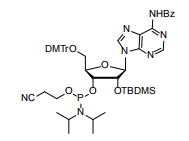

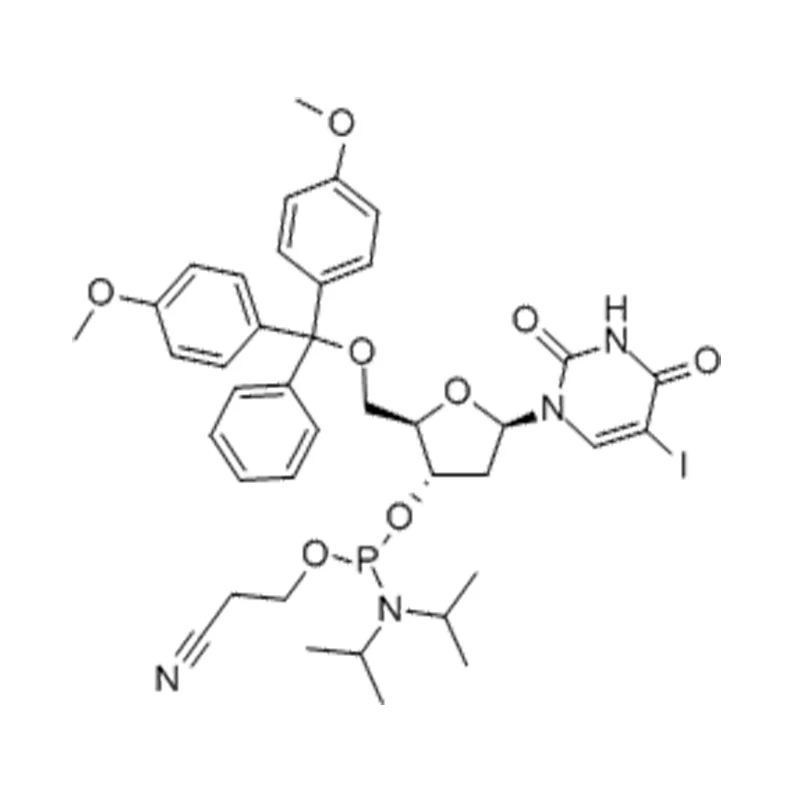
The iodine atom at the 5‑position of the pyrimidine ring imparts photoreactive properties and enables further functionalization via cross‑coupling reactions. The DMTr group protects the 5′‑hydroxyl during synthesis, while the 3′‑phosphoramidite enables stepwise coupling in solid‑phase oligonucleotide synthesis. 5′-O-DMTr-5-iodo-2′-dU-3′-CED phosphoramidite is primarily used to incorporate 5‑iododeoxyuridine (I‑dU) into synthetic DNA strands for structural biology, cross‑linking studies, and crystallography.
|
Parameter |
Specification |
|
Product name |
5′-O-DMTr-5-iodo-2′-dU-3′-CED phosphoramidite |
|
CAS number |
178925-48-9 |
|
Molecular Formula |
C39H46IN4O8P |
|
Molecular Weight |
856.68 |
|
pKa |
7.94±0.10 |
5′-O-DMTr-5-iodo-2′-dU-3′-CED phosphoramidite is a specialized nucleoside building block for the synthesis of modified oligonucleotides with potent therapeutic potential. As a purine nucleoside analog, 5′-O-DMTr-5-iodo-2′-dU-3′-CED phosphoramidite exhibits broad‑spectrum anticancer effect targeting indolent lymphoid malignancies, with an anti‑cancer mechanism that relies on inhibiting DNA synthesis and inducing apoptosis. In oligonucleotide synthesis workflows, 5′-O-DMTr-5-iodo-2′-dU-3′-CED phosphoramidite is used as a protecting reagent and phosphorylating agent for the synthesis of DNA, ensuring proper formation of phosphodiester bonds between nucleotides. The iodine substitution in 5′-O-DMTr-5-iodo-2′-dU-3′-CED phosphoramidite is photoreactive and is used for cross‑linking studies to probe the structure of protein‑DNA complexes. Brominated and iodinated nucleosides such as this are also employed in crystallography studies of oligonucleotide structure.
|
Advantage |
Detail |
|
Production Strength |
GMP-certified campus spanning 100+ mu, 3 multi-purpose workshops, 6 D-grade clean zone production lines, and 150+ reactors (20L–5000L), supporting high/low temp, anaerobic & hydrogenation; kg to ton scale production. |
|
Fast Delivery |
R&D samples: one week; commercial orders: 1–2 months after payment. Express (DHL/FedEx) or air/sea freight available. |
|
Global Partners |
Trusted by 30+ pharmaceutical companies in USA, Europe, India, Brazil, and Southeast Asia; long-term cooperation with generic drug manufacturers, CROs, and impurity standard distributors. |
|
Licensed Exporter |
Valid drug import/export license — no compliance delays. |
|
Dual Quality Grades |
Both research/pharma grade(≥98%)and high-purity impurity grade(≥99%)available to meet diverse customer needs. |
The 5‑iodo substitution in 5′-O-DMTr-5-iodo-2′-dU-3′-CED phosphoramidite is photoreactive and is used for cross‑linking studies to probe the structure of protein‑DNA complexes. I‑dU cross‑linking at 325 nm is higher than Br‑dU, making this the preferred choice for photocross‑linking experiments.
Brominated and iodinated nucleosides such as 5′-O-DMTr-5-iodo-2′-dU-3′-CED phosphoramidite are used in crystallography studies of oligonucleotide structure, where the heavy iodine atom serves as an anomalous scattering center for phasing.
5′-O-DMTr-5-iodo-2′-dU-3′-CED phosphoramidite is a purine nucleoside analog with broad‑spectrum anticancer effect targeting indolent lymphoid malignancies. The anti‑cancer mechanism relies on inhibiting DNA synthesis and inducing apoptosis.
5′-O-DMTr-5-iodo-2′-dU-3′-CED phosphoramidite requires no changes to the coupling protocol recommended by synthesizer manufacturers, enabling straightforward incorporation of I‑dU into DNA sequences using standard automated oligonucleotide synthesis.
Cosperpharm supplies 5′-O-DMTr-5-iodo-2′-dU-3′-CED phosphoramidite at ≥95% purity, with batch‑specific characterization data to support reproducibility in oligonucleotide synthesis, cross‑linking studies, and biological assays.
The synthesis of 5′-O-DMTr-5-iodo-2′-dU-3′-CED phosphoramidite starts with 5‑iodo‑2′‑deoxyuridine, which is first protected at the 5′‑hydroxyl with a dimethoxytrityl (DMTr) group. The resulting 2′‑deoxy‑5′‑O‑DMT‑5‑iodouridine is then reacted with 2‑cyanoethyl N,N‑diisopropylchlorophosphoramidite to install the 3′‑(2‑cyanoethyl)-(N,N‑diisopropyl) phosphoramidite moiety. The synthesis of this compound was first developed in the early 1990s.
Industrial production follows validated protocols optimized for batch‑to‑batch reproducibility. Cosperpharm employs synthetic routes that ensure high purity and consistent performance in automated oligonucleotide synthesis. Batch‑specific production records are available upon request.
Need 5′-O-DMTr-5-iodo-2′-dU-3′-CED phosphoramidite for your oligonucleotide synthesis, cross‑linking studies, or anticancer research program? Cosperpharm is ready to supply the high‑purity material you require — along with the technical support and reliable delivery your timeline demands. Contact us for a quote, lead time information, or to discuss your specific application requirements.
Address
No. 2 Yangguang 3rd Road, Duodao Chemical Cycle Industrial Park, Jingmen City, Hubei Province, China
Tel

![1-[2,3-Bis[(9Z,12Z)-octadeca-9,12-dien-1-yloxy]propyl]pyrrolidine](https://www.cosperpharma.com/upload/8820/1-2-3-bis-9z-12z-octadeca-9-12-dien-1-yloxy-propyl-pyrrolidine-349384.webp "1-[2,3-Bis[(9Z,12Z)-octadeca-9,12-dien-1-yloxy]propyl]pyrrolidine")
![1,2,4-Triazolo[4,3-a]pyridin-3(2H)-one](https://www.cosperpharma.com/upload/8820/1-2-4-triazolo-4-3-a-pyridin-3-2h-one-440735.webp "1,2,4-Triazolo[4,3-a]pyridin-3(2H)-one")