
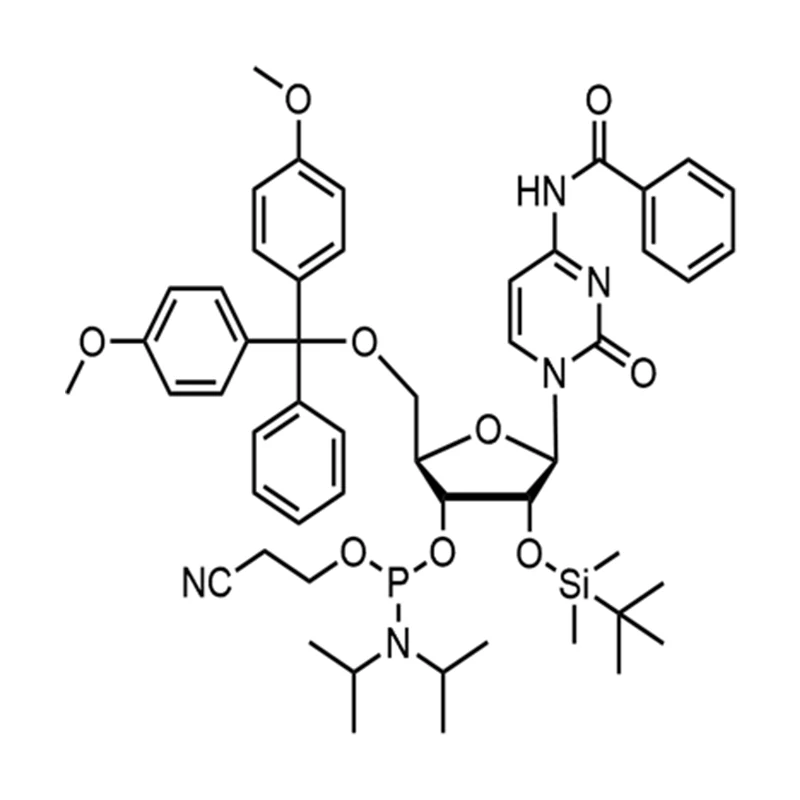
Bz-rC Phosphoramidite is a fundamental monomer for the chemical synthesis of RNA oligonucleotides. The N4‑benzoyl protecting group on the cytosine base prevents branching and chain termination during the phosphoramidite coupling cycle, while the 2′-O‑TBDMS group protects the 2′-hydroxyl throughout chain assembly and is removed after synthesis using fluoride‑based reagents such as triethylamine trihydrofluoride (TEA·3HF). Bz-rC Phosphoramidite is compatible with standard RNA synthesis protocols on automated DNA/RNA synthesizers (e.g., Applied Biosystems, MerMade, Dr. Oligo), typically using 0.25 M activator solutions (5‑ethylthio‑1H‑tetrazole, 4,5‑dicyanoimidazole) and coupling times of 5–10 minutes. Bz-rC Phosphoramidite has been extensively validated in the synthesis of RNA for structural studies, antisense oligonucleotides, siRNA, and aptamers. Bz-rC Phosphoramidite is also used as a reference standard in oligonucleotide impurity profiling, as the benzoyl group can give rise to characteristic byproducts (e.g., N4‑benzoyl‑depyrimidination products) that must be monitored during process development.
|
Parameter |
Specification |
|
Product Name |
Bz-rC Phosphoramidite |
|
CAS Number |
118380-84-0 |
|
Molecular Formula |
C₅₂H₆₆N₅O₉PSi |
|
Molecular Weight |
976.17 g/mol |
|
Purity (HPLC) |
≥98% (typical supplier specification) |
|
Physical Form |
Solid |
|
Appearance |
White to off-white powder |
|
Storage Temperature |
2-8℃ |
|
pKa |
8.55±0.20(predicted) |
Each batch undergoes:
● Gas chromatography (GC) – purity ≥97.0%
● Non‑aqueous titration – purity ≥97.0%
● Refractive index – confirmatory analysis
● ¹H NMR – structural verification
● Appearance – colorless to light yellow to light orange clear liquid
A comprehensive COA, MSDS (with full GHS information), and certificate of origin accompany every shipment.
Q1: What is the difference between Bz-rC Phosphoramidite and Ac‑rC Phosphoramidite?
A: Bz-rC Phosphoramidite uses a benzoyl (Bz) protecting group on the N4 exocyclic amine of cytosine, while Ac‑rC uses an acetyl (Ac) group. The benzoyl group provides greater protection against depyrimidination under the acidic conditions of DMT removal (3% trichloroacetic acid in dichloromethane). For most RNA synthesis applications, the benzoyl group is preferred for long or deoxycytidine‑rich sequences.
Q2: What is the recommended coupling time for Bz-rC Phosphoramidite on a standard synthesizer?
A: Under standard RNA synthesis conditions with 0.25 M activator (e.g., 5‑ethylthio‑1H‑tetrazole or 4,5‑dicyanoimidazole), a coupling time of 5–10 minutes is typical for Bz-rC Phosphoramidite. For longer oligonucleotides (>40‑mer) or high‑throughput synthesis, optimizing activator concentration and coupling time may improve yields.
Bz-rC Phosphoramidite is the standard building block for introducing cytidine residues into synthetic RNA oligonucleotides for research, diagnostics, and therapeutic development.
Used to incorporate 2′-OH cytidine into siRNA duplexes. The TBDMS group is removed after synthesis, yielding fully native RNA for RNAi studies.
ASOs targeting RNA transcripts require RNA segments (e.g., in gapmer designs). Bz-rC Phosphoramidite supplies the necessary cytidine residues with full nuclease resistance when left as 2′-OH or modified.
Aptamer libraries and individual aptamer candidates are chemically synthesized using Bz-rC Phosphoramidite to ensure sequence fidelity and scalability.
For X‑ray crystallography and NMR studies, well‑defined RNA sequences must be synthesized with high purity. Bz-rC Phosphoramidite delivers the required coupling efficiency and deprotection cleanness.
As a potential process impurity in oligonucleotide drug substances (e.g., residual N4‑benzoyl‑cytidine, incomplete deprotection products), Bz-rC Phosphoramidite or its deprotected derivatives serve as reference standards in HPLC and LC‑MS methods.
Ready to order Bz-rC Phosphoramidite for your next RNA synthesis project? Cosperpharm‘s team is standing by to discuss your purity requirements, documentation needs, and delivery timelines.
Address
No. 2 Yangguang 3rd Road, Duodao Chemical Cycle Industrial Park, Jingmen City, Hubei Province, China
Tel

![1-[2,3-Bis[(9Z,12Z)-octadeca-9,12-dien-1-yloxy]propyl]pyrrolidine](https://www.cosperpharma.com/upload/8820/1-2-3-bis-9z-12z-octadeca-9-12-dien-1-yloxy-propyl-pyrrolidine-349384.webp "1-[2,3-Bis[(9Z,12Z)-octadeca-9,12-dien-1-yloxy]propyl]pyrrolidine")
![1,2,4-Triazolo[4,3-a]pyridin-3(2H)-one](https://www.cosperpharma.com/upload/8820/1-2-4-triazolo-4-3-a-pyridin-3-2h-one-440735.webp "1,2,4-Triazolo[4,3-a]pyridin-3(2H)-one")