
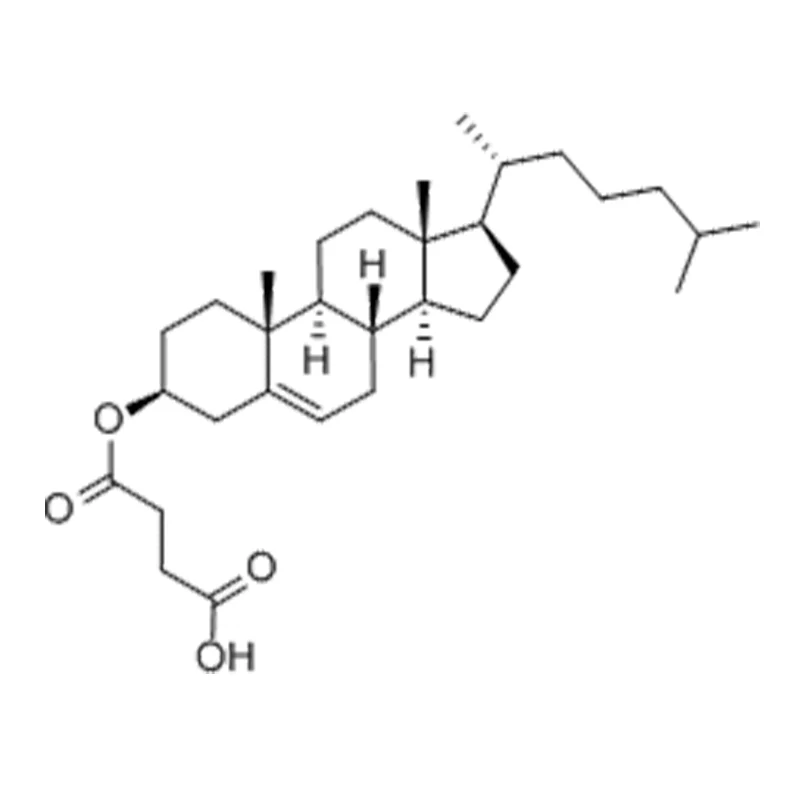
Cholesteryl hemisuccinate is a versatile functional lipid excipient widely employed in the formulation of pH‑sensitive liposomes for triggered drug delivery. DOPE/CHEMS liposomes incorporating Cholesteryl hemisuccinate release >80% payload at pH 5.5 compared to <40% at pH 7.4, demonstrating its unique utility for endosomal escape and targeted cancer therapy. Beyond drug delivery, Cholesteryl hemisuccinate acts as an ionizable anionic detergent that stabilizes unilamellar vesicles and liposomes, and it has been used as an emulsifying agent in vesicular delivery systems for anticancer drugs, antibiotics, and oligonucleotides, as well as to solubilize various proteins including chemokine receptor 1 and erythrocyte ghosts. Cholesteryl hemisuccinate also serves as a critical component in DDM/CHS detergent systems for membrane protein crystallization, and as a cholesterol substitute in protein crystallography where its presence improves crystallization conditions for membrane proteins. Furthermore, Cholesteryl hemisuccinate has been shown to inhibit the growth of murine C1498 myeloid and L1210 lymphocytic leukemia cells at concentrations of 50 and 150 μM, respectively, and protects rodents against the toxic effects of acetaminophen, adriamycin, carbon tetrachloride, chloroform, and galactosamine. The pH‑responsive behavior of Cholesteryl hemisuccinate has been extensively validated by differential scanning calorimetry (DSC), and it has been demonstrated to outperform cholesterol as a DPPC bilayer stabilizer in liposomal formulations. Additionally, the morpholine‑containing analogue of Cholesteryl hemisuccinate (Mochol, CAS 452323-21-6) has been developed as a cationic cholesterol analogue for use as a functional lipid component in Lipid Nanoparticles (LNPs) for nucleic acid delivery applications.
|
Parameter |
Specification |
|
Product Name |
Cholesteryl hemisuccinate |
|
CAS Number |
1510-21-0 |
|
Molecular Formula |
C₃₁H₅₀O₄ |
|
Molecular Weight |
486.73 g/mol |
|
Purity |
≥98.0% (industrial grade); ≥97.0% (reference standard) |
|
Appearance |
White to off-white solid |
|
Melting Point |
178 °C (lit.) |
|
Boiling Point |
586.0 ± 43.0 °C (predicted) |
|
Density |
1.06 ± 0.1 g/cm³ (predicted) |
|
Refractive Index |
−34° (C= 2, CHCl₃) |
|
Solubility |
Chloroform (10 mg/mL; slightly soluble in methanol, heated/ultrasonic) |
|
pKa |
4.40 ± 0.17 (predicted) |
|
LogP |
10.708 (est) |
|
Storage Condition |
−20 °C, sealed, dry, under inert atmosphere |
|
Shelf Life |
6 months after receipt at RT; stable for >12 months at −20 °C |
|
HS Code |
29171900 |
|
WGK Germany |
3 |
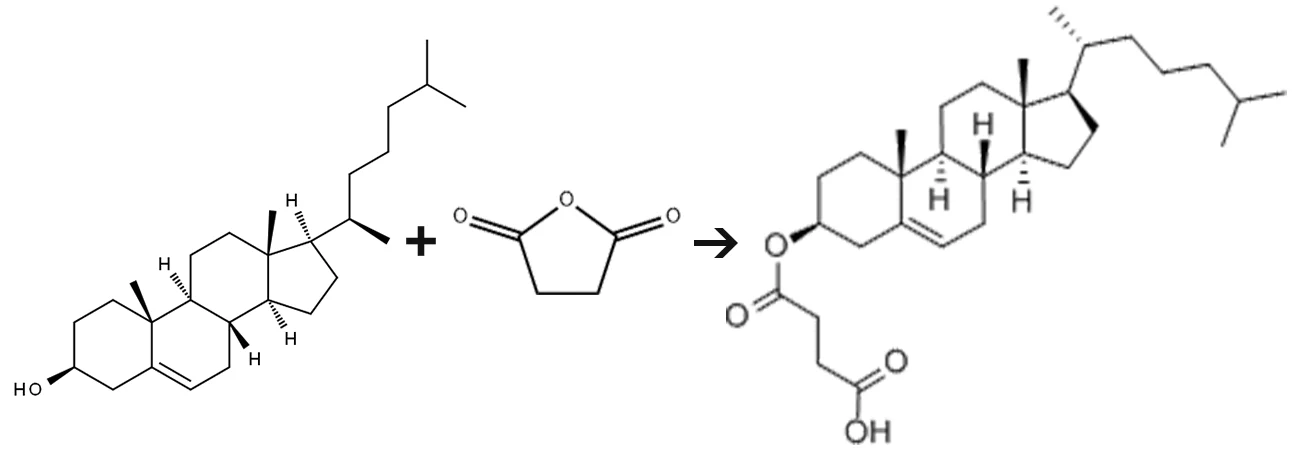
Succinic anhydride (14.7 mmol, 1.57 equivalents) and 4-dimethylaminopyridine (DMAP, 1.584 mmol, 0.17 equivalents) were successively added to a solution of (3β)-cholestere-5-en-3-ol (9.37 mmol) in 28 mL of pyridine. The reaction mixture was stirred at room temperature for 7 days. Upon completion, the mixture was poured into ice water, pH adjusted to 7 with dilute hydrochloric acid, and then extracted with chloroform. The organic phase was dried with anhydrous sodium sulfate and concentrated under reduced pressure to yield a crude product. The crude product was purified by column chromatography to obtain the target compound with yields of 79% or 96%, and analytical purity>99.9%.
Q1: What is the difference between Cholesteryl hemisuccinate (CHEMS) and cholesterol?
A: Cholesteryl hemisuccinate (CHEMS) is a semi‑synthetic cholesterol ester in which the 3β‑hydroxyl group of cholesterol is esterified with succinic acid, introducing an ionizable carboxyl group. This modification endows Cholesteryl hemisuccinate with pH‑dependent amphiphilicity and a net anionic charge under physiological conditions, whereas cholesterol is neutral and lacks pH‑responsive behavior.
Q2: How should Cholesteryl hemisuccinate be stored?
A: Store Cholesteryl hemisuccinate in a tightly sealed container under inert atmosphere at −20 °C for long‑term storage (>12 months). For short‑term storage (up to 6 months), 2–8 °C is acceptable. Protect from light, moisture, and strong oxidizing agents.
Each batch undergoes:
● Gas chromatography (GC) – purity ≥97.0%
● Non‑aqueous titration – purity ≥97.0%
● Refractive index – confirmatory analysis
● ¹H NMR – structural verification
● Appearance – colorless to light yellow to light orange clear liquid
A comprehensive COA, MSDS (with full GHS information), and certificate of origin accompany every shipment.
Need Cholesteryl hemisuccinate for your LNP formulation program, membrane protein crystallization project, or liposomal drug delivery development? Cosperpharm makes procurement straightforward — from research‑grade reference standards to multi‑kilogram GMP supplies. Contact us today for pricing, technical documentation, or a custom synthesis inquiry.
Address
No. 2 Yangguang 3rd Road, Duodao Chemical Cycle Industrial Park, Jingmen City, Hubei Province, China
Tel

![1-[2,3-Bis[(9Z,12Z)-octadeca-9,12-dien-1-yloxy]propyl]pyrrolidine](https://www.cosperpharma.com/upload/8820/1-2-3-bis-9z-12z-octadeca-9-12-dien-1-yloxy-propyl-pyrrolidine-349384.webp "1-[2,3-Bis[(9Z,12Z)-octadeca-9,12-dien-1-yloxy]propyl]pyrrolidine")
![1,2,4-Triazolo[4,3-a]pyridin-3(2H)-one](https://www.cosperpharma.com/upload/8820/1-2-4-triazolo-4-3-a-pyridin-3-2h-one-440735.webp "1,2,4-Triazolo[4,3-a]pyridin-3(2H)-one")