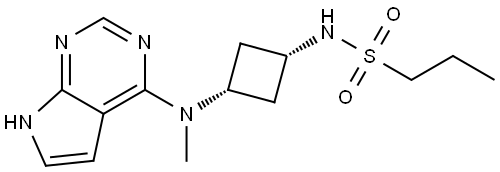

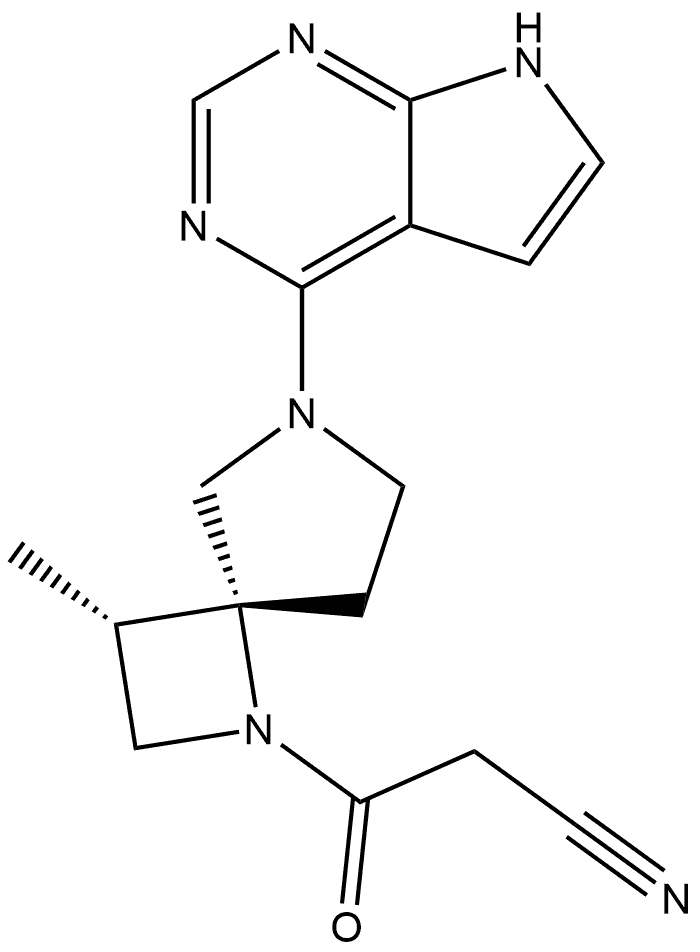
Delgocitinib is a first-in-class JAK inhibitor and certified reference standard developed for the topical and systemic treatment of inflammatory skin conditions and autoimmune diseases. As the active pharmaceutical ingredient developed under the code names JTE-052 and LEO-124249, Delgocitinib has demonstrated efficacy in blocking multiple cytokine signaling pathways and inhibiting pruritus. In pharmaceutical quality control contexts, Delgocitinib serves as the primary reference standard for impurity profiling, analytical method development, and regulatory submissions. Delgocitinib is recognized through multiple regulatory designations including INN, USAN, JAN, and WHO-DD, making it indispensable for ANDA filings and quality control testing. The drug substance Delgocitinib exhibits excellent stability when stored under recommended conditions, with solutions stable for up to 1 month at –20°C. Furthermore, Delgocitinib functions as a specific JAK1/2/3/Tyk2 inhibitor that concentration-dependently inhibits IL-2-induced T cell proliferation (IC₅₀ = 8.9 nM), demonstrating the exceptional therapeutic potential of this well-characterized molecular scaffold.
|
Parameter |
Specification |
|
Product Name |
Delgocitinib |
|
CAS Number |
1263774-59-9 |
|
Molecular Formula |
C₁₆H₁₈N₆O |
|
Molecular Weight |
310.35 g/mol |
|
Appearance |
White solid |
|
Storage Condition |
Store at –20°C |
Delgocitinib inhibits JAK1, JAK2, JAK3, and tyrosine kinase 2. In preclinical studies, topical application of delgocitinib has demonstrated anti-inflammatory effects on the skin, improved skin barrier dysfunction, and suppressed IL-31-induced pruritus.
In clinical trials, digalitinib has demonstrated its ability to improve skin symptoms and quality of life in patients with atopic dermatitis.
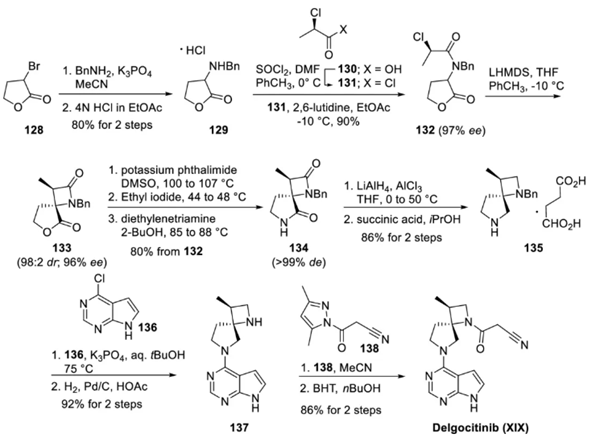
Synthetic Route
Bromolactone 128 reacts with benzylamine via an SN₂ reaction to form α-amino lactone 129; subsequent acylation of amine 129 with the optically pure acyl chloride 131 (prepared by treatment with the commercial acid 130 and thionyl chloride) yields lactone 132. Lactone 132 is treated with LHMDS to generate an enolate anion. This enolate anion undergoes an SN₂ substitution reaction to remove the chlorine atom, forming spirocyclic lactone 133, thereby establishing two stereocenters with a diastereomeric ratio (dr) of 98:2 and an enantiomeric purity of 96%. The γ-carbon of spirocyclic lactone 133 is attacked by potassium phosphate anhydride, opening the lactone ring and generating a carboxylic acid, which then reacts with iodomethane to form an ethyl ester. Finally, treatment with diethylenetriamine releases the anhydride group, yielding a free amine; this free amine undergoes cyclization via the corresponding ethyl ester intermediate to form spirocyclic amide 134. The carbonyl group in spirocyclic amide 134 is reduced using lithium aluminum hydride and aluminum chloride in tetrahydrofuran (THF) to obtain diamine 135, which is crystallized as a dibasic salt at a yield of 86%. Diamine 135 undergoes an SNAr reaction with chloropyrimidinopyrrole. The benzyl protecting group is subsequently removed via catalytic hydrogenation, yielding amine 137 after these two steps, with a total overall yield of 92%. Amin 137 is then subjected to an amidation reaction with cyanoacetopyrazole. The product obtained from the reaction between amine 137 and cyanoacetopyrazole is recrystallized from n-butanol, with the addition of 3 wt% BHT (butylhydroxytoluene) as an antioxidant, to afford the final product digotin at a yield of 86%, with both enantiomeric purity (ee) and diastereomeric purity (de) exceeding 99%.。
Connect with Cosperpharm for Delgocitinib that delivers the purity, documentation, and supply reliability your research program requires. Whether you are advancing JAK inhibitor research, developing analytical methods, or scaling up production, our team is ready to partner with you.
Address
No. 2 Yangguang 3rd Road, Duodao Chemical Cycle Industrial Park, Jingmen City, Hubei Province, China
Tel