
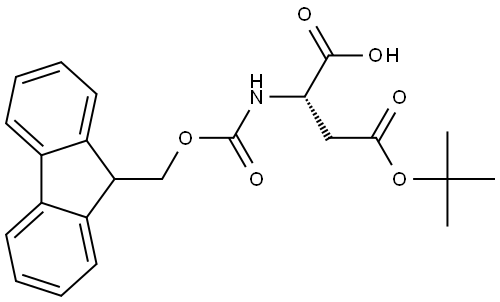
Fmoc-Asp(OtBu)-OH (also known as Fmoc-L-aspartic acid 4-tert-butyl ester) is a high-purity Fmoc-protected amino acid essential for solid-phase peptide synthesis. Fmoc-Asp(OtBu)-OH is specifically designed to prevent the formation of aspartimide by‑products, a significant challenge in Fmoc SPPS that can drastically reduce peptide yield and complicate purification. The tert-butyl ester protecting group on the β‑carboxyl effectively masks the side chain carboxylic acid, preventing the cyclization reactions that lead to aspartimide formation during chain assembly and Fmoc deprotection steps. Fmoc-Asp(OtBu)-OH is available with ≥98.0% HPLC purity and very low levels of dipeptide, free amino acids, and acetic acid impurities, making it suitable for both research and process-scale peptide production. Applications of Fmoc-Asp(OtBu)-OH range from the synthesis of linear and cyclic therapeutic peptides to the manufacture of peptide-based drug candidates. Fmoc-Asp(OtBu)-OH is the standard choice for incorporating aspartic acid into Fmoc SPPS workflows, offering reliable performance and consistent quality across all scales of synthesis.
Product Parameters
|
Parameter |
Specification |
|
Product Name |
Fmoc-Asp(OtBu)-OH |
|
CAS Number |
71989-14-5 |
|
Molecular Formula |
C₂₃H₂₅NO₆ |
|
Molecular Weight |
411.45 g/mol |
|
Appearance |
White to off-white crystalline powder |
|
Melting Point |
148–150 °C (decomposes) |
|
Boiling Point |
530.45°C at 760 mmHg (predicted) |
|
Density |
1.2498 g/cm³ |
|
pKa |
3.57±0.23 |
|
Storage Condition |
2-8℃ |
Product Advantages
2. High purity for reproducible peptide synthesis. Fmoc-Asp(OtBu)-OH is available with ≥98.0% to ≥99.0% HPLC purity and features very low levels of dipeptide, free amino acids, and acetic acid impurities. This high purity translates directly to cleaner crude peptides, higher yields, and simplified purification.
3. Well‑characterized with consistent specifications. Each batch of Fmoc-Asp(OtBu)-OH is tested for HPLC purity, specific optical rotation ([α]₂₀/D −24 ± 2°, c=1 in DMF), melting point (148–150 °C), water content (≤1.0%), and D‑enantiomer content (≤0.3%), ensuring batch‑to‑batch consistency for reproducible results.
4. Flexible supply for all synthesis scales. Cosperpharm supplies Fmoc-Asp(OtBu)-OH from 1g reference samples for analytical method development and process optimization to 25kg drums for commercial peptide manufacturing. R&D samples ship within 5–7 business days; bulk orders ship within 2–3 weeks.
5. Broad research and manufacturing applications. Fmoc-Asp(OtBu)-OH is used in the synthesis of linear and cyclic therapeutic peptides, peptide drug candidates, peptide-based diagnostics, and research peptides for studying protein‑protein interactions, enzyme mechanisms, and receptor binding.
Synthetic Route
In a 2000 mL three-port flask, add 581 g tert-butyl acetate and 133 g aspartic acid, stir, and gradually add 96.5 mL perchloric acid. Let the mixture react at 10°C for 48 hours, then cool to 0°C and add 700 mL water for extraction (using the remaining tert-butyl acetate as the solvent). Neutralize with Na₂CO₃ to pH 7, separate the layers, and concentrate the tert-butyl acetate layer under reduced pressure to obtain a mixture of Asp(OtBu)₂, Asp(OtBu), and Asp-OtBu oil. Combine this oil layer with the aqueous phase and set aside.
Transfer the mixture to a 3000 mL three-port flask, add 125 g CuSO₄·5H₂O, adjust the pH to 3 with concentrated hydrochloric acid, stir, and heat to 50°C for 12 hours to yield Cu[Asp(OtBu)]ₓ (x = 1-2.). Cool to room temperature, add 116.2 g tetramethylenediamine and 300 mL dioxane, adjust the pH to 8–9 with triethylamine to obtain Asp(OtBu). Add 82 g Fmoc-OSu to Asp(OtBu), maintain pH at 8–9, react for 8 hours, extract with ethyl acetate, acidify, wash with water, distill under reduced pressure, crystallize, and dry to yield 85 g Fmoc-L-aspartic acid beta-tert-butyl ester with a yield of 20.7%.
Analysis of Fmoc-L-aspartic acid beta-tert-butyl ester by HPLC revealed a purity of 99.2%, optical rotation of-23.5°, melting point of 147.9–149.5°C, and an isomer content of 0.18%.
Application Scenarios
Fmoc Solid‑Phase Peptide Synthesis
Fmoc-Asp(OtBu)-OH is a standard building block for incorporating aspartic acid residues into synthetic peptides using Fmoc SPPS. The OtBu protecting group on the β‑carboxyl prevents aspartimide formation during chain assembly.
Prevention of Aspartimide By‑Products
The primary advantage of Fmoc-Asp(OtBu)-OH is its ability to prevent aspartimide formation — a common side reaction in Fmoc SPPS, particularly in sequences containing Asp‑Xaa motifs or when using microwave‑assisted synthesis. This leads to higher crude peptide purity and simplified purification.
Therapeutic Peptide Manufacturing
Bulk quantities of Fmoc-Asp(OtBu)-OH are used in process‑scale synthesis of peptide‑based pharmaceuticals, including linear and cyclic therapeutic peptides, peptide drug conjugates, and clinical‑stage peptide candidates.
Research Peptide Synthesis
Used extensively in academic and pharmaceutical research for the synthesis of peptides for studying protein‑protein interactions, enzyme mechanisms, receptor binding, and structure‑activity relationships.
Microwave‑Assisted SPPS
Fmoc-Asp(OtBu)-OH is fully compatible with microwave‑accelerated Fmoc SPPS, enabling rapid synthesis of aspartic acid‑containing peptides without the risk of temperature‑induced aspartimide formation.
Process Development & Scale‑Up
Pharmaceutical process chemists use Fmoc-Asp(OtBu)-OH for reaction optimization, impurity mapping, and development of scalable manufacturing routes for peptide drug substances.
Peptide Drug Quality Control
As a high‑purity reference material, Fmoc-Asp(OtBu)-OH is used in analytical method development, impurity profiling, and QC testing for peptide‑based drug products.
Cyclic Peptide Synthesis
Essential for the synthesis of cyclic peptides containing aspartic acid residues, where selective side chain protection is critical for successful cyclization strategies.
Contact Us
Looking for a reliable source of Fmoc-Asp(OtBu)-OH for your peptide synthesis campaign? Need bulk quantities for process-scale manufacturing with full regulatory documentation? Cosperpharm‘s team is ready to support your project — from technical guidance on preventing aspartimide formation in challenging sequences to custom packaging and supply agreements. Contact us today for pricing, availability, or to request batch‑specific documentation.
Address
No. 2 Yangguang 3rd Road, Duodao Chemical Cycle Industrial Park, Jingmen City, Hubei Province, China
Tel

![1-[2,3-Bis[(9Z,12Z)-octadeca-9,12-dien-1-yloxy]propyl]pyrrolidine](https://www.cosperpharma.com/upload/8820/1-2-3-bis-9z-12z-octadeca-9-12-dien-1-yloxy-propyl-pyrrolidine-349384.webp "1-[2,3-Bis[(9Z,12Z)-octadeca-9,12-dien-1-yloxy]propyl]pyrrolidine")
![1,2,4-Triazolo[4,3-a]pyridin-3(2H)-one](https://www.cosperpharma.com/upload/8820/1-2-4-triazolo-4-3-a-pyridin-3-2h-one-440735.webp "1,2,4-Triazolo[4,3-a]pyridin-3(2H)-one")