
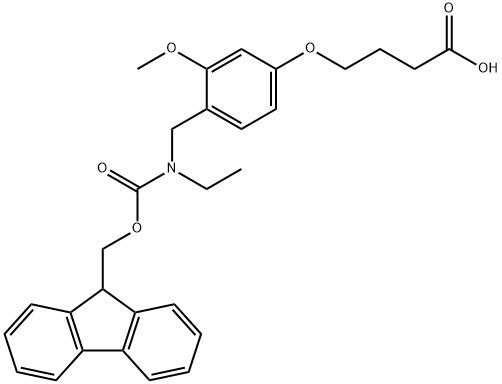
Fmoc-N-ethyl-MPBA is a specialized building block designed for applications in solid‑phase synthesis, bioconjugation, and linker chemistry. The rigid aromatic core of Fmoc-N-ethyl-MPBA provides a stable scaffold for the attachment of payloads, while the Fmoc protecting group enables orthogonal deprotection under mild base conditions for subsequent functionalization. The terminal carboxylic acid group of Fmoc-N-ethyl-MPBA facilitates conjugation to amine‑containing molecules or solid supports, making Fmoc-N-ethyl-MPBA a versatile intermediate for the construction of drug conjugates, targeted delivery systems, and specialized chemical libraries. For researchers requiring precise control over linker geometry and protecting group strategy, Fmoc-N-ethyl-MPBA offers a uniquely pre‑organized architecture that combines an aromatic core with orthogonal functional handles.
Product Parameters
|
Parameter |
Specification |
|
Product Name |
Fmoc-N-ethyl-MPBA |
|
CAS Number |
2173156-53-9 |
|
Molecular Formula |
C₂₉H₃₁NO₆ |
|
Molecular Weight |
|
|
Boiling Point |
692.9±55.0℃ |
|
Density |
1.226±0.06g/cm3 |
|
pKa |
4.60±0.10 |
Product Advantages
1. Orthogonal Functional Groups for Stepwise Conjugation
Fmoc-N-ethyl-MPBA features an Fmoc‑protected secondary amine and a free terminal carboxylic acid — two orthogonal functional handles that can be selectively addressed under different conditions. The carboxylic acid can be activated and conjugated to amines or solid supports without affecting the Fmoc protecting group, followed by base‑mediated Fmoc removal to liberate the secondary amine for further derivatization. This orthogonal strategy is essential for the construction of multifunctional conjugates, branched linkers, and specialized chemical libraries.
2. Rigid Aromatic Core for Defined Linker Geometry
The 3‑methoxyphenyl core of Fmoc-N-ethyl-MPBA provides a rigid, conformationally defined scaffold that positions the carboxylic acid handle and the Fmoc‑protected amine at a precise spatial orientation. In drug‑conjugate design, linker rigidity influences payload release kinetics, metabolic stability, and overall conjugate pharmacology — advantages that flexible, aliphatic linkers cannot provide.
3. Base‑Labile Fmoc Protection for Mild Deprotection
The Fmoc protecting group on the secondary amine of Fmoc-N-ethyl-MPBA is cleaved under mild basic conditions (20% piperidine in DMF, 2×10 min) — conditions that are orthogonal to acid‑labile protecting groups and compatible with most conjugation strategies. This avoids the harsh acidic or reductive conditions required for removal of alternative protecting groups (e.g., Boc or Cbz), preserving the integrity of acid‑sensitive payloads.
4. Versatile Scaffold for Medicinal Chemistry
Fmoc-N-ethyl-MPBA serves as a versatile intermediate for the construction of targeted drug conjugates (ADCs), PROTAC linkers, and specialized chemical libraries. The combination of an aromatic core, flexible butyric acid spacer, and orthogonally protected amine provides a tunable platform for optimizing linker length, hydrophilicity, and payload attachment geometry.
Application Scenarios
Antibody‑Drug Conjugate (ADC) Linker Synthesis
Fmoc-N-ethyl-MPBA serves as a linker building block in ADC development, where the carboxylic acid handle enables conjugation to amine‑containing payloads or antibody attachment sites, while the orthogonally protected amine allows for further functionalization or branching.
PROTAC Linker Design
In proteolysis‑targeting chimera (PROTAC) development, Fmoc-N-ethyl-MPBA provides a rigid aromatic spacer with orthogonal handles for attachment of E3 ligase ligands and target protein binders, enabling precise control over linker geometry and degradation efficacy.
Solid‑Phase Synthesis
The terminal carboxylic acid group of Fmoc-N-ethyl-MPBA enables direct loading onto solid supports (e.g., Wang resin, Rink amide resin) for solid‑phase synthesis of conjugated libraries, with the Fmoc group allowing for on‑resin deprotection and further derivatization.
Bioconjugation Researchers use
Fmoc-N-ethyl-MPBA to create bioconjugates, linking biomolecules to synthetic scaffolds or reporter groups through the carboxylic acid handle or the deprotected amine following Fmoc removal.
Targeted Drug Delivery
The rigid aromatic core and orthogonal functional handles of Fmoc-N-ethyl-MPBA make it suitable for constructing targeted drug delivery systems, where precise linker geometry influences receptor recognition, internalization, and payload release.
Medicinal Chemistry Library Construction
Fmoc-N-ethyl-MPBA is employed in the synthesis of diverse chemical libraries for high‑throughput screening, where the orthogonal protecting group strategy enables diversification at two distinct sites in a controlled, stepwise manner.
Product Quality Assurance
Cosperpharm has established a comprehensive quality assurance system for Fmoc-N-ethyl-MPBA that meets the rigorous expectations of advanced research and development applications:
Thorough analytical characterization. Each batch undergoes analytical release testing including HPLC purity verification (≥95% for standard grade; ≥98% for high‑purity grade upon request), ¹H NMR confirmation of molecular identity, mass spectrometry confirmation, appearance verification, and residual solvent analysis where applicable. Physical property verification is conducted in accordance with established specifications.
Full batch traceability. From raw material procurement through synthesis, purification, and final packaging, every step is fully documented and traceable. Each batch receives a unique lot number with sufficient retention samples maintained in accordance with Cosperpharm quality procedures.
Stability monitoring program. Cosperpharm conducts ongoing stability studies under recommended storage conditions (2–8 °C, protected from light and moisture). Stability summaries are available upon request.
Documentation for research applications. Every shipment includes a Certificate of Analysis (COA) with batch‑specific purity and characterization data, a Material Safety Data Sheet (SDS), and customs documentation for international delivery. Custom quality agreements are available for customers requiring additional documentation.
Customer‑initiated quality audits. Qualified customers are welcome to audit Cosperpharm‘s manufacturing, quality control, and documentation facilities. Please contact our regulatory team to schedule an audit.
Contact Us
From PROTAC linkers to ADC building blocks — Cosperpharm supplies the specialized intermediates you need to advance your conjugation chemistry programs. Reach out today to request a quote for Fmoc-N-ethyl-MPBA or to discuss custom synthesis options for your specific linker requirements.
Address
No. 2 Yangguang 3rd Road, Duodao Chemical Cycle Industrial Park, Jingmen City, Hubei Province, China
Tel

![1-[2,3-Bis[(9Z,12Z)-octadeca-9,12-dien-1-yloxy]propyl]pyrrolidine](https://www.cosperpharma.com/upload/8820/1-2-3-bis-9z-12z-octadeca-9-12-dien-1-yloxy-propyl-pyrrolidine-349384.webp "1-[2,3-Bis[(9Z,12Z)-octadeca-9,12-dien-1-yloxy]propyl]pyrrolidine")
![1,2,4-Triazolo[4,3-a]pyridin-3(2H)-one](https://www.cosperpharma.com/upload/8820/1-2-4-triazolo-4-3-a-pyridin-3-2h-one-440735.webp "1,2,4-Triazolo[4,3-a]pyridin-3(2H)-one")