
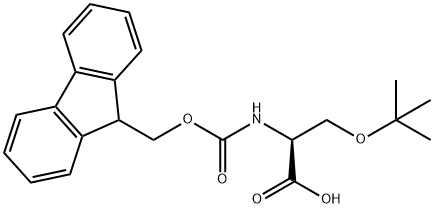
Fmoc-Ser(tBu)-OH is a high-purity Fmoc-protected amino acid designed for the incorporation of serine residues into peptides assembled via Fmoc/tBu SPPS methodologies. Fmoc-Ser(tBu)-OH features the acid-labile tert-butyl ether group on the serine hydroxyl, which provides complete protection against unwanted side reactions during chain assembly while being cleanly removed in the final TFA cleavage step. Fmoc-Ser(tBu)-OH is supplied with very low levels of dipeptide, free-amino acids, and acetic acid impurities, ensuring high-fidelity peptide synthesis without premature chain termination. Fmoc-Ser(tBu)-OH is a standard building block accepted by all automated peptide synthesizers and is routinely used in both research-scale and process-scale peptide manufacturing.
Product Parameters
|
Parameter |
Specification |
|
Product Name |
Fmoc-Ser(tBu)-OH |
|
CAS Number |
71989-33-8 |
|
Molecular Formula |
C₂₂H₂₅NO₅ |
|
Molecular Weight |
383.44 g/mol |
|
Appearance |
White to almost white powder |
|
Melting Point |
125.0–135.5°C |
|
Boiling Point |
510.36℃ |
|
Solubility |
Clear solution (10% in DMF); soluble in DMF, CHCl₃, DCM, EtOAc, DMSO, acetone |
|
Density |
1.2369 |
|
pKa |
3.44±0.10 |
|
Storage Condition |
2–8 °C |
Synthetic Preparation
The synthesis of Fmoc-Ser(tBu)-OH is achieved through a multi-step process. One common route involves the esterification of L-serine, followed by introduction of the tert-butyl protecting group onto the hydroxyl side chain, saponification of the ester, and finally attachment of the Fmoc group to the α-amino group using Fmoc-OSu or Fmoc-Cl. Published syntheses are described in the literature. Commercial production employs optimized processes to achieve ≥98% HPLC purity with very low levels of process-related impurities.
Storage Conditions
Store Fmoc-Ser(tBu)-OH in a tightly sealed container at 2–8 °C. The compound is stable at room temperature (15–30 °C) for short-term storage, but refrigeration is recommended for long-term stability. Keep the container dry and protected from light.
Shelf life: 2–3 years when stored at 2–8 °C.
Handling precautions: Use in a fume hood. Wear chemical-resistant gloves, safety goggles, and a lab coat. Avoid generating dust. After handling, wash hands thoroughly.
Application Scenarios
1. Fmoc/tBu SPPS Standard Building Block
Fmoc-Ser(tBu)-OH is the standard building block for incorporating serine residues into peptides assembled via Fmoc SPPS, compatible with all automated peptide synthesizers and manual synthesis platforms
2. Therapeutic Peptide Manufacturing
Used in the commercial-scale production of peptide therapeutics requiring serine residues with complete side-chain protection, including GLP-1 analogs, peptide antibiotics, and peptide hormones
3. Phosphopeptide Synthesis
Serine residues serve as precursors for phosphoserine incorporation; Fmoc-Ser(tBu)-OH is the starting point for preparing Fmoc-Ser(PO(OBzl)OH)-OH and other phosphoserine derivatives
4. Glycopeptide Synthesis
The free hydroxyl obtained after tBu removal can be glycosylated; Fmoc-Ser(tBu)-OH is used to prepare glycosylated serine derivatives for glycopeptide synthesis
5. Peptide Library Development
Employed in the synthesis of peptide libraries for drug discovery and SAR studies, where serine residues are required at defined positions
Enzymatic Peptide Modifications After peptide assembly and global deprotection, the free serine hydroxyl can be modified by enzymes such as kinases (phosphorylation) or glycosyltransferases
6. Process Development & Scale-Up
Peptide process chemists use Fmoc-Ser(tBu)-OH for reaction optimization (coupling conditions, deprotection protocols), impurity mapping, and development of scalable manufacturing routes
7. Quality Control Reference Standard
Serves as a reference standard in HPLC method development for Fmoc-protected amino acids used in peptide manufacturing QC testing
Contact Us
Ready to order Fmoc-Ser(tBu)-OH for your peptide synthesis project? Contact Cosperpharm for pricing, documentation, and technical support.
Address
No. 2 Yangguang 3rd Road, Duodao Chemical Cycle Industrial Park, Jingmen City, Hubei Province, China
Tel

![1-[2,3-Bis[(9Z,12Z)-octadeca-9,12-dien-1-yloxy]propyl]pyrrolidine](https://www.cosperpharma.com/upload/8820/1-2-3-bis-9z-12z-octadeca-9-12-dien-1-yloxy-propyl-pyrrolidine-349384.webp "1-[2,3-Bis[(9Z,12Z)-octadeca-9,12-dien-1-yloxy]propyl]pyrrolidine")
![1,2,4-Triazolo[4,3-a]pyridin-3(2H)-one](https://www.cosperpharma.com/upload/8820/1-2-4-triazolo-4-3-a-pyridin-3-2h-one-440735.webp "1,2,4-Triazolo[4,3-a]pyridin-3(2H)-one")