
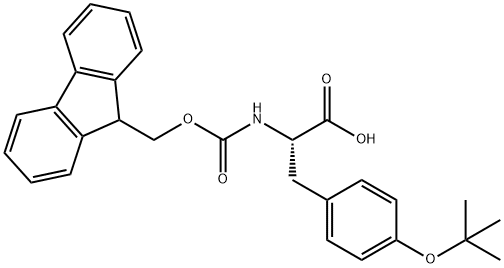
Fmoc-Tyr(tBu)-OH is the preferred tyrosine building block for Fmoc-based solid-phase peptide synthesis, widely employed to prevent tyrosine side-chain acylation and other unwanted side reactions during peptide assembly. The tert-butyl ether protecting group of Fmoc-Tyr(tBu)-OH effectively masks the phenolic hydroxyl group throughout the chain elongation process, while the Fmoc group safeguards the α-amino function. Fmoc-Tyr(tBu)-OH enables the efficient incorporation of tyrosine residues into a diverse range of peptide therapeutics, including opioid peptides, neuropeptides, kinase substrate peptides, and hormone analogs. Fmoc-Tyr(tBu)-OH is supplied as a high-purity crystalline solid (≥98.0% HPLC) with very low levels of dipeptide, free amino acid, and acetic acid impurities, ensuring reliable and reproducible coupling performance. The compound is a standard building block for the introduction of tyrosine amino-acid residues by Fmoc SPPS.
Product Parameters
|
Parameter |
Specification |
|
Product Name |
Fmoc-Tyr(tBu)-OH |
|
CAS Number |
71989-38-3 |
|
Molecular Formula |
C₂₈H₂₉NO₅ |
|
Molecular Weight |
459.53 g/mol |
|
Appearance |
|
|
Melting Point |
~150 °C |
|
Boiling Point |
658.2 °C at 760 mmHg |
|
Solubility |
Soluble in DMSO (100 mg/mL); soluble in DMF; |
|
Storage Temperature |
Store below +30°C |
|
Density |
1.218±0.06 g/cm3(Predicted) |
Why Cosperpharm?
Tyrosine protection requires the right strategy. The phenolic hydroxyl group of tyrosine is prone to acylation and oxidation during SPPS. Fmoc-Tyr(tBu)-OH provides the gold-standard protection: the tert-butyl ether effectively masks the phenol throughout chain elongation while remaining orthogonal to the Fmoc strategy. Our analytical release protocol includes HPLC purity verification (≥98.0%), enantiomeric purity confirmation (≥99.8%), and identity verification — because even trace impurities in this building block can compromise your peptide synthesis yield and purity.
Documentation that supports regulatory submission. Every shipment of Fmoc-Tyr(tBu)-OH includes a Certificate of Analysis (COA) with batch-specific HPLC purity, enantiomeric purity, water content (K.F.), and residual solvent data. For customers involved in GMP peptide manufacturing, Cosperpharm provides DMF-ready documentation packages, stability summaries, and custom quality agreements upon request.
Flexible supply across all development stages. Cosperpharm supplies Fmoc-Tyr(tBu)-OH across the full range of applications — from 1g–25g quantities for research-scale peptide synthesis, to 100g–500g batches for process validation, to kilogram-scale lots for commercial peptide manufacturing. R&D samples ship within 5–7 business days; bulk orders ship within 2–3 weeks.
Technical support for the full synthetic cascade. Our process chemistry team can advise on coupling condition optimization, deprotection strategies, and impurity profiling for tyrosine-containing peptides. We have extensive experience with this building block across multiple peptide manufacturing campaigns.
Global reach with transparent pricing. Cosperpharm ships to pharmaceutical manufacturers, CROs, and research laboratories worldwide, with full customs documentation included. Volume discounts apply at larger scales.
Synthetic Route
Suspend O-tert-butyl-L-tyrosine in a dioxane solution and react it with fluorene methoxycarbonyl azide via acylation to obtain a crude product. This product is then extracted with ethyl acetate at pH 9–10 and purified by recrystallization.
Application Scenarios
Opioid Peptide Synthesis
Used in the synthesis of opioid peptides including Leu-enkephalinamide and related analogs via solid-phase synthesis.
Neuropeptide Synthesis
Essential for synthesizing neuropeptides where tyrosine plays critical roles in receptor recognition and signaling.
Kinase Substrate Peptides
Employed in the preparation of peptide substrates for kinase activity assays and inhibitor screening.
Anticancer Peptide Development
Used in the synthesis of anticancer peptides incorporating tyrosine residues.
Hormone Analog Synthesis
Serves as a building block for peptide hormone analogs where tyrosine is essential for biological activity.
Post-Translational Modification Studies
The tyrosine residue serves as a substrate for enzymatic modifications including phosphorylation, sulfation, and nitration.
Contact Us
Ready to secure Fmoc-Tyr(tBu)-OH for your peptide synthesis campaign? Need a custom packaging size or regulatory documentation package? Cosperpharm's team is here to help. Contact us today for a quote, technical consultation, or to discuss your specific requirements.
Address
No. 2 Yangguang 3rd Road, Duodao Chemical Cycle Industrial Park, Jingmen City, Hubei Province, China
Tel

![1-[2,3-Bis[(9Z,12Z)-octadeca-9,12-dien-1-yloxy]propyl]pyrrolidine](https://www.cosperpharma.com/upload/8820/1-2-3-bis-9z-12z-octadeca-9-12-dien-1-yloxy-propyl-pyrrolidine-349384.webp "1-[2,3-Bis[(9Z,12Z)-octadeca-9,12-dien-1-yloxy]propyl]pyrrolidine")
![1,2,4-Triazolo[4,3-a]pyridin-3(2H)-one](https://www.cosperpharma.com/upload/8820/1-2-4-triazolo-4-3-a-pyridin-3-2h-one-440735.webp "1,2,4-Triazolo[4,3-a]pyridin-3(2H)-one")