
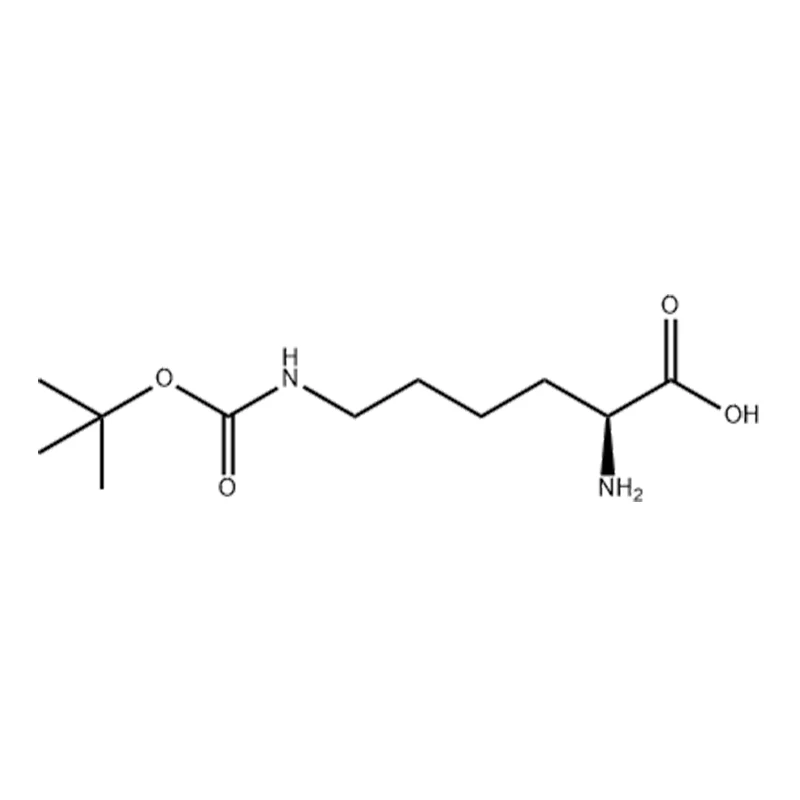
H‑Lys(Boc)‑OH (CAS 2418‑95‑3) is a key ε‑amino‑protected lysine derivative for solution‑phase peptide synthesis and as a precursor for activated esters. H‑Lys(Boc)‑OH is commonly used in solution‑phase peptide synthesis, fragment condensation, and as a building block for the preparation of pentafluorophenyl esters for β‑peptide synthesis. Additionally, H‑Lys(Boc)‑OH has been explored as a therapy to treat recurrent herpes simplex infections, highlighting its potential beyond conventional peptide synthesis. Moreover, H‑Lys(Boc)‑OH is an essential starting material for the introduction of lysine residues into synthetic peptides via the N‑terminus, where the Boc‑protected ε‑amino group prevents unwanted side reactions. With a molecular weight of 246.30 g/mol and a melting point of 227–232 °C (dec.), H‑Lys(Boc)‑OH is supplied as a stable, white to off‑white crystalline powder, offering excellent handling convenience and long‑term stability under proper storage conditions.
|
Parameter |
Specification |
|
Product Name |
H-Lys(Boc)-OH |
|
CAS Number |
2418-95-3 |
|
Molecular Formula |
C₁₁H₂₂N₂O₄ |
|
Molecular Weight |
246.30 g/mol |
|
Purity |
≥95 % – ≥98 % (HPLC) |
|
Physical Form |
Crystalline powder |
|
Appearance |
White to off-white powder |
|
Melting Point |
250 °C (dec., lit.) |
|
Boiling Point |
389.3℃ |
|
Density |
1.1313 |
H‑Lys(Boc)‑OH is synthesized by selective Boc protection of the ε‑amino group of L‑lysine, leaving the α‑amino group free:
Step 1 — Copper complexation to protect the α‑amino and α‑carboxyl groups: L‑Lysine is reacted with copper(II) salts (e.g., CuSO₄ or CuCO₃) to form a stable copper‑lysine complex. The copper ion coordinates to both the α‑amino and α‑carboxyl groups, effectively masking them from reacting with the Boc protecting reagent.
Step 2 — Boc protection of the ε‑amino group: The copper‑lysine complex is reacted with di‑tert‑butyl dicarbonate (Boc₂O) in an aqueous‑organic solvent mixture (e.g., water/dioxane or water/acetone). The pH is maintained at 9–10 with a base such as NaOH or triethylamine. The Boc group selectively reacts with the free ε‑amino group.
Step 3 — Removal of the copper complex: The copper ion is removed by treatment with a chelating agent such as EDTA or by precipitation with hydrogen sulfide (H₂S) gas, followed by filtration. The resulting product is H‑Lys(Boc)‑OH.
Step 4 — Purification and isolation: The crude product is purified by recrystallisation from a suitable solvent system (e.g., water/ethanol or acetic acid/water) to achieve ≥98 % HPLC purity. The final product is isolated as a white to off‑white crystalline powder.
Store H‑Lys(Boc)‑OH in a tightly sealed container at 2–8 °C in a clean, dry, well‑ventilated area. Keep the container protected from light and moisture. The compound is stable under recommended storage conditions. Do not store near strong oxidizing agents, strong bases, or strong acids. Protect from moisture to prevent hydrolysis of the Boc group.
Shelf life: Typically 2–3 years when stored at 2–8 °C in a sealed container. Accelerated stability data and long‑term stability summaries are available upon request to support regulatory filings.
Handling precautions: Use in a fume hood where appropriate. Wear chemical‑resistant gloves, safety goggles, and a lab coat. Avoid generating dust. Do not eat, drink or smoke in work areas. After handling, wash hands thoroughly. Refer to the Safety Data Sheet (SDS) for complete safety information.
1. Solution‑Phase Peptide Synthesis
Essential building block for solution‑phase peptide synthesis, where the Boc‑protected ε‑amino group prevents side reactions and the free α‑amino group enables N‑terminal coupling.
2. Fragment Condensation
Used in convergent peptide synthesis strategies, where protected peptide fragments are assembled in solution; the free N‑terminus of H‑Lys(Boc)‑OH allows for coupling to C‑terminal activated fragments.
3.Preparation of Pentafluorophenyl Esters
H‑Lys(Boc)‑OH can be used to prepare pentafluorophenyl esters, which are valuable activated intermediates for the synthesis of β‑peptides and other complex peptide architectures.
4.Introduction of N‑Terminal Lysine
Ideal starting material for introducing N‑terminal lysine residues into synthetic peptides, where the Boc‑protected ε‑amino group prevents unwanted side reactions during chain elongation.
5. Antiviral Research
H‑Lys(Boc)‑OH has been explored as a therapy to treat recurrent herpes simplex infections, making it of interest in antiviral drug discovery research.
Synthesis of Branched and Dendritic Peptides The Boc‑protected ε‑amino group can be selectively deprotected to generate a free ε‑amine, enabling the synthesis of branched peptides, peptide dendrimers, and multivalent peptide constructs.
6. Bioconjugation Research
Serves as a starting material for the synthesis of lysine‑based linkers and conjugates for attachment of drugs, fluorophores, or targeting ligands.
Custom Peptide Synthesis Services High‑purity building block for custom peptide synthesis, enabling incorporation of lysine residues into client‑designed sequences with orthogonal protection.
Interested in incorporating H‑Lys(Boc)‑OH into your next solution‑phase peptide synthesis or fragment condensation project? Cosperpharm is your trusted partner for high‑purity Boc‑protected amino acids with comprehensive documentation and flexible supply options. Contact us today to request a quote, obtain a Certificate of Analysis, or discuss custom synthesis and packaging requirements. Our dedicated customer support team is ready to assist with product specifications, regulatory documentation, and shipping coordination. From early‑stage research to commercial manufacturing, we’re here to support your success.
Address
No. 2 Yangguang 3rd Road, Duodao Chemical Cycle Industrial Park, Jingmen City, Hubei Province, China
Tel

![1-[2,3-Bis[(9Z,12Z)-octadeca-9,12-dien-1-yloxy]propyl]pyrrolidine](https://www.cosperpharma.com/upload/8820/1-2-3-bis-9z-12z-octadeca-9-12-dien-1-yloxy-propyl-pyrrolidine-349384.webp "1-[2,3-Bis[(9Z,12Z)-octadeca-9,12-dien-1-yloxy]propyl]pyrrolidine")
![1,2,4-Triazolo[4,3-a]pyridin-3(2H)-one](https://www.cosperpharma.com/upload/8820/1-2-4-triazolo-4-3-a-pyridin-3-2h-one-440735.webp "1,2,4-Triazolo[4,3-a]pyridin-3(2H)-one")