
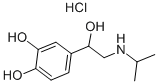
Isoprenaline Hydrochloride is a potent, non-selective β-adrenergic receptor agonist with well-established clinical utility as a bronchodilator and cardiac stimulant . As the hydrochloride salt of isoproterenol, Isoprenaline Hydrochloride is a synthetic catecholamine that acts on β1-adrenergic receptors in the myocardium to increase heart rate and cardiac output, and on β2-adrenergic receptors in bronchiolar and vascular smooth muscle to cause relaxation . Isoprenaline Hydrochloride has been extensively used in the management of bradyarrhythmias, heart block, and as a bronchodilator in asthma and chronic obstructive pulmonary disease.
|
Parameter |
Specification |
|
Product Name |
Isoprenaline Hydrochloride |
|
CAS Number |
51-30-9 |
|
Molecular Formula |
C₁₁H₁₇NO₃·HCl |
|
Molecular Weight |
247.72 g/mol |
|
Appearance |
White to off-white crystalline powder |
|
Melting Point |
|
|
Boiling Point |
192 °C |
|
Density |
1.2296 |
|
Storage Condition |
2-8 °C, protected from light and air |
Indicated for the treatment of bronchial asthma attacks, and also indicated for chronic emphysema.
In intact rat adipocytes, Isoprenaline (300 nM, 3 minutes) increases the activity of particulate cGMP- and cilostamide-inhibited, low-Km cAMP phosphodiesterase (cAMP PDE) by approximately 100%. Isoprenaline inhibits insulin-stimulated glucose transport activity in rat adipocytes. Isoprenaline promotes a time-dependent reduction in insulin-stimulated cell surface GLUT4 accessibility (t1/2 approximately 2 minutes) of >50% in the absence of adenosine, which is directly correlated with the observed inhibition of transport activity. Isoprenaline (5 nM and 10 mM) increases cyclic AMP levels, and this effect is enhanced by Cilostamide (10 mM), rolipram (10 mM), a specific PDE (phosphodiesterase 4) inhibitor for cyclic AMP, and cyclic AMP-elevating agents (50 nM ANF or 30 nM SNP plus 100 nM DMPPO). Isoprenaline increases the transcriptional activity of the GIα-2 gene by 140% compared with the control group, while specific hybridization to the Gsα gene remains unchanged. Isoprenaline (20 nM) increases the amplitude of total iK and causes a negative shift of approximately 10 mV in the IK activation curve, and blocks L-type calcium currents regardless of the presence or absence of 300 nM nisoldipine. In isolated rabbit pacemaker cells, Isoprenaline (20 nM) increases the spontaneous pacemaker rate of sinoatrial node pacemaker cells by 16%.
Isoprenaline (NCI-c55630) is a non-selective β-adrenergic receptor agonist used in the treatment of bradycardia and heart block.
From cardiovascular research to quality control testing, Cosperpharm provides the β-agonist reference materials you need. Contact us today to discuss your Isoprenaline Hydrochloride requirements.
Address
No. 2 Yangguang 3rd Road, Duodao Chemical Cycle Industrial Park, Jingmen City, Hubei Province, China
Tel